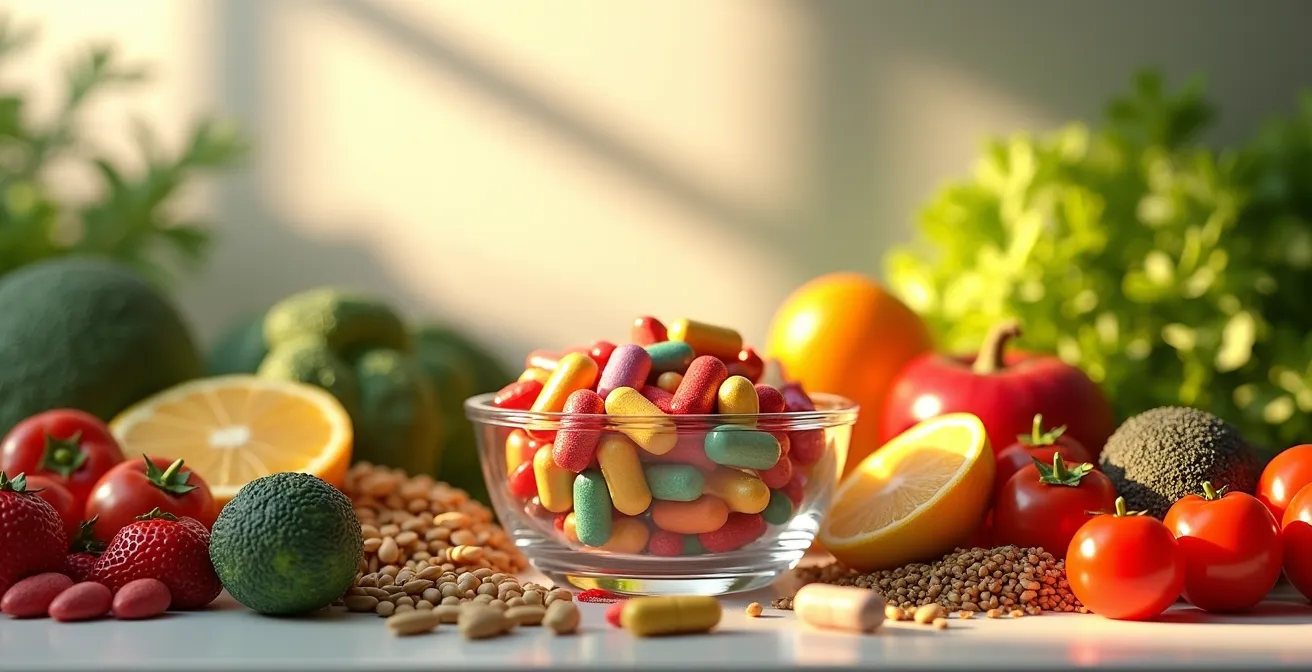
Despite popular belief, a daily multivitamin is not a safety net for a poor diet; it’s an attempt to replicate a symphony with a single note.
- Whole foods provide complex information (nutrient synergy, fiber, phytochemicals) that isolated synthetic vitamins cannot.
- Key health outcomes like gut diversity and inflammation are directly tied to food patterns, not supplement intake.
Recommendation: Shift your focus from “filling gaps” with pills to building a foundation of health with nutrient-dense, diverse whole foods.
For many busy people, the daily multivitamin feels like a nutritional insurance policy. A quick, easy way to cover any gaps left by a less-than-perfect diet. It’s a comforting thought: no matter how rushed your meals are, at least you’re getting your vitamins. But from a functional medicine perspective, this approach misses the entire point of nutrition. We’ve been trained to see nutrients as individual components—a checklist of Vitamin C, Iron, and B12 to tick off. This reductionist view is precisely where the multivitamin strategy falls short.
The truth is, food is not just a collection of nutrients; it is complex biological information. Every bite you take sends a cascade of instructions to your cells, your genes, and the trillions of microbes living in your gut. A whole food contains thousands of compounds—phytochemicals, enzymes, antioxidants, and diverse types of fiber—all working in intricate synergy. This “food matrix” determines how nutrients are absorbed, used, and how they communicate with your body. A synthetic vitamin, isolated in a lab and pressed into a pill, is stripped of this context. It’s like handing a musician a single sheet of music and expecting them to perform a symphony.
This article will deconstruct that symphony. We will move beyond the simplistic “pills vs. food” debate and explore the specific, powerful mechanisms by which whole foods build health in ways a multivitamin never can. We will explore how food diversity transforms your gut, how plant compounds fight disease, why some “health” foods are sabotaging you, and how you can manage inflammation and energy, all through what’s on your plate. It’s time to stop looking for shortcuts and start understanding the profound language of food.
To navigate this deep dive into the power of whole foods, we have structured the article to cover the core principles of a food-first approach. The following sections will guide you through the science and practical application of true nourishment.
Summary: Rethinking Nutrition Beyond the Pill
- 30 Plants a Week: The Challenge That Fixes Digestion
- “Eat the Rainbow”: Which Color Vegetable Prevention Cancer?
- The “Health Food” That Is Actually Ultra-Processed
- Calories vs Nutrients: Why 100 Calories of Almonds Beats 100 Calories of Soda?
- Soluble vs Insoluble: Which Fiber Stops the Afternoon Hunger Pangs?
- Nightshades: Are Tomatoes Causing Your Joint Pain?
- Dairy and Acne: Is There Really a Link for Adults?
- Glucose Spikes: Why They Inflame Your Arteries Even if You Are Thin?
30 Plants a Week: The Challenge That Fixes Digestion
One of the most significant failings of a multivitamin-centric approach is its complete disregard for the gut microbiome. Your gut is home to trillions of bacteria, and their health is fundamental to yours. These microbes are not passive residents; they digest food, produce vitamins, regulate your immune system, and even influence your mood. What do they eat? Fiber and polyphenols from plants. A multivitamin offers them nothing.
The key to a thriving gut is not just eating plants, but eating a wide variety of them. Different plant species feed different families of beneficial bacteria, promoting a diverse and resilient microbial ecosystem. This is where the “30 plants a week” challenge comes in. It’s a simple metric to encourage diversity. This isn’t about volume, but variety—herbs, spices, nuts, seeds, grains, legumes, fruits, and vegetables all count. According to landmark research from the American Gut Project, individuals eating 30 or more different plant types per week had significantly more diverse gut microbiomes than those eating 10 or fewer. This diversity is linked to better health outcomes across the board.
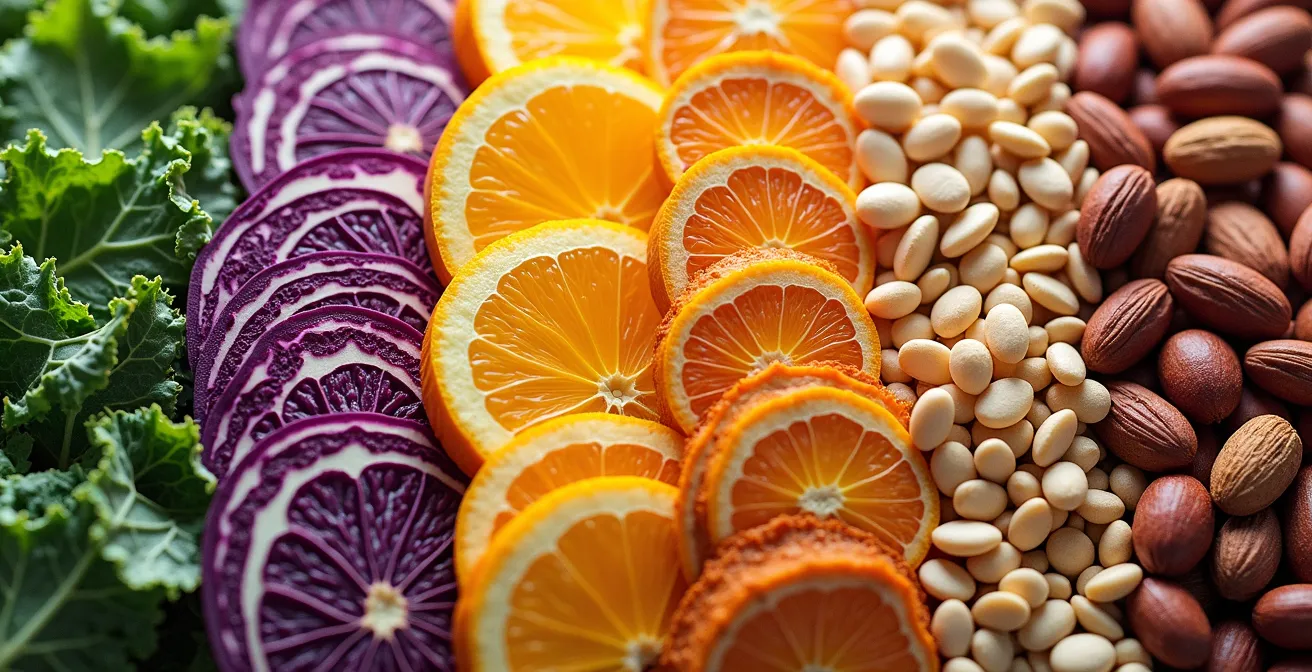
This image perfectly illustrates the complexity we should be aiming for. Each plant has a unique fibrous structure and chemical composition, providing a different type of “food” for your gut microbes. A diet rich in this variety creates a robust internal ecosystem that can outcompete pathogenic bacteria and reduce inflammation, a feat no multivitamin could ever accomplish. It’s a direct demonstration of food acting as powerful information for your gut.
Your Weekly Plant Diversity Audit
- List Your Staples: Write down every fruit, vegetable, grain, nut, seed, legume, herb, and spice you’ve eaten in the last week. Be specific (e.g., romaine lettuce and kale are two different plants).
- Categorize and Count: Group your items (e.g., Fruits, Veggies, Spices) and tally the total number of unique plants. Is your count closer to 10 or 30?
- Identify the Gaps: Where is your variety lacking? Are you only eating the same 3-4 vegetables? Do you use the same two herbs? Are nuts and seeds missing entirely?
- Plan One Swap: Identify one simple substitution for the coming week. Swap white rice for quinoa, add a new herb like dill to your salad, or try a different type of bean in your chili.
- Introduce One “New”: Commit to buying one fruit or vegetable you haven’t had in months (or ever). This single action can start a cascade of dietary diversification.
“Eat the Rainbow”: Which Color Vegetable Prevention Cancer?
The vibrant colors of fruits and vegetables are not just for show. They are the visible markers of thousands of powerful plant compounds called phytochemicals. These substances, like flavonoids, carotenoids, and polyphenols, are a plant’s natural defense system against pests and UV radiation. When we eat plants, these compounds act as potent antioxidants and anti-inflammatory agents in our bodies. A multivitamin might provide Vitamin C, but it completely misses the thousands of other protective compounds that come with eating an orange.
Different colors signify different phytochemicals with unique health benefits. For example, the deep purple in blueberries comes from anthocyanins (linked to brain health), the orange in carrots from beta-carotene (a precursor to Vitamin A), and the red in tomatoes from lycopene (linked to prostate health). Cruciferous vegetables like broccoli and Brussels sprouts contain a particularly potent compound called sulforaphane. Research is increasingly pointing to its powerful role in disease prevention. In fact, MD Anderson Cancer Center research indicates that sulforaphane can slow the multiplication of cancerous cells, potentially reducing a tumor’s ability to grow and spread.
This highlights the concept of nutrient synergy. It is likely not one single compound, but the complex interplay of all of them, that provides the greatest protection. As Erma Levy, a research dietitian at MD Anderson, explains:
We aren’t sure yet if it’s one phytochemical that’s working against cancer or if it’s a combination of all of them. But many different phytochemicals have been shown to have anti-cancer properties. So, no one fruit or vegetable will provide everything your body needs.
– Erma Levy, MD Anderson Cancer Center
This is why the advice is to “eat the rainbow.” By incorporating a wide spectrum of colors into your diet, you ensure you are consuming a broad array of these protective compounds. A multivitamin can’t even begin to replicate this natural, synergistic pharmacy.
The “Health Food” That Is Actually Ultra-Processed
One of the most pervasive myths in modern nutrition is that “fortified” equals “healthy.” Many breakfast cereals, plant-based milks, and protein bars are marketed as health foods precisely because they are fortified with a spray of synthetic vitamins and minerals. This is the multivitamin logic applied to food production, and it’s equally flawed. These products are often ultra-processed foods (UPFs), stripped of their natural fiber and nutrients, only to have a few synthetic ones added back in.
The problem is that our bodies don’t treat synthetic, isolated nutrients the same way they treat nutrients from whole foods. In a whole food, vitamins and minerals are bound within a complex “food matrix” of fiber, enzymes, and other co-factors. This matrix ensures a slower, more controlled release and absorption. For example, the Vitamin C in an apple is packaged with flavonoids and fiber that enhance its function and moderate its absorption. A synthetic vitamin, lacking this context, can be less bioavailable or may not be utilized by the body in the same way. The body simply doesn’t recognize it as effectively without its natural synergistic partners.

This stark image of fortified cereal tells a story of nutritional isolation. It looks clean and simple, but it represents a departure from the complexity of real food. When you choose a fortified cereal over a bowl of oatmeal with berries and nuts, you are trading a rich, informational food symphony for a handful of isolated, synthetic notes. Research consistently shows that getting nutrients from whole foods is always the superior option for long-term health, as the body is designed to process food in its complete, natural form.
Calories vs Nutrients: Why 100 Calories of Almonds Beats 100 Calories of Soda?
The idea that “a calorie is a calorie” is one of the most damaging myths in nutrition. It’s the kind of thinking that allows someone to believe a multivitamin can patch up a diet of processed foods. From a purely energetic standpoint, 100 calories of almonds and 100 calories of soda provide the same amount of energy. But from a functional, informational perspective, they are worlds apart.
The 100 calories from soda deliver a rush of refined sugar with zero fiber, vitamins, or minerals. This sends a loud, disruptive signal to your body: a rapid spike in blood sugar, followed by a surge of the hormone insulin to shuttle that sugar out of the bloodstream. This metabolic roller coaster can lead to energy crashes, cravings, and, over time, insulin resistance. It is an “empty” calorie, providing energy but no nutritional information.
In contrast, the 100 calories from almonds come packaged with a wealth of information. They deliver healthy fats, protein, and, crucially, fiber. This food matrix signals to your body to slow down. The fiber and fat blunt the glycemic response, leading to a much gentler, more sustained release of energy. The protein promotes satiety, keeping you feeling full longer. Furthermore, those calories carry vital minerals like magnesium and manganese, and protective Vitamin E. This is the essence of nutrient density: the amount of nutritional value per calorie. Almonds are nutrient-dense; soda is nutrient-poor.
Choosing foods based on their nutrient density rather than their calorie count is a cornerstone of a food-first philosophy. It’s about asking what “instructions” you are giving your body with each meal. A multivitamin provides no calories and no metabolic information—it is silent on the critical conversation of blood sugar and satiety.
Soluble vs Insoluble: Which Fiber Stops the Afternoon Hunger Pangs?
Fiber is a carbohydrate that your body can’t digest, yet it’s one of the most important components of a healthy diet—and it’s completely absent from a multivitamin. There are two main types, and they play different roles. Insoluble fiber (found in wheat bran, nuts, and vegetables like cauliflower) acts as “bulk,” helping to promote regularity. But it’s soluble fiber that holds the key to controlling hunger and blood sugar.
Soluble fiber, found in oats, barley, nuts, seeds, beans, and fruits like apples and citrus, dissolves in water to form a thick, gel-like substance in your digestive tract. This gel has several profound effects. First, it slows down stomach emptying, which makes you feel fuller for longer. This is the direct antidote to the 3 PM slump and craving for a quick energy hit. Second, this viscous gel physically slows down the absorption of sugar into the bloodstream, preventing sharp glucose spikes after a meal.
The impact is significant. A meal rich in soluble fiber leads to a much more stable blood sugar curve. This not only prevents hunger but also reduces the demand on your pancreas to produce insulin. In fact, clinical studies demonstrate that soluble fiber can dramatically reduce the glucose and insulin response after a meal. One study on psyllium, a concentrated source of soluble fiber, found that it led to significant reductions in fasting blood glucose, insulin, and HbA1c (a measure of long-term blood sugar control) in individuals with Type 2 diabetes. The authors attributed this directly to the viscosity of the hydrated fiber in the gut.
This powerful mechanism of satiety and glycemic control is something a pill can never offer. It is a physical property of whole food, a perfect example of the “food matrix” at work.
Nightshades: Are Tomatoes Causing Your Joint Pain?
While we champion a diverse, plant-rich diet, it’s crucial to introduce the concept of bio-individuality. There is no one-size-fits-all “perfect diet.” A food that is a superfood for one person may be a source of inflammation for another. A multivitamin, with its standardized formula, completely ignores this fundamental biological reality. It assumes everyone needs the same things in the same amounts.
A classic example of this principle is the nightshade family of vegetables. This group includes tomatoes, peppers, eggplants, and potatoes. For most people, these are healthy, nutrient-dense foods. However, for a subset of the population, they can be problematic. Nightshades contain alkaloids, such as solanine, which are natural pesticides. In sensitive individuals, these compounds can trigger an inflammatory response, potentially exacerbating conditions like arthritis, joint pain, or digestive issues.
This isn’t to say nightshades are “bad.” It’s to say that your body has a unique response to the information it receives. The only way to discover what works for you is to listen to your body. An elimination diet, where you remove a food group for a period and then reintroduce it, is the gold standard for identifying food sensitivities. This is a personalized, investigative approach to nutrition. It’s about becoming a detective of your own health, paying attention to subtle signals like bloating, skin issues, joint aches, or brain fog after eating certain foods.

This process of mindful selection is the essence of bio-individuality. It’s about building a diet based on your unique needs, not on a generic formula from a bottle. It requires engagement and awareness, treating food as a personal conversation with your body, not a task to be completed.
Dairy and Acne: Is There Really a Link for Adults?
The concept of bio-individuality extends beyond just plant foods. For some adults, dairy products can be a trigger for inflammatory conditions like acne. The proteins in milk, such as casein and whey, can stimulate the production of Insulin-like Growth Factor 1 (IGF-1). In susceptible individuals, elevated IGF-1 can lead to increased sebum production and skin inflammation, creating the perfect storm for acne breakouts. This is another clear example of food as information, where a specific food sends a hormonal signal that can manifest physically.
This brings us back to the central fallacy of the multivitamin-as-insurance model. Many people take multivitamins in the hope of preventing chronic diseases. Yet, the evidence for this is strikingly weak. Large-scale studies have consistently failed to show a benefit. In a comprehensive review, Johns Hopkins research reveals that multivitamins do not reduce the risk for heart disease, cancer, or cognitive decline. In fact, they noted that certain high-dose supplements, like beta-carotene and vitamin E, could even be harmful.
Relying on a pill gives a false sense of security, distracting from the very lifestyle habits that *are* proven to work. As Dr. Larry Appel of the Johns Hopkins Welch Center for Prevention states forcefully:
Pills are not a shortcut to better health and the prevention of chronic diseases. Other nutrition recommendations have much stronger evidence of benefits—eating a healthy diet, maintaining a healthy weight, and reducing the amount of saturated fat, trans fat, sodium and sugar you eat.
– Dr. Larry Appel, Johns Hopkins Welch Center for Prevention
The answer to health isn’t found in a standardized pill but in a personalized diet. It’s in understanding your individual triggers, like dairy for acne, and focusing on the foundational habits that truly build resilience and prevent disease.
Key Takeaways
- A multivitamin cannot replicate the complex “food matrix” of fiber, enzymes, and phytochemicals that ensure nutrient bioavailability.
- Dietary diversity, especially aiming for 30+ unique plants per week, is crucial for a healthy gut microbiome, which supplements ignore.
- Real food communicates with your body, influencing everything from hormonal balance to inflammation, while synthetic pills are just isolated chemical compounds.
Glucose Spikes: Why They Inflame Your Arteries Even if You Are Thin?
Perhaps the most insidious damage from a poor diet, and one that a multivitamin is powerless to prevent, is the chronic inflammation caused by repeated blood sugar spikes. It’s a common misconception that blood sugar is only a concern for diabetics or overweight individuals. The reality is that anyone, regardless of their weight, can experience significant internal damage from what we call poor glycemic variability.
Every time you eat a meal high in refined carbohydrates and sugar (like white bread, pastries, or sugary drinks), you trigger a rapid spike in blood glucose. Your body responds with a flood of insulin to manage it. This roller coaster, repeated multiple times a day, is highly inflammatory. It generates oxidative stress, a process that damages the delicate lining of your arteries (the endothelium). Over time, this chronic, low-grade inflammation is a primary driver of atherosclerosis (hardening of the arteries), heart disease, and other chronic conditions.
What’s fascinating is how individual these responses are. Groundbreaking personalized nutrition research shows that people can have wildly different blood sugar responses to the exact same food. Where one person might have a modest rise after eating a banana, another might have a significant spike. This is bio-individuality in action, influenced by genetics, your microbiome, and even your stress levels. A multivitamin, again, is a blunt instrument in a world that requires a precise, personalized approach.
Controlling these spikes comes back to the principles of the food-first approach: pairing carbohydrates with fiber, fat, and protein to slow absorption. It’s about choosing whole, unprocessed foods that speak to your body in a calm, steady voice, rather than the loud, inflammatory shout of refined sugar. This is active, daily management of inflammation at the most fundamental level—something no pill can do for you.
The ultimate goal is to shift your mindset from seeking a quick fix in a bottle to cultivating a deep, intuitive relationship with the food you eat. Start by focusing on adding one more colorful vegetable to your plate or trying one new herb this week. Your health is built one nutrient-dense, whole-food meal at a time.