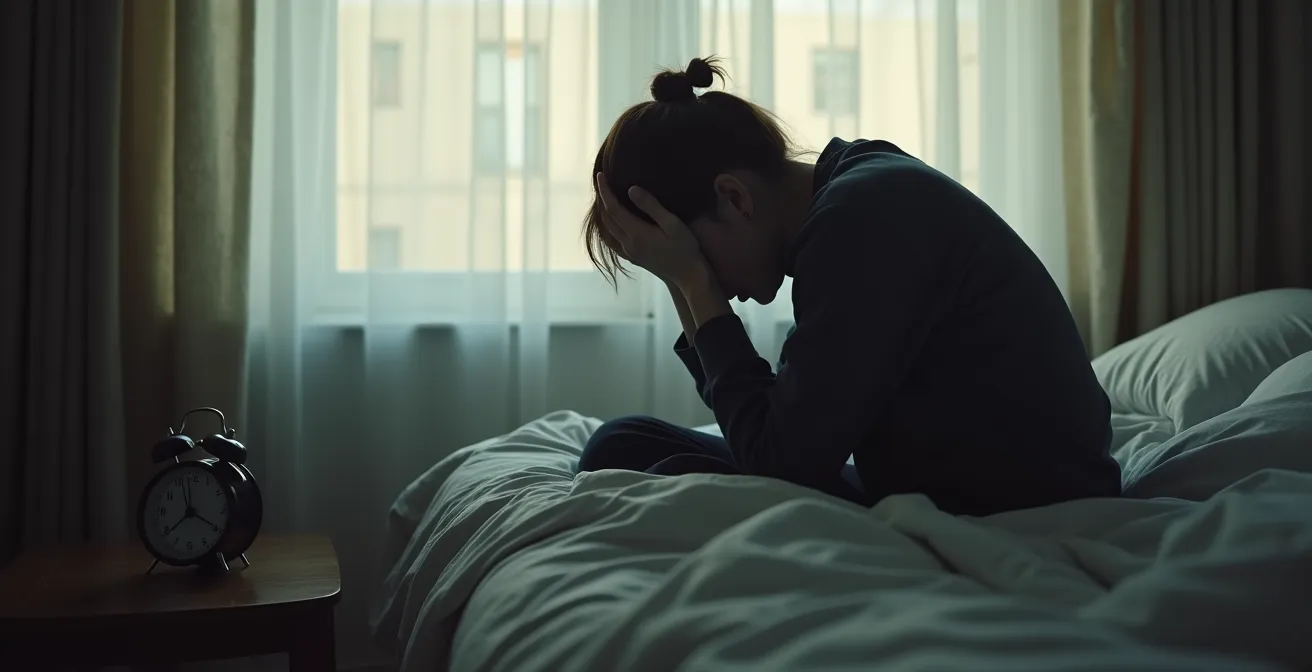
The number of hours you sleep is a misleading metric; the true cause of morning fatigue is a disrupted sleep architecture.
- Factors like a noon coffee, an evening glass of wine, or even the wrong magnesium supplement can systematically destroy your deep and REM sleep stages.
- Environmental cues, such as room temperature and light exposure, dictate your body’s ability to produce melatonin and enter restorative sleep phases.
Recommendation: Stop chasing an 8-hour target and start a clinical investigation into the specific factors fragmenting your sleep quality throughout the night.
In my clinical practice, the most common complaint is not a lack of time in bed, but a profound sense of fatigue despite hitting the proverbial eight-hour mark. Patients arrive frustrated, armed with sleep tracker data showing sufficient duration, yet they feel cognitively sluggish and physically unrefreshed. They have followed the standard advice: they avoid late-night meals, they have a dark room, and they try to be consistent. Yet, the exhaustion persists. This paradox highlights a fundamental misunderstanding of sleep’s function. It is not a monolithic state of unconsciousness.
Sleep is an intricate process, a carefully structured sequence of stages known as sleep architecture. This architecture includes light sleep, restorative deep sleep (N3), and REM sleep, each with a distinct neurological purpose. Feeling rested is not the result of total time spent asleep, but of completing a sufficient number of these cycles intact. The modern sleeper’s problem is rarely duration; it’s the constant, subtle fragmentation of this architecture. These disruptions, often unnoticed, prevent the brain and body from completing their essential repair work.
The prevailing belief is that the battle for good sleep is lost in the final hours before bed. But what if the damage is done much earlier? This clinical investigation will move beyond generic sleep hygiene to dissect the hidden saboteurs that dismantle your sleep quality from within. We will analyze how a noon espresso, a single glass of wine, or even a seemingly healthy supplement can systematically prevent you from reaching the restorative stages you need. This is not about sleeping longer; it’s about sleeping deeper and more efficiently.
This guide offers a diagnostic framework to identify and address the specific factors compromising your sleep. By examining each potential disruptor, you can begin to reconstruct a truly restorative night’s sleep.
Summary: A Clinical Investigation into Unrestful Sleep
- Snoring or Apnea: When Should You See a Specialist?
- Why One Glass of Wine Destroys Your REM Cycle?
- Blue Blockers: Do They Actually Work or Is It Hype?
- 65 Degrees: Why Your Room Is Too Hot for Deep Sleep?
- Glycinate vs Citrate: Which Magnesium Actually helps Sleep?
- Coffee Half-Life: Why Your Noon Espresso Affects Your Deep Sleep?
- Why Your Morning Routine Should Start the Night Before?
- Sleep Tracking Anxiety: When Your Watch Ruins Your Rest?
Snoring or Apnea: When Should You See a Specialist?
The first step in any clinical sleep investigation is to rule out a structural obstruction. Loud, chronic snoring is more than a nuisance; it’s a potential indicator of Obstructive Sleep Apnea (OSA), a condition where breathing repeatedly stops and starts during sleep. These “apneic events” cause a sharp drop in blood oxygen levels, forcing the brain to briefly awaken to restore breathing. While you may not remember these arousals, they can occur hundreds of times a night, completely shattering your sleep architecture and preventing you from ever reaching or sustaining restorative deep sleep. This chronic oxygen deprivation and sleep fragmentation is not benign.
The consequences extend far beyond daytime grogginess. The repeated stress on the cardiovascular system increases the risk of hypertension and heart disease. Neurologically, the impact is severe. Research increasingly links OSA to cognitive decline. In fact, a meta-analysis found that individuals with sleep-disordered breathing have a 26% increased risk of developing cognitive impairment or dementia. The hippocampus, a brain region critical for memory, is particularly vulnerable to the intermittent hypoxia caused by apnea.
Case Study: Reversing Brain Damage with OSA Treatment
A landmark neuroimaging study provided a stark visualization of this damage. Researchers found significant gray-matter volume reductions in the hippocampus and frontal lobes of patients with OSA. However, the study also offered a message of hope. After just three months of consistent treatment with a CPAP machine, which maintains an open airway, patients showed significant increases in gray-matter volume in these same affected brain regions. This structural recovery was mirrored by measurable improvements in their memory, attention, and executive function.
If your partner reports you gasp or stop breathing during sleep, or if you wake up with headaches and a dry mouth alongside persistent fatigue, a consultation with a sleep specialist is not optional; it is a critical diagnostic step. The goal isn’t just to stop the snoring, but to protect your brain’s long-term health.
Why One Glass of Wine Destroys Your REM Cycle?
Alcohol is perhaps the most misunderstood sleep aid. Many people use it to “relax” and fall asleep faster, and initially, it does. Alcohol is a sedative that enhances the activity of the GABA neurotransmitter, which quiets the central nervous system and can induce sleep more quickly. However, this initial benefit is a clinical trap. As your body metabolizes the alcohol over the course of the night, a significant “rebound effect” occurs. The sedative effect wears off, leading to a surge in the stimulating neurotransmitter glutamate, which causes fragmented sleep and frequent awakenings in the second half of the night.
The most significant damage, however, is to your sleep architecture. While alcohol may initially promote deep sleep, it aggressively suppresses REM (Rapid Eye Movement) sleep. This is the stage most associated with memory consolidation, emotional processing, and learning. A single glass of wine with dinner is enough to significantly delay the onset and reduce the total amount of REM sleep you get. This is why you can sleep for eight hours after drinking and wake up feeling mentally foggy, emotionally irritable, and uncreative. Your brain was deprived of its crucial “software update” phase.

The shadow cast by that evening glass of wine is long, metaphorically disrupting the delicate patterns of your sleep. You may have slept, but you did not fully restore cognitive function. From a clinical perspective, if improving mental clarity and mood is your goal, alcohol is one of the first substances to eliminate from your evening routine. The trade-off for a faster sleep onset is simply too high, resulting in a net loss of restorative sleep.
Blue Blockers: Do They Actually Work or Is It Hype?
The discussion around blue light and sleep has become mainstream, leading to a market flooded with “blue-blocking” glasses. To assess their efficacy, we must first understand the mechanism they target: melatonin suppression. Your entire sleep-wake cycle is governed by an internal clock that is highly sensitive to light, especially light on the blue end of the spectrum. Exposure to this light in the evening sends a powerful signal to your brain that it’s still daytime, which actively suppresses the release of melatonin, the hormone that signals your body it’s time to sleep.
The circadian rhythm is based on the light-and-dark cycle of the sun and controlled by a part of the brain called the suprachiasmatic nucleus, located in the hypothalamus. This master ‘body clock’ gets its cues from a number of environmental and personal factors, ranging from the amount of light exposure (most significant), to exercise, and temperature.
– Sleep Foundation Editorial Team, Sleep Foundation Temperature Guide
Not all blue-blocking glasses are created equal. The clear or light-yellow lenses marketed as “computer glasses” are designed primarily to reduce digital eye strain by filtering a small percentage (10-30%) of blue light. While they may offer some comfort for daytime screen use, their impact on melatonin suppression is minimal. To truly protect your circadian rhythm, a much more aggressive approach is needed. This is where the deep orange or red-lensed glasses come in. These are not for aesthetic appeal; they are tools designed to block 90-100% of blue (and sometimes green) light wavelengths.
This table from a comparative analysis by sleep experts clarifies the distinction:
| Feature | Clear Computer Glasses | Orange/Red Blue Blockers |
|---|---|---|
| Blue Light Blocked | 10-30% | 90-100% |
| Primary Purpose | Reduce eye strain | Prevent melatonin suppression |
| Best Use Time | During screen work | 2-3 hours before bed |
| Impact on Sleep | Minimal | Significant |
| Color Distortion | None | Substantial |
The verdict is clear: if your goal is to mitigate the sleep-disrupting effects of evening light exposure from screens and artificial lighting, the heavily tinted orange/red lenses are the only clinically effective option. Wearing them for 2-3 hours before your intended bedtime can help preserve your natural melatonin production, allowing you to fall asleep faster and achieve a more natural sleep architecture.
65 Degrees: Why Your Room Is Too Hot for Deep Sleep?
Alongside light, temperature is one of the most powerful environmental cues for regulating sleep. To initiate sleep, your body’s core temperature needs to drop by about two to three degrees Fahrenheit. This temperature drop is a key signal to your brain to begin producing melatonin and transition into sleep. A bedroom that is too warm actively works against this natural physiological process, making it harder to fall asleep and, more importantly, harder to reach and maintain the deepest, most physically restorative stages of sleep (N3).
Many people mistake a “cozy” warm room for a sleep-conducive environment, but the opposite is true from a thermoregulatory standpoint. A high ambient temperature prevents your body from effectively offloading heat, a necessary step for entering deep sleep. This can lead to a night of restless, light sleep with more frequent awakenings, even if you are not consciously aware of feeling hot. The ideal temperature range for sleep is surprisingly cool, generally recommended to be between 60-67°F (15-19°C) for most adults.
Case Study: The Impact of Nighttime Temperature on Older Adults’ Sleep
A revealing study conducted in Boston homes monitored 50 older adults using wearable sleep sensors. It found that sleep quality was not a subjective feeling but was directly tied to ambient nighttime temperature. The research showed that sleep efficiency was highest when the room temperature was between 20–25°C (68–77°F). More critically, there were clinically relevant drops in sleep efficiency and restfulness as temperatures rose above this optimal range. This real-world data demonstrates that even a few degrees can be the difference between a fragmented night and a truly restorative one.
If you wake up tired, one of the simplest and most effective interventions is to lower your thermostat. It is a non-negotiable variable in the equation of sleep quality. Experimenting within that 60-67°F range can have a more profound impact on your deep sleep percentage than many other, more complicated interventions.
Glycinate vs Citrate: Which Magnesium Actually helps Sleep?
In the search for sleep solutions, magnesium has rightly gained attention as a crucial mineral. It plays a role in regulating neurotransmitters that promote calm and relaxation, including GABA. However, declaring a magnesium deficiency and grabbing the first bottle off the shelf is a common mistake that can lead to disappointing or even counterproductive results. The form of magnesium you take is critically important, as different forms have vastly different absorption rates and effects on the body.
Two of the most common forms are magnesium citrate and magnesium glycinate. Magnesium citrate is well-known for its laxative effects. It is often used to treat constipation because it draws water into the intestines. While it does contain magnesium, taking it before bed can lead to gastrointestinal distress and nighttime awakenings, completely defeating the purpose of a sleep aid. In contrast, magnesium glycinate (or bisglycinate) is magnesium bound to the amino acid glycine. Glycine itself has calming properties on the brain. This form is highly bioavailable and has minimal laxative effect, making it the superior clinical choice for sleep support.

Another promising form for cognitive health is Magnesium L-Threonate, which has been shown to cross the blood-brain barrier effectively, potentially supporting both sleep and brain plasticity. The key is to approach supplementation with the same precision as any other clinical intervention: choose the right tool for the job. For general sleep support and calming the nervous system, glycinate is the gold standard.
Action Plan: Choosing the Right Magnesium for Sleep
- Start with Magnesium Glycinate (200-400mg) taken 30-60 minutes before your intended bedtime to leverage its calming effects.
- Consider Magnesium L-Threonate as an alternative if your goals include both sleep improvement and cognitive enhancement.
- Explicitly avoid Magnesium Citrate in the evening due to its high potential for causing sleep-disrupting laxative effects.
- Take your chosen supplement with a small amount of food to improve absorption and minimize any potential stomach upset.
- Track your subjective sleep quality and objective data (if available) for at least two weeks before making any adjustments to your dosage.
Coffee Half-Life: Why Your Noon Espresso Affects Your Deep Sleep?
Caffeine is a powerful stimulant whose effects are far more persistent than most people realize. Its primary mechanism is blocking adenosine receptors in the brain. Adenosine is a neurotransmitter that builds up throughout the day, creating “sleep pressure” that makes you feel tired. By blocking its action, caffeine artificially masks this fatigue. The critical factor that is often ignored is caffeine’s half-life, which is the time it takes for your body to eliminate 50% of the substance. For the average adult, this is approximately 5 to 6 hours.
This means that if you drink a cup of coffee containing 100mg of caffeine at 12:00 PM (noon), about 50mg is still active in your system at 6:00 PM. By midnight, when you are trying to get restorative sleep, there is still 25mg circulating in your brain—the equivalent of a quarter cup of coffee. Based on this, sleep researchers calculate that 25% of a noon coffee’s caffeine can still be active at midnight. While you might not feel “wired” and may be able to fall asleep, this residual caffeine is sufficient to disrupt your sleep architecture.
Specifically, caffeine has been shown to reduce the amount of slow-wave deep sleep (N3), the most physically restorative stage of sleep. It can also increase the number of arousals during the night, even if you don’t fully wake up. You may get your eight hours, but the quality of that sleep is significantly degraded. The clinical recommendation is to establish a strict “caffeine curfew.” For most people, this means avoiding all caffeine at least 8-10 hours before bedtime. This allows your body enough time to clear the majority of the substance from your system, permitting adenosine to do its job and allowing you to enter deep sleep unimpeded.
Why Your Morning Routine Should Start the Night Before?
While a consistent wake-up time is important, the foundation for a productive morning is laid by the actions taken the night before. The transition from the alert, sympathetic “fight-or-flight” state of a busy day to the calm, parasympathetic “rest-and-digest” state required for sleep does not happen instantly. It requires a deliberate process, often referred to as a “wind-down routine.” This routine is not about luxury; it’s a non-negotiable physiological buffer period that signals to your brain and body that the day is over and it’s time to prepare for sleep.
Engaging in stimulating activities right up until bedtime—such as answering work emails, watching intense television, or scrolling through social media—keeps your cortisol levels and heart rate elevated. This creates a state of “tired but wired,” where you are physically exhausted but mentally unable to switch off. A proper wind-down routine should focus on decreasing stimulation. This involves dimming the lights to encourage melatonin production, disengaging from screens, and practicing activities that lower your heart rate, such as light stretching, reading a physical book, or meditation. The goal is to create a predictable sequence of events that your brain learns to associate with sleep.
Sleep consistency is as important as sleep duration. A study at the University of Michigan found that first-year medical residents, a group known for high stress and demanding schedules, showed the direct impact of this principle. Those with irregular sleep habits had significantly lower daily moods and more symptoms of depression than participants who managed to maintain consistent sleep and wake times. A wind-down routine is the primary tool for enforcing this consistency, ensuring you are ready for sleep at the same time each night.
Preparing for the next day as part of this routine—laying out clothes, packing a bag, writing a to-do list—also serves a crucial function. It offloads mental tasks from your brain, preventing the late-night rumination and “I can’t forget to…” thoughts that often delay sleep onset.
Key Takeaways
- Sleep quality is determined by your sleep architecture—the proper cycling through deep and REM sleep—not just total hours in bed.
- Hidden saboteurs like mid-day caffeine, evening alcohol, and even a warm room can systematically destroy this architecture without you realizing it.
- A clinical approach involves identifying and eliminating these specific disruptors, from choosing the right magnesium supplement to establishing a strict wind-down routine.
Sleep Tracking Anxiety: When Your Watch Ruins Your Rest?
In the quest for better sleep, many have turned to wearable technology. These devices can be valuable tools for identifying broad patterns in sleep duration and heart rate. However, for a growing number of individuals, they have become a source of significant anxiety. This phenomenon, termed “orthosomnia,” describes an unhealthy obsession with achieving “perfect” sleep scores. Instead of being a helpful guide, the tracker becomes a nightly judge, and the quest for good data ironically becomes the very thing that ruins your rest.
The cycle is pernicious. A person wakes up, immediately checks their sleep score, and sees a low number for “deep sleep” or a high number of “awakenings.” This data point triggers anxiety and frustration, setting a negative tone for the entire day. They may feel more tired simply because the device told them their sleep was poor—a classic self-fulfilling prophecy. That evening, they go to bed with a sense of performance anxiety, determined to get a better score, which increases their physiological arousal and makes it harder to fall asleep naturally. The tracker has transformed the restorative process of sleep into a pass/fail test.
Patients report checking their sleep scores immediately upon waking, with poor scores creating anxiety that affects the entire day’s mood and energy, creating a self-fulfilling prophecy of poor sleep.
– Parkview Health clinical report
The clinical advice is to reframe your relationship with sleep data. Use your tracker as a long-term investigative tool, not a daily report card. Look for weekly or monthly trends: is your bedtime consistent? Did your resting heart rate change after you stopped drinking alcohol? Focus more on your subjective feelings—your energy levels, mood, and cognitive clarity during the day—as the primary indicator of sleep quality. If you find that checking your score is the first thing you do and it dictates your mood, consider taking a “data fast” for a week. Your body’s own signals are often a more reliable guide than any algorithm.
Ultimately, restoring your cognitive function is not about blindly adhering to an eight-hour rule but about becoming a clinical investigator of your own biology and behavior. By systematically identifying and eliminating the factors that fragment your sleep architecture, you can achieve truly restorative rest, regardless of what the clock says. The first step is to shift your focus from quantity to quality, treating your sleep with the precision it deserves.
Frequently Asked Questions about Sleep Quality and Orthosomnia
How do I know if I have orthosomnia?
If you find that checking your sleep data causes stress, you spend an excessive amount of time and effort trying to optimize your scores, or a “poor” score significantly affects your mood for the day, you may be experiencing symptoms of orthosomnia.
Should I stop using my sleep tracker completely?
Not necessarily. A helpful strategy is to take a ‘data fast.’ Consider wearing the device for a week without checking the daily results. At the end of the week, review the data to look for broad trends rather than focusing on the performance of a single night. This helps detach your daily mood from the score.
What’s a better way to assess my sleep quality?
The ultimate test of sleep quality is how you feel. Pay close attention to your energy levels upon waking and throughout the day, your mood, and your ability to focus. Use device data as a secondary tool to identify long-term patterns or correlate changes with lifestyle adjustments, not as the primary judge of your rest.