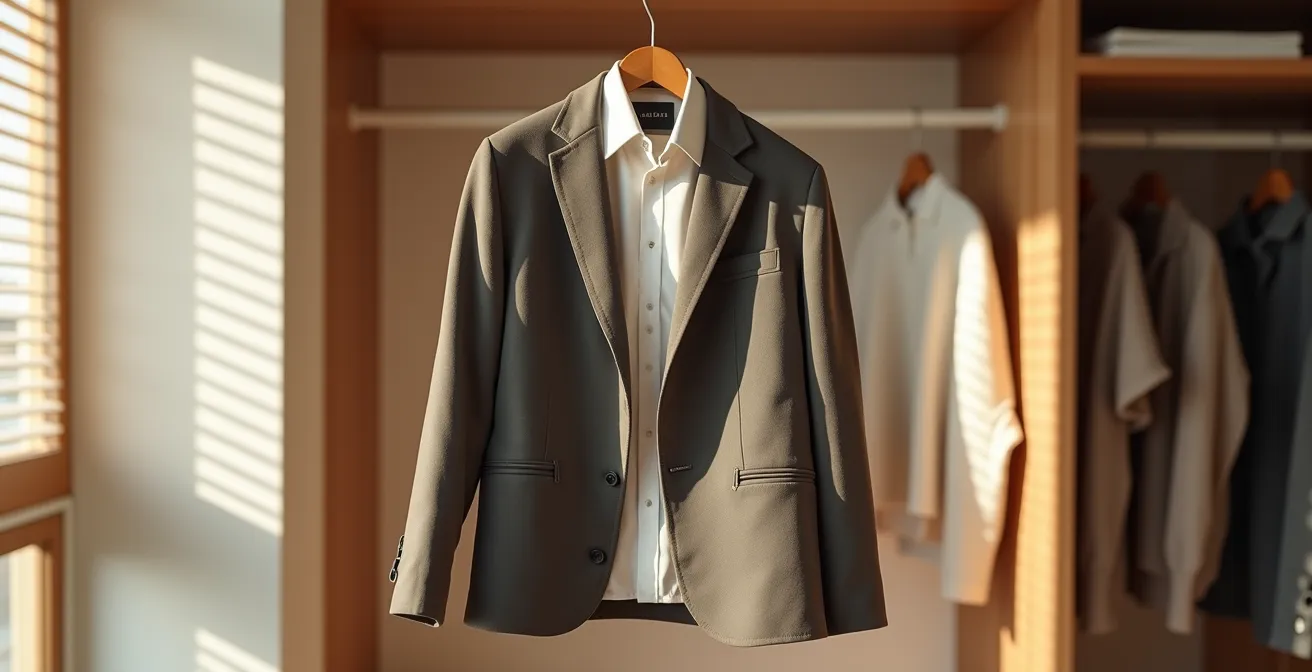
Contrary to popular belief, mastering ‘smart casual’ isn’t about memorizing endless lists of clothing items. The real key is understanding a simple system of ‘formality points’ where key pieces like shoes and a blazer add or subtract from your outfit’s overall formality, giving you a universal formula to confidently navigate any dress code.
The dreaded two-word dress code: “Smart Casual.” It appears on everything from event invitations to first-day-at-work emails, and for many, it triggers a quiet wave of panic. The fear is universal: arriving conspicuously underdressed suggests a lack of respect, while being overdressed can make you seem out of touch. This ambiguity leaves professionals and event-goers alike standing in front of their closets, paralyzed by indecision. It’s a moment of vulnerability where your professional confidence hangs in the balance.
Most advice online offers generic lists of “dos and don’ts”—wear blazers, avoid ripped jeans, choose chinos. While not incorrect, this approach is flawed because it provides rules without a system. It fails to explain why a blazer works or how the right pair of shoes can salvage an entire outfit. It treats dressing as a memory test rather than a skill. This article rejects that premise. It’s not about giving you another list to memorize.
The true key to decoding any dress code, especially the nebulous “smart casual,” isn’t found in a specific garment but in a flexible, rule-based system. We will introduce the concept of “formality points,” a mental framework for evaluating how individual pieces contribute to the whole. You will learn to identify the “anchor pieces” that define an outfit’s level of formality and use “contextual modulators” like fabric and fit to fine-tune your look.
This guide will equip you with a durable, logical framework. We will break down the subtle but critical differences between professional dress codes, navigate high-stakes social events, and reveal how to transition an outfit from day to night effortlessly. By the end, you won’t just know what to wear; you’ll understand why it works, empowering you to assemble the perfect outfit for any occasion with unwavering confidence.
Contents: How to Finally Decode Smart Casual
- Business Casual vs Business Professional: The One Detail That Changes Everything
- The Wedding Guest Mistake That Upstages the Bride
- How to Stalk a Company Culture Before Your Interview Outfit Choice?
- How to Go from Boardroom to Bar Without Changing Your Whole Outfit?
- Why Shoes Are the Only Thing That Define Your Level of Formality?
- Made-to-Measure vs Bespoke: Is the Extra $1000 Worth It?
- The “Too Much” Mistake: When Accessories Distract from Your Message
- How to Make a Cheap Outfit Look Expensive Using Only Accessories?
Business Casual vs Business Professional: The One Detail That Changes Everything
The distinction between business casual and business professional is the first hurdle where many stumble. It’s not about two entirely different wardrobes; it’s about one critical element that adds or subtracts a significant number of “formality points.” That element is structured tailoring, most commonly embodied by the suit jacket or blazer. Business professional almost always demands a full suit, where the jacket and trousers are made from the same fabric. This creates a uniform, authoritative silhouette that carries the highest level of formality.
Business casual, by contrast, breaks that suit apart. The core principle is pairing separates: think tailored trousers or chinos with a crisp shirt, but without the matching suit jacket. This is where the “third piece rule” becomes your most reliable tool. Your base is a shirt and trousers (two pieces). Adding a structured blazer instantly elevates the outfit, pushing it toward the more formal end of business casual. Removing that blazer, or swapping it for a less structured item like a cardigan or a fine-gauge knit sweater, lowers the formality.
The single detail that changes everything is the presence and structure of that third piece. For business professional, a matching suit jacket is non-negotiable. For business casual, a non-matching blazer, a cardigan, or even just a well-fitted shirt and trousers can suffice, depending on the workplace. The most common mistake is misjudging this one detail—either by wearing a full suit to a casual office or by showing up in just a shirt where a blazer was the expected norm. Mastering this single variable is the first step to decoding all professional dress codes.
This system also helps clarify the great “can I wear jeans?” debate. In a creative or tech-focused business casual environment, dark, well-fitted jeans with no distressing can work—but only if they are elevated with high-formality pieces like a blazer and leather dress shoes to compensate. For business professional, denim is almost universally unacceptable. It all comes down to balancing those formality points.
The Wedding Guest Mistake That Upstages the Bride
Navigating wedding dress codes uses the same “formality points” system, but with a crucial social twist: the goal is not to achieve maximum formality, but to hit the *correct* level of formality without overshadowing the bridal party. The most infamous mistake, of course, is wearing white, ivory, or champagne. These colors are reserved for the bride and wearing them is the fastest way to commit a major faux pas. But other, more subtle errors can also draw unwanted attention.
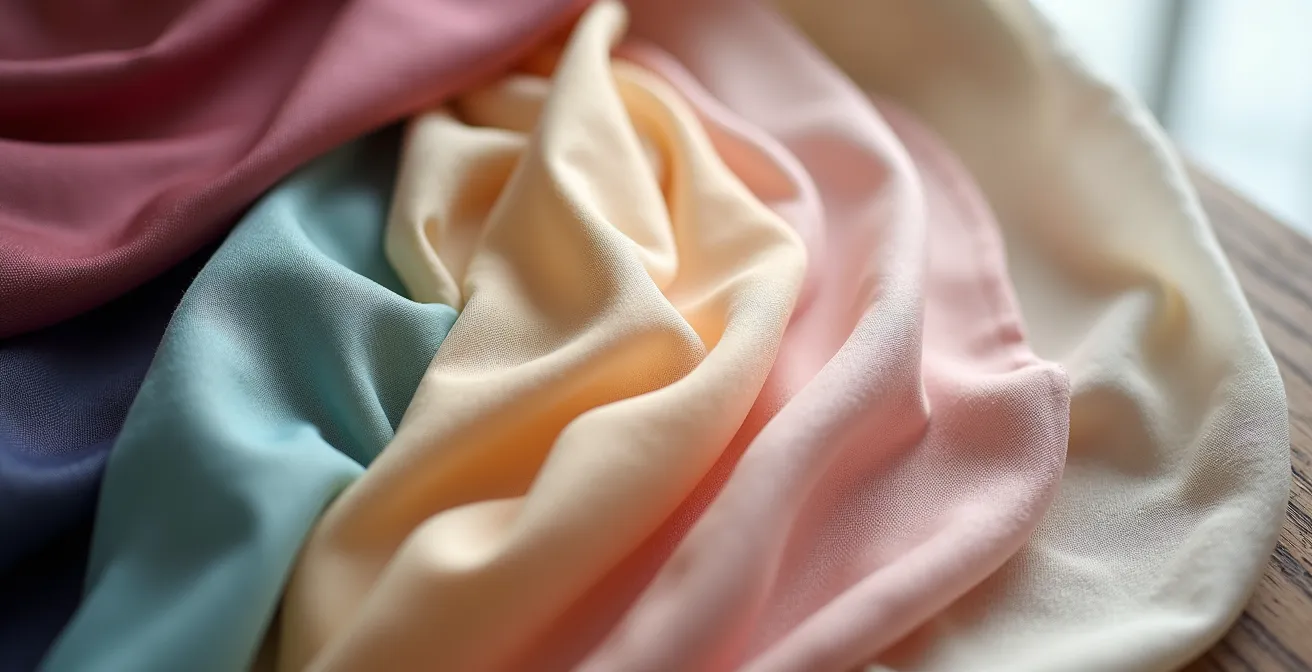
Beyond the obvious color rule, the most common mistake is a failure to consider context. A guest wearing a bright, sequined floor-length gown to a casual afternoon garden wedding is just as out of place as someone in a sundress at a black-tie evening affair. The invitation is your primary source of intelligence. Look for keywords like “black-tie,” “cocktail attire,” or “semi-formal.” If none are present, use the venue and time of day as your guide. A ceremony in a grand ballroom implies a higher formality level than one on a beach.
A case study of common wedding guest errors highlights a guest who wore a bright red, attention-grabbing dress to a formal wedding, inadvertently becoming a focal point in photos. The solution is to choose outfits that are elegant and respectful but not distracting. Opt for rich jewel tones, sophisticated pastels, or classic navy and charcoal. The principle is one of supportive elegance; your attire should complement the celebratory atmosphere, not compete with it. When in doubt, it is always better to be slightly overdressed than underdressed. A simple, classic dress or a sharp blazer and trousers can be dressed up or down with accessories, providing a safe and versatile option.
Ultimately, the system is about respect for the occasion and the people at its center. Your outfit should communicate that you understand and honor the significance of the day. By subtracting elements that are too loud—be it color, sparkle, or silhouette—you show impeccable social awareness.
How to Stalk a Company Culture Before Your Interview Outfit Choice?
Walking into an interview is a high-stakes performance, and your outfit is the costume that sets the first impression. Choosing the right level of formality isn’t guesswork; it’s a matter of strategic reconnaissance. Before you even think about what to wear, you must “stalk” the company’s culture to calibrate your formality points accurately. Your goal is to dress one level *above* the company’s daily standard—this shows respect and ambition without appearing out of place.
Your investigation begins online. The company’s official website, especially the “About Us” or “Team” page, is your first stop. Are the employee headshots formal portraits in suits, or candid snaps in branded polo shirts? Look for photo galleries of company events or team-building exercises. This imagery is a direct window into their accepted dress code. Pay attention to what leadership wears versus what junior employees wear to understand the internal hierarchy of dress.
Social media is your next frontier. As noted by LinkedIn Career Expert Andrew Cross, “These insights can provide a good baseline… Look to see if the company has an Instagram account or a Glassdoor page with pictures.” Search LinkedIn for employees who hold a similar role to the one you’re interviewing for. Analyze their profile pictures and any photos they’re tagged in at work-related events. This provides real-world, uncurated evidence of the day-to-day dress code. A consistent pattern of button-downs and chinos across the marketing team is a clear signal.
If your digital search leaves you uncertain, don’t be afraid to ask directly. When the recruiter or HR contact schedules your interview, it is perfectly acceptable to ask, “Could you offer some guidance on the typical dress code in the office?” This proactive question is seen as thoughtful and detail-oriented, not ignorant. It shows you care about fitting in. By gathering this intel, you can confidently apply the formality points system, adding that blazer or choosing the leather loafers that signal you are a perfect fit before you’ve even answered a single question.
How to Go from Boardroom to Bar Without Changing Your Whole Outfit?
The modern professional’s day rarely ends at 5 PM. The ability to transition seamlessly from a formal business setting to a relaxed social one is a hallmark of sartorial efficiency. This challenge is perfectly solved by the “formality points” system, where the goal is to quickly subtract formality without a complete wardrobe change. The key is to build a modular outfit around a versatile base layer.
Start with a high-quality, well-fitted base: a crisp button-down shirt and a pair of quality trousers (like chinos or wool flannel). This is your neutral canvas. For the boardroom, you add formality points with a structured blazer, a conservative tie, and leather dress shoes like Oxfords. This combination is unambiguously professional. The transformation for the bar is a strategic process of removal and replacement. An effective transition, as a case study on modular wardrobes demonstrated, can take as little as two minutes if planned correctly. The secret lies in performance fabrics like merino wool, which resist wrinkles and odors throughout a long day.
The following table, based on advice from experts at Ape to Gentleman on mastering business casual, breaks down the transformation process piece by piece, illustrating how simple swaps can drastically alter your look.
| Item | Boardroom Version | Bar Version | Transformation Tip |
|---|---|---|---|
| Jacket | Structured blazer | Remove or swap for leather jacket | Keep unstructured blazer in neutral tones |
| Shirt | Crisp button-down with tie | Open collar, rolled sleeves | Remove tie, undo top buttons |
| Shoes | Oxford dress shoes | Loafers or clean sneakers | Keep spare casual shoes at office |
| Accessories | Conservative watch | Statement watch or bracelet | Swap formal for casual accessories |
The most impactful changes are often the smallest. Simply removing the tie, unfastening the top one or two buttons of your shirt, and rolling up your sleeves immediately signals a shift from work to leisure. Swapping your structured blazer for a leather jacket or simply going without a jacket altogether makes a huge difference. The final—and perhaps most crucial—swap is the shoes. Changing from formal Oxfords to relaxed loafers or minimalist leather sneakers is the definitive signal that the business day is over.
Why Shoes Are the Only Thing That Define Your Level of Formality?
While an overstatement, the sentiment that shoes are the *only* thing that matters contains a deep truth about social perception. Of all the items in an outfit, footwear carries the most weight in the “formality points” system. You can wear an expensive suit, but if you pair it with worn-out or inappropriate shoes, the entire look is undermined. Conversely, an excellent pair of shoes can elevate an otherwise simple outfit of chinos and a shirt into something sharp and intentional.
This psychological effect happens because people often conduct a subconscious “ground-up scan” when assessing someone. As one Style Psychology Expert from the MasterClass Style Guide confirms, “People subconsciously scan from the ground up to assess status and attention to detail. Worn-out or inappropriate shoes act as a ‘credibility killer’, instantly negating any effort made with the rest of the outfit.” Your shoes are your foundation, both literally and figuratively. They signal how much you care about the details.
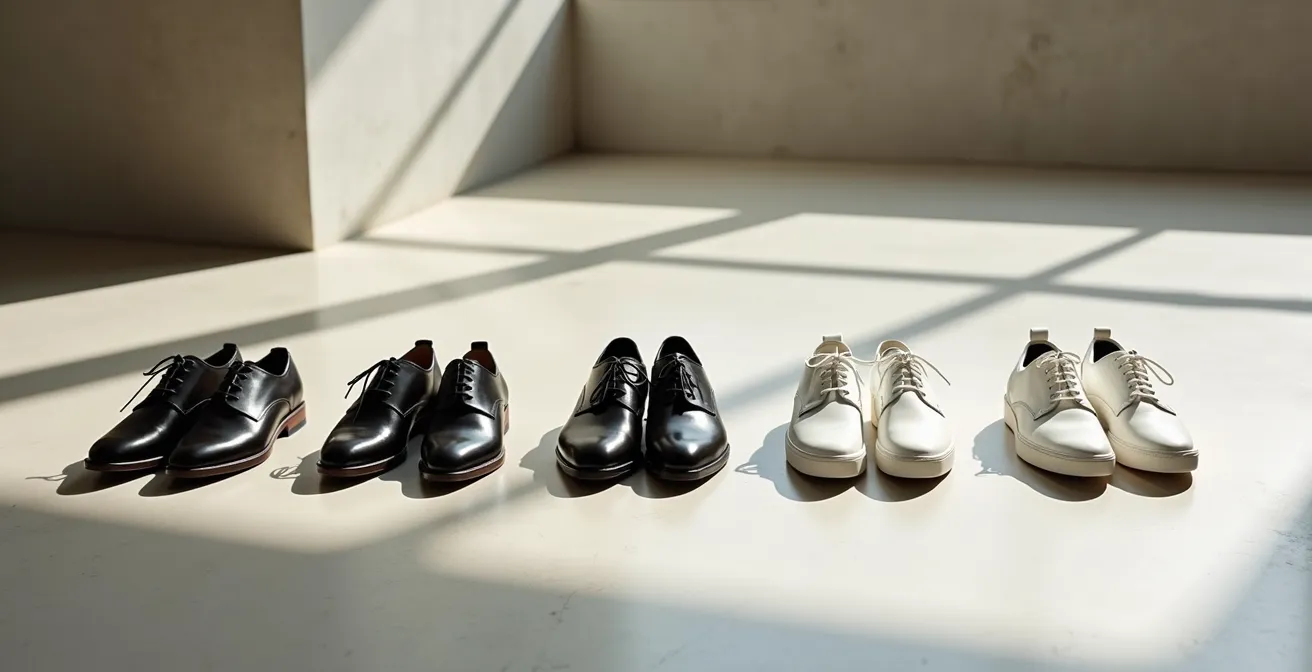
The formality of shoes exists on a clear spectrum. At the highest end are patent leather Oxfords, reserved for black-tie events. Below that are classic leather Oxfords and Derbies, the standard for business professional attire. Next come loafers, brogues, and Chelsea boots, which are the heartland of smart casual. Finally, at the least formal end, you have boat shoes, driving moccasins, and minimalist sneakers. The cleaner the design, the darker the color, and the thinner the sole, the more formal the shoe.
This is why a great pair of dark brown leather loafers can make well-fitted dark jeans appropriate for a smart casual setting, while the same jeans with chunky running sneakers would be far too casual. The shoes act as the formality anchor. They set the baseline from which the rest of the outfit is judged. Investing in two or three high-quality pairs of shoes across this spectrum gives you the power to modulate the formality of your entire wardrobe with minimal effort.
Made-to-Measure vs Bespoke: Is the Extra $1000 Worth It?
Once you understand the power of anchor pieces like blazers and trousers, the question of quality and fit becomes paramount. This is where the worlds of off-the-rack, made-to-measure (MTM), and bespoke tailoring come into play. While an off-the-rack garment is a mass-produced item, MTM and bespoke offer personalized fit. Made-to-measure involves altering a pre-existing pattern to your measurements, while bespoke involves creating a unique pattern from scratch. The price difference can be significant, often over $1,000 for a bespoke piece.
Is it worth it? The answer lies not in the initial price tag, but in a metric called cost-per-wear. A cheap, ill-fitting blazer might seem like a bargain, but if its poor construction means you only wear it a handful of times before it looks tired, its cost-per-wear is high. A well-made MTM or bespoke garment, on the other hand, is an investment. It is built to last for hundreds of wears, and its perfect fit means you will reach for it constantly. Over a five-year period, the more expensive piece often proves to be the better financial decision.
This analysis, inspired by cost-per-wear models from tailoring experts like those at Savile Row Co., shows how the math works out. The initial sticker shock of a bespoke item fades when you consider it a lifetime piece.
| Item Type | Initial Cost | Expected Wears | Cost Per Wear | 5-Year ROI |
|---|---|---|---|---|
| Off-the-rack blazer | $300 | 30 wears | $10/wear | Poor durability |
| Made-to-Measure blazer | $800 | 200 wears | $4/wear | Good investment |
| Bespoke blazer | $1500 | 300+ wears | $5/wear | Lifetime piece |
For most people, a hybrid strategy is the most practical approach. Invest in MTM for your most important structural piece—the navy blazer or the grey wool trousers that will form the backbone of countless outfits. Then, buy high-quality off-the-rack basics like shirts and chinos and spend a small amount to have them professionally tailored for a perfect fit. This approach gives you the 80/20 of a bespoke wardrobe without the full expense. The extra $1,000 for full bespoke is worth it only when an item is truly a “lifetime” piece or if your body shape makes off-the-rack and MTM unworkable.
The “Too Much” Mistake: When Accessories Distract from Your Message
Accessories are the finishing touches that can elevate an outfit from good to great. They are powerful tools for adding personality and polish. However, they are also where many people commit the “too much” mistake. An outfit, particularly in a professional context, should have one, and only one, primary visual focal point. All other accessories must be subordinate, supporting that single point of interest rather than competing with it. When accessories start to fight for attention, they distract from your most important asset: your message.
Think of it as visual noise. A bold tie, a brightly colored pocket square, a lapel pin, a statement watch, and flashy cufflinks all worn at the same time create a chaotic and amateurish impression. Instead of projecting confidence, it suggests a lack of restraint and poor judgment. The goal of accessorizing is to add a single, deliberate accent that complements your look and draws the eye in a controlled manner. This could be a beautifully tied silk scarf, a classic timepiece, or a unique pair of eyeglasses.
The power of this “one focal point” rule is backed by data. A case study from experts at The Wardrobe Consultant analyzed successful presentations and found a compelling pattern. Speakers who used a single statement accessory—such as a bold watch or a unique pocket square—were rated as 40% more memorable and professional than those who used multiple competing focal points. One executive’s client feedback on his “executive presence” measurably improved after he switched from wearing a tie, pocket square, and statement watch simultaneously to choosing just one of these items per outfit.
The practical application is simple: before you walk out the door, look in the mirror and ask yourself, “What is the one thing I want people to notice?” If your eyes are darting between your tie, your watch, and your shoes, you have too many focal points. Take one thing off. This act of subtraction is often the most sophisticated style choice you can make. It demonstrates a quiet confidence that needs no shouting to be heard.
Key takeaways
- Mastering smart casual relies on a “formality points” system, not memorizing lists.
- Shoes are the most powerful “anchor piece” in any outfit, setting the baseline for formality.
- An outfit should have only one primary focal point; all other accessories must be subordinate.
How to Make a Cheap Outfit Look Expensive Using Only Accessories?
The secret to looking polished and expensive often has little to do with the price tag of your clothes and everything to do with the quality of your accessories. A simple, affordable outfit of a black knit top and well-fitting trousers can be transformed into a statement of quiet luxury with a few strategic additions. This is the ultimate application of the “formality points” system, where you use high-impact accessories to dramatically elevate the perceived value of your entire look. The most effective method is “The Trinity of Perceived Value” strategy.
This strategy focuses on three areas that have a disproportionate impact on how an outfit is perceived. These are the items people notice up close and which signal an attention to detail. Investing in quality in these three categories will pay dividends across your entire wardrobe, making everything you own look better. A high-quality leather belt that matches your shoes, for example, creates a cohesive and intentional look that instantly elevates simple chinos and a shirt.
The second pillar is a quality metal accessory. This doesn’t have to be expensive, but it should be classic and well-made. A minimalist watch with a clean face or a simple, elegant piece of jewelry provides a focal point that signals sophistication. The final, and perhaps most impactful, element is eyewear. Whether prescription glasses or sunglasses, quality frames sit on your face and are often the first thing people see. Investing in frames that suit your face shape is one of the single best style investments you can make. By focusing your budget on these key items, you can create an aura of quality that extends to your entire ensemble.
Action plan: The Trinity of Perceived Value Strategy
- Invest in quality leather goods: Start with one good belt and a matching pair of shoes. This creates visual harmony and instantly elevates basic trousers or jeans.
- Add one quality metal accessory: Choose a classic watch or a single piece of minimalist jewelry (e.g., a simple bracelet or necklace). This serves as your refined focal point.
- Upgrade your eyewear: Quality frames for your glasses or sunglasses instantly elevate your face and your entire look. This is a high-impact investment.
- Mind the ‘high-contact’ points: Pay attention to items people see up close, such as your wallet or pen. A quality version of these small items reinforces the impression of overall quality.
- Perfect your grooming: The ultimate free accessory. A sharp haircut and clean, well-maintained hands and nails make every outfit look more intentional and expensive.
By mastering this trinity, you gain the power to make any outfit look deliberate and well-considered. It’s not about wealth; it’s about wisdom. This strategic approach to accessorizing is the final key to unlocking a style that is both authentic and effortlessly impressive.
Now that you possess the system, the next logical step is to audit your own wardrobe. Apply these rules to what you already own and identify the key pieces that can elevate your professional and social confidence today.