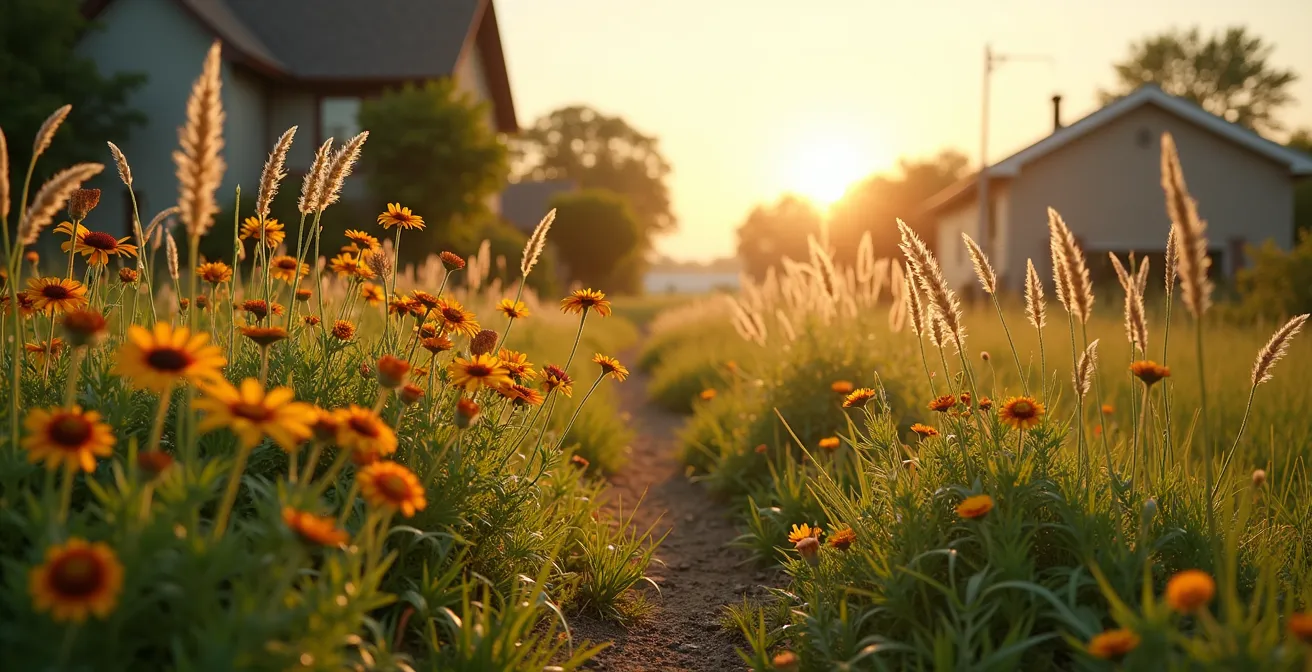
The survival of your garden in a heatwave isn’t about choosing ‘tough’ plants; it’s about building a resilient, self-sufficient ecosystem from the ground up.
- Native plants thrive by deploying specific root architectures and forming critical alliances with underground soil microbes.
- Exotic plants often fail because they are disconnected from these local, life-sustaining support systems and cannot cope with extreme soil conditions.
Recommendation: Stop replacing dead plants and start engineering a native garden system that manages its own water, health, and resilience.
There’s a familiar heartbreak for any gardener: the sight of a once-vibrant, carefully chosen plant shriveling under the relentless glare of a summer heatwave. You followed the advice—you mulched, you watered deeply at dawn, you even bought plants labeled “drought-tolerant.” Yet, when the temperatures soar, your expensive exotics wilt and die, while the “weeds” on the roadside seem to flourish. This frustrating cycle leaves many gardeners feeling defeated, constantly replacing casualties and fighting a losing battle against the climate.
The conventional wisdom often fails because it treats the plant as an isolated individual. The real difference between a native survivor and an exotic casualty isn’t just toughness; it’s connection. Exotic plants, even those from other arid climates, are like talented athletes without a local support team. They lack the deep, evolutionary integration with the specific soil, microorganisms, and weather patterns of your region. Native plants, on the other hand, are masters of their home turf. Their resilience comes from a sophisticated, underground network of systems they’ve perfected over millennia.
But what if you could stop fighting nature and start working with it? The key isn’t just to pick native plants, but to understand and replicate the systems that allow them to thrive. This guide moves beyond the surface-level advice. We will explore the hidden architecture of native plant survival—from their specialized roots and soil partnerships to their ability to create cooling microclimates and even wage chemical warfare. By understanding these mechanisms, you can finally build a garden that doesn’t just survive heatwaves, but thrives in them.
To help you build this resilient garden, this article explores the fundamental strategies native plants use to outlast their exotic counterparts. We will cover everything from soil science to wildlife partnerships, providing a complete roadmap to a self-sufficient landscape.
Summary: The Secrets to a Heat-Proof Garden Ecosystem
- The “Pretty” Flower That Is Illegal to Plant in Your State
- Clay or Sand: Why Your Lavender Dies in Wet Soil?
- Xeriscaping: How to Have a Green Garden with Zero Irrigation?
- Which Native Flowers Save the Specific Butterfly Species in Your Area?
- Native Evergreens: What Looks Good in January Without Maintenance?
- February to November: How to Ensure Bees Have Food All Year?
- Thermal Mass: How to Grow Figs Against a Brick Wall in Cool Climates?
- Why Tilling Your Soil Kills the Micro-Organisms That Feed Your Plants?
The “Pretty” Flower That Is Illegal to Plant in Your State
When we think of resilient plants, we often picture rugged survivors. But in the world of native ecosystems, some plants don’t just survive; they dominate. Their strategy isn’t just about tolerating harsh conditions, but about actively making the environment hostile for competitors. Many gardeners have learned this the hard way after planting an attractive, fast-spreading species, only to watch it escape the garden bed and aggressively take over, out-competing everything in its path. These plants are often declared invasive, making them illegal to plant.
This aggressive behavior is frequently a form of sophisticated chemical warfare, or allelopathy. Instead of just competing for sunlight and water, these plants release chemicals from their roots or decaying leaves that inhibit the growth of nearby species. They effectively poison the soil for their rivals, ensuring their own genetic dominance. This is a powerful survival mechanism that many ornamental exotics simply do not possess, leaving them vulnerable in a landscape where natives are actively fighting for territory.
Case Study: Rhus typhina’s Allelopathic Invasion Strategy
A 2021 study demonstrated how the invasive Rhus typhina (staghorn sumac) releases root allelochemicals that significantly decrease soil organic carbon (SOC) and total nitrogen (TN), creating hostile conditions where native plants cannot compete. The research showed direct inhibition of both plant growth and soil microbial activity through chemical warfare.
Understanding this principle is the first step toward building a resilient garden. It’s not enough to choose a “tough” plant; you must understand its role within the larger ecosystem. Choosing a well-behaved native means you’re selecting a team player, not an invader that will eventually create more work and ecological harm.
Clay or Sand: Why Your Lavender Dies in Wet Soil?
Many gardeners have experienced this frustrating scenario: you plant beautiful lavender, a Mediterranean native known for its love of sun and heat, but it dies during the first major heatwave. The culprit isn’t just the heat, but a deadly combination of heat and the wrong soil structure. Lavender, like many drought-tolerant plants, has a root architecture designed for gritty, fast-draining soil. When planted in heavy clay soil, which retains water, a heatwave creates a “boiled root” phenomenon. The sun bakes the wet clay, effectively cooking the roots in hot, stagnant water, leading to swift plant death.
This highlights a critical principle: a plant’s resilience is directly tied to its native soil. Native plants have evolved a specific root architecture perfectly suited to local conditions. Prairie plants develop deep taproots to find moisture far below the surface of sandy loam, while woodland natives create shallow, fibrous networks to capture nutrients in the top layer of forest soil. Exotics, lacking this specialization, often fail. Their roots are unprepared for the unique challenges of your garden’s clay or sand, making them the first casualties when conditions become extreme.
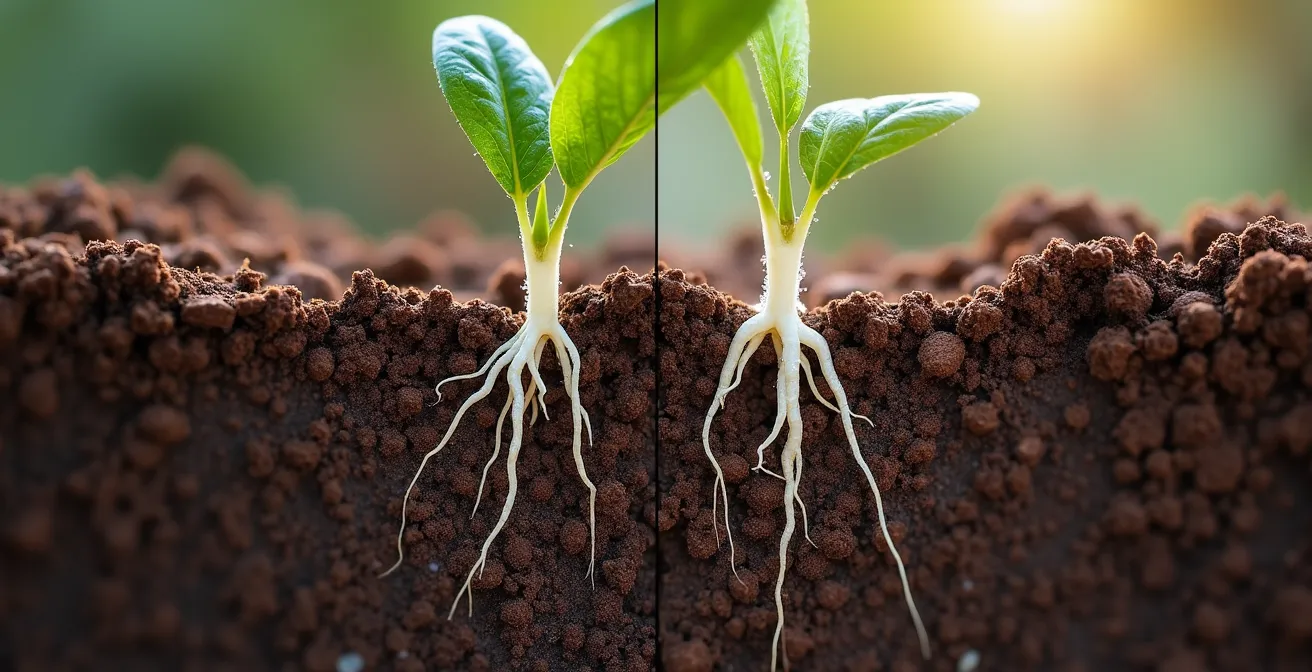
As this cross-section illustrates, dense, wet clay soil during high heat leaves no room for air and essentially suffocates and overheats the root system. In contrast, native plants adapted to clay have roots that can better tolerate these low-oxygen conditions or have growth cycles that avoid the worst of the summer stress. Matching the plant to your specific soil type is more critical than matching it to rainfall or sun exposure alone.
Your Soil Rescue Plan: Surviving Heatwaves
- For clay soil: Amend with compost or pine bark fines to improve drainage and create air pockets, preventing the “boiling” effect.
- For sandy soil: Apply a 3-inch layer of organic mulch (like shredded leaves or wood chips) to help retain vital moisture and cool the root zone.
- Water deeply and infrequently, encouraging roots to grow downward. Do this the evening or morning before a predicted heatwave, not during the peak heat.
- Check for moisture before watering. Dig down 2-3 inches; if the soil is cool and damp, the plant doesn’t need more water, even if the surface is dry.
- Create temporary shade for particularly vulnerable plants using shade cloth or even a patio chair during the hottest part of the day.
Xeriscaping: How to Have a Green Garden with Zero Irrigation?
The term “xeriscaping” often conjures images of barren landscapes filled with rocks, cacti, and sparse, scrubby plants. But this is a common misconception. True xeriscaping, especially when executed with native plants, is about creating a lush, vibrant, and self-sufficient garden that requires little to no supplemental irrigation once established. The secret lies in using plants that have not only adapted to low water but have also evolved to work together to conserve it.
One of the most effective native xeriscaping strategies is the use of “living mulch.” Instead of bare soil or wood chips, this technique involves planting low-growing, mat-forming native groundcovers. These plants create a dense carpet that provides numerous benefits that traditional mulch cannot. They actively cool the soil surface, significantly reduce water evaporation, suppress weeds, and provide habitat for beneficial insects. This turns the ground layer from a passive element into an active, contributing part of the garden ecosystem.
Case Study: Native Groundcover Success in California Drought Gardens
The Sunset magazine profile highlights California gardens using native groundcovers like woolly thyme and creeping germander as living mulch. These plants form low, fragrant mats that hold up to foot traffic while cooling soil surfaces and reducing evaporation more effectively than wood chips, creating successful zero-irrigation zones.
This systemic approach is starkly different from a traditional exotic lawn, which is one of the most water-intensive elements in modern landscaping. A native lawn or meadow, by contrast, is designed for dormancy and deep-rooted survival, showcasing the profound efficiency of a native system.
| Aspect | Native Drought-Tolerant Lawn | Traditional Exotic Lawn |
|---|---|---|
| Water Needs | 0-1 inch monthly | 1-2 inches weekly |
| Summer Color | Golden-brown (dormant) | Green (with irrigation) |
| Root Depth | 6-8 feet | 2-3 feet |
| Maintenance | Minimal mowing | Weekly mowing required |
Which Native Flowers Save the Specific Butterfly Species in Your Area?
A garden buzzing with life—bees, butterflies, and birds—is more than just a pleasant sight; it’s a sign of a healthy, functioning ecosystem. While many exotic flowers can provide nectar, native plants offer a level of specialized support that is essential for the survival of local wildlife. This is because native plants and native insects have co-evolved over thousands of years, creating intricate and often exclusive relationships. Many butterfly or moth species, for example, can only lay their eggs on a single type of native “host plant.” Without it, they cannot reproduce.
This deep connection is a primary reason why native ecosystems are so much more vibrant. In fact, research shows that this isn’t just a minor difference. According to Garden for Wildlife, landscapes planted with native species support significantly more life; their research confirms that native plants support 29% more wildlife diversity than gardens dominated by exotics. This is because every part of the plant—from its leaves and pollen to its seeds and stems—is a familiar and usable resource for the local food web.
Even more impressively, some native plants are uniquely adapted to support pollinators during the most stressful times. As native plant expert Barbara Eisenstein points out, certain species actually ramp up their production in the heat, becoming critical oases when exotics shut down.
While exotics wilt, certain natives thrive. Profile the ‘workhorse’ native genera like Pycnanthemum (Mountain Mint), Rudbeckia, and Echinacea that are not only heat-tolerant but often increase their nectar flow in high temperatures.
– Barbara Eisenstein, Weeding Wild Suburbia Blog
By planting these “workhorse” natives, you are not just adding a pretty flower; you are installing a critical piece of infrastructure for your local ecosystem, ensuring that pollinators have a reliable food source even at the peak of a heatwave.
Native Evergreens: What Looks Good in January Without Maintenance?
A plant that offers four-season interest, especially through the bleakness of January, must possess incredible resilience. That same toughness, which allows a native evergreen to withstand freezing winds and heavy snow, is your greatest asset during a summer heatwave. Unlike many deciduous plants that shed their leaves, native evergreens have evolved remarkable adaptations to reduce water loss year-round. Their needles often have a waxy coating, and broadleaf evergreens like Mahonia or Rhododendron have leathery leaves, both of which are highly effective at preventing transpiration (the loss of water through foliage).
However, their greatest value in a resilient garden comes not from their individual toughness, but from their ability to be used strategically to engineer the garden environment. A well-placed evergreen is not just a plant; it’s a tool for creating beneficial microclimates. Planted on the west or south side of a garden bed, a native pine, cedar, or holly can cast crucial afternoon shade, protecting more delicate understory plants from the most intense solar radiation. Grouped together, they can form a windbreak that reduces the drying effect of hot summer winds, preserving soil moisture across a large area.
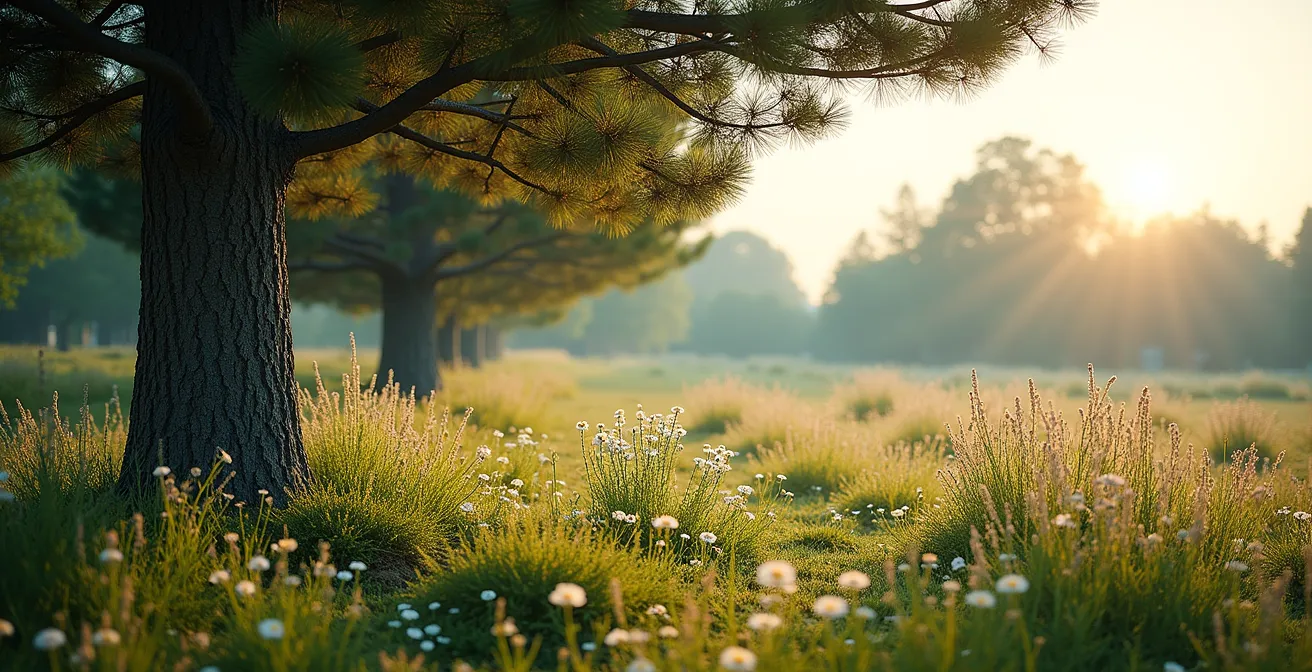
This image demonstrates how a single, mature native evergreen can create a zone of cooler, more humid air, allowing a diverse community of smaller plants to thrive where they would otherwise perish. This is a perfect example of designing a garden as an interactive system, where one plant’s characteristics provide a life-sustaining service for others.
Action Plan: Auditing Your Evergreen Placement
- Points of contact: Identify key areas needing protection from harsh afternoon sun (west-facing walls, vulnerable perennial beds) or drying winds. These are your target zones for evergreen placement.
- Collect: Inventory your existing evergreens. Are they waxy-needled species like Pines or Firs, or broadleaf natives like Mahonia? Note their current locations and health.
- Coherence: Confront your inventory with your goals. Does that Blue Spruce on the west side actually provide afternoon shade to your hydrangeas, or is it too far away to be effective?
- Mémorabilité/émotion: Evaluate the year-round visual impact. Does your evergreen provide critical structure and texture in winter, or does it get lost? A well-placed evergreen should be a focal point.
- Plan d’intégration: Create a simple planting or relocation plan. Prioritize adding or moving one key evergreen to create a cooling microclimate or an effective windbreak for maximum heatwave protection.
February to November: How to Ensure Bees Have Food All Year?
A resilient garden is a living system, and a key measure of its health is its ability to support life throughout the seasons. For pollinators like bees, this means having a consistent food source from the first warm days of late winter to the last mild days of fall. Many exotic gardens fail this test, offering a huge flush of flowers in late spring but becoming a “nectar desert” during the peak heat of summer or in the autumn. This boom-and-bust cycle is dangerous for bee colonies, which need a steady supply of pollen and nectar to thrive.
Native plant ecosystems, by contrast, are built on the principle of succession planting. Different species have evolved to bloom at different times, ensuring that there is always something available for pollinators. Early-blooming woodland ephemerals feed the first emerging queen bees, summer-blooming prairie flowers sustain the colony through the heat, and late-blooming asters and goldenrods provide the final critical resources before winter.
This strategy of continuous bloom is not just about timing; it’s also about reliability. Native plants are adapted to perform even when conditions are tough, providing a dependable food source when water-hungry exotics have stopped flowering.
Case Study: Year-Round Pollinator Support Strategy
Native plant gardens featuring succession planting of drought-tolerant species like Prairie Dropseed, Yarrow, and Ironweed provide continuous nectar sources. The Perennial Resource study shows these natives maintain bloom and nectar production even during extreme heat when exotic flowers fail, ensuring bee colony survival through critical summer stress periods.
By intentionally designing a garden with a continuous sequence of native blooms, you are creating more than just a pretty display. You are building a reliable, season-long cafeteria for essential pollinators, strengthening the entire local food web and making your garden an integral part of the surrounding ecology.
Thermal Mass: How to Grow Figs Against a Brick Wall in Cool Climates?
The hard surfaces in and around our gardens—brick walls, stone patios, concrete paths—are not neutral elements. They are active participants in your garden’s microclimate, absorbing solar energy during the day and radiating it back out at night. This phenomenon, known as thermal mass, can be a powerful tool or a deadly threat, depending on how you use it. In cooler climates, planting a fig tree against a south-facing brick wall can allow it to survive winter, as the stored heat protects it from frost. In a heatwave, however, that same wall becomes a radiant oven.
As horticulturists at the Desert Botanical Garden warn, this effect can be lethal for plants that are not adapted to intense, radiated heat. This is a critical factor that many gardeners overlook when placing plants.
A south or west-facing wall can become a radiant oven, cooking the plant it’s supposed to help.
– Desert Botanical Garden Horticulturists, Plant Care Tips During Extreme Heat Wave
Native plants often have built-in strategies for dealing with this. Some have silvery or hairy leaves that reflect sunlight, while others have deep root systems that can find cooler soil away from the hot surface. Understanding the properties of different materials is key to mitigating the risks and harnessing the benefits of thermal mass.
| Material | Heat Retention | Risk in Heatwave | Mitigation Strategy |
|---|---|---|---|
| Brick Wall | Very High | Can cook plants | Trellis with air gap |
| Natural Boulder | Moderate | Balanced heat release | Partial shade planting |
| Concrete | High | Intense radiation | Temporary shading |
| Stone | Moderate-High | Gradual heat release | Morning sun position |
By using a trellis to create an air gap between a plant and a hot wall, or by choosing heat-loving natives to plant near stone features, you can turn these potentially destructive elements into valuable assets in your garden’s ecosystem.
Key Takeaways
- Native plant resilience is not a single trait but a complex system of adaptations involving roots, soil, and climate.
- The foundation of a drought-proof garden is a healthy, undisturbed soil ecosystem teeming with microbial life.
- Strategic design, using plants and materials to create beneficial microclimates, is more effective than simply choosing “tough” plants.
Why Tilling Your Soil Kills the Micro-Organisms That Feed Your Plants?
For generations, gardeners have been taught to till their soil, breaking it up to create a fine, fluffy seedbed. We now know that this practice, while well-intentioned, is one of the most destructive things you can do to your garden’s long-term health. The soil beneath your feet is not inert dirt; it is a living, breathing ecosystem, a complex web of bacteria, fungi, and other microorganisms that forms the true foundation of your garden’s resilience. This soil ecosystem is responsible for breaking down organic matter, cycling nutrients, and, most importantly, creating a structure that can hold water.
When you till, you pulverize this delicate structure. You destroy the intricate fungal networks (mycelial hyphae) that act like a sponge, holding moisture in the soil and transporting it to plant roots. Tilling effectively turns a living sponge into dead dust, which compacts easily and loses water rapidly to evaporation. A no-till approach, by contrast, preserves this vital structure. It allows a complex soil food web to develop, creating a garden that is far more resistant to drought and disease. This is becoming increasingly critical as our climate changes, a fact underscored by hard data. For instance, USDA climate data shows that plant hardiness zones are shifting north at 13 miles per decade, meaning our gardens must be more resilient than ever.
Building a healthy, drought-proof soil ecosystem doesn’t require heavy machinery. It relies on gentle, additive methods that mimic how nature builds soil in a forest or prairie—from the top down.
Your Action Plan for Building Living Soil
- Apply sheet mulching (lasagna gardening) in the fall: Layer cardboard, compost, and leaves directly on top of your garden bed to smother weeds and build rich soil without digging.
- Plant native cover crops like clover or vetch in bare areas. Their roots create channels in the soil and add nitrogen, and they can be cut down to form a natural mulch.
- Top-dress with compost: Instead of digging it in, simply spread a one-inch layer of high-quality compost on the soil surface each year to feed the soil life below.
- Maintain fungal networks by avoiding all tillage. If soil is compacted, use a broadfork to gently aerate it without turning over and destroying the soil layers.
- Leave the roots of harvested annual plants in the ground. As they decompose, they create channels for air and water and provide food for soil microbes.
Your journey to a resilient garden doesn’t start with a shopping trip for ‘tough’ plants, but with a simple decision to build a better system. Begin today by assessing your soil and choosing one native to champion. You’re not just planting a flower; you’re laying the foundation for an ecosystem that can finally take care of itself.