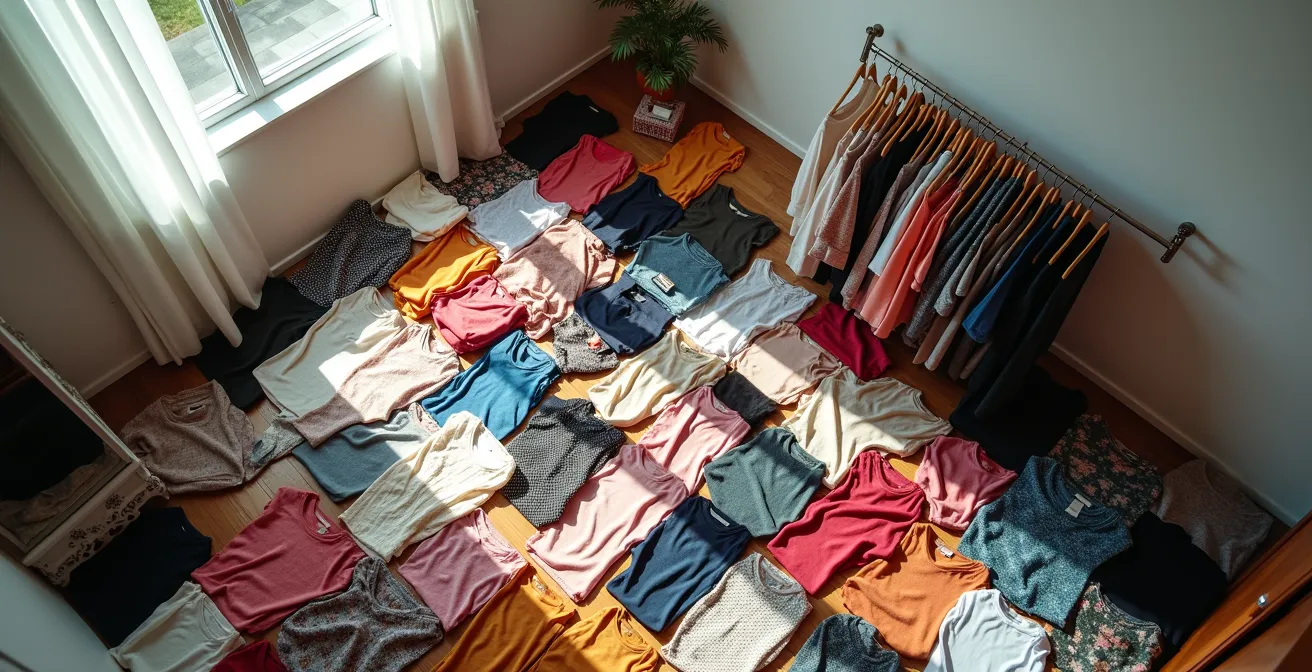
Contrary to popular belief, staying stylish isn’t about chasing endless micro-trends; it’s about treating your wardrobe as a managed investment portfolio.
- The relentless cycle of “in” and “out” is a financial drain designed to fuel overconsumption, not enhance your personal style.
- True style longevity comes from strategic acquisition of high-quality “blue-chip” assets, focusing on fit, material, and timelessness over fleeting fads.
Recommendation: Shift your mindset from “shopping” to “investing” by allocating 80% of your budget to core, lasting pieces and tracking their long-term value through metrics like cost-per-wear.
The feeling is all too familiar. A new “aesthetic” floods your social media feed—be it “coastal grandmother,” “cottagecore,” or the latest “-core” of the week. Suddenly, the clothes you bought just months ago feel dated. The pressure to buy a few new items to participate in the trend is immense, a quick fix to feel current. But this cycle, fueled by the relentless engine of micro-trends, is a carefully constructed trap. It’s a system that benefits ultra-fast fashion brands by ensuring their products—and your wardrobe—have a built-in obsolescence, destroying both your budget and your ability to cultivate a genuine, lasting personal style.
The common advice is to “build a capsule wardrobe” or “buy classics,” but this often misses the fundamental issue. It’s not just about what you buy; it’s about a radical shift in mindset. What if the solution wasn’t to become a better shopper, but a smarter investor? The true antidote to the chaos of micro-trends is to stop viewing your clothes as disposable goods and start treating your wardrobe as a financial portfolio of personal assets. This approach prioritizes long-term value, quality assessment, and strategic allocation over impulsive, trend-driven consumption.
By adopting this investment strategy, you move beyond the surface-level discussion of “timeless pieces” and into the mechanics of what makes a garment valuable. This guide will deconstruct the wardrobe-as-portfolio approach, showing you how to build a versatile core collection, assess asset quality, time your purchases for maximum return, manage your clothing budget like cash flow, and ultimately understand why a well-chosen, tailored piece is always a better investment than an expensive, off-the-rack status symbol.
To navigate this strategic shift, we will explore a series of practical frameworks. This article breaks down the essential components of building a high-performing wardrobe portfolio, from creating maximum versatility with minimal pieces to understanding the hidden market forces at play.
Summary: Why Chasing “Micro-Trends” Is Destroying Your Budget and Style?
- How to Create 30 Outfits from Just 10 Seasonal Pieces?
- The Seam Test: How to Spot Cheap Quality in Expensive Brands?
- When to Buy Winter Coats to Save 40% Off Retail?
- Trench Coat or Puffer: Which Investment Lasts 5 Years?
- What Happens to Unsold Seasonal Collections (And Why It Matters)?
- How to Project Cash Flow When Market Demand Is Erratic?
- How to Remove Salt Stains from Leather Shoes in Winter?
- Why a $500 Suit With Tailoring Looks Better Than a $2000 Off-the-Rack?
How to Create 30 Outfits from Just 10 Seasonal Pieces?
The core of a successful wardrobe portfolio is achieving maximum versatility with a minimal number of high-performing assets. The goal isn’t restriction; it’s efficiency. The idea of a “capsule wardrobe” is gaining significant traction, not as a trend, but as a strategic response to fashion fatigue. In fact, consumer data shows that 88% of Stitch Fix clients cited ‘wardrobe builders’ like knits and basic tops as the pieces they were most likely to purchase, signaling a move toward foundational items. This is the essence of the Core 7 + Versatile 3 formula.
This method involves selecting seven foundational “blue-chip” pieces and three versatile “connector” items. The blue-chip pieces are the bedrock of your portfolio—think a classic black blazer, well-fitting dark jeans, a quality white t-shirt, or a neutral coat. These are timeless items in neutral colors that offer structural integrity to any outfit. The three connector pieces are where you introduce personality and adaptability. These could be a silk scarf, a textured sweater, or a statement belt, items that can transform the look and feel of the core pieces without requiring a complete overhaul.
To ensure these 10 pieces can genuinely create 30 distinct outfits, you must apply a rigorous testing method before finalizing your selection. Start by ensuring your basics work together using the “3-3-3” rule: can you form a cohesive look with any combination of your three primary tops, three bottoms, and three pairs of shoes? Then, for each individual piece, test at least three different styling variations. Can a shirt be worn tucked, untucked, and half-tucked? Can a sweater be a standalone top and a layering piece? This stress-testing ensures every item in your portfolio is a hard-working asset, not a passive occupant of closet space.
By reserving one “slot” in your 10-piece collection for a rotating trend-tester item, you can engage with current styles in a controlled, low-risk way without compromising the stability of your core portfolio.
The Seam Test: How to Spot Cheap Quality in Expensive Brands?
In an investment portfolio, due diligence is critical. You wouldn’t buy a stock without researching the company; likewise, you shouldn’t invest in a garment without assessing its intrinsic quality. Price and brand name are no longer reliable indicators of quality. Many luxury brands, in an attempt to compete with the speed of fast fashion, have quietly adopted lower-quality production methods. The key is to learn how to identify the physical signs of good construction, starting with the “seam test.”
A high-quality seam will be straight, dense (high stitches per inch), and flat, with no puckering or loose threads. On a well-made garment, the pattern will align perfectly at the seams—a clear sign that the manufacturer took the time and used enough fabric to do it right. Conversely, low stitch density, sloppy finishing, and misaligned patterns are red flags. Another crucial checkpoint is the fabric itself. Natural fibers like wool, cotton, silk, and linen generally outperform and outlast synthetics like polyester and acrylic, which are prone to pilling and retaining odors. The problem is systemic; the ultra-fast fashion model is built on speed, not longevity. A 2021 undercover investigation into SHEIN found that workers making clothes for the brand worked more than 75 hours a week, a pace that makes rigorous quality control virtually impossible.
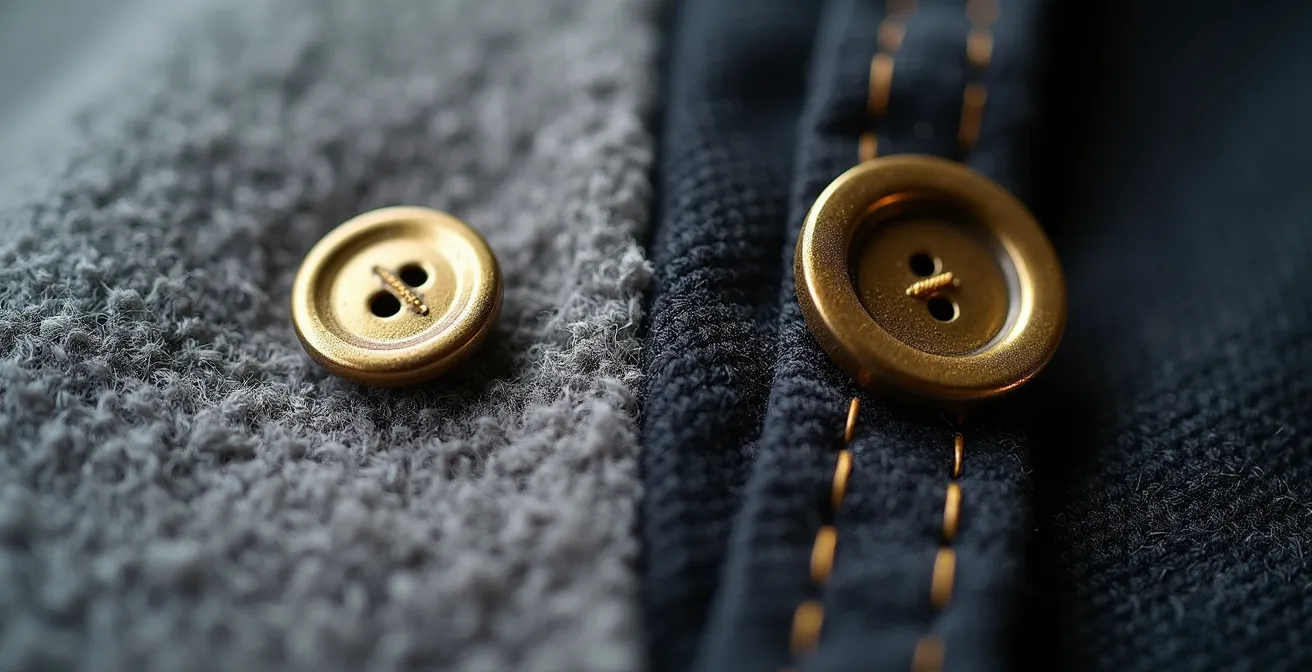
As the visual comparison shows, the difference is tangible. A cheap synthetic fabric often has a superficial sheen and feels slick or rough, while quality natural fibers have depth and texture. Look at the hardware: zippers should be metal (YKK is a gold standard), not plastic. Buttons should feel substantial, be sewn on tightly, and ideally have a “shank” (a small piece of thread wrapped behind the button) to create space for the fabric to drape cleanly when buttoned. These small details are the difference between an asset that will appreciate with wear and one destined for the landfill.
By training your eye and hand to recognize these signals, you immunize yourself against the marketing of expensive brands selling subpar products and make investments based on tangible value, not perceived prestige.
When to Buy Winter Coats to Save 40% Off Retail?
A cornerstone of any successful investment strategy is timing the market. For a wardrobe portfolio, this means acquiring high-value, high-cost assets like winter coats when their price is at its most favorable, not when demand is at its peak. Paying full retail price for a winter coat in November is the equivalent of buying a stock at its 52-week high. The savviest investors know that patience yields the greatest returns.
The retail calendar has a predictable rhythm that you can leverage. The most significant discounts on current-season outerwear occur when retailers are desperate to clear floor space for incoming spring collections. This window typically opens in late January and runs through February, offering discounts that can easily reach 40-60% off the original price. The trade-off is that selection may be limited in terms of size and color, but the savings are substantial. Another powerful, often overlooked strategy is to enter the pre-owned market in the early fall. In September and October, discerning owners sell last season’s luxury coats to fund new purchases, flooding platforms like The RealReal and Vestiaire Collective with high-quality inventory. This is where a classic Burberry trench or a Max Mara coat can be acquired for 50-70% less than its original retail value. This approach is particularly effective for timeless designs, as their value depreciates slowly after the initial first-year drop.
For those willing to be more proactive, sample sales offer the deepest discounts, often 60-80% off, but require insider knowledge and subscriptions to specific brand newsletters or services.
| Time Period | Discount Range | Pros | Cons |
|---|---|---|---|
| Late January/February | 40-60% off | Deepest retail clearance, current season styles | Limited sizes/colors available |
| September/October (Pre-owned) | 50-70% off original | Best selection of luxury pieces on resale platforms | Previous season’s models |
| Sample Sales (Year-round) | 60-80% off | Access to premium stock, deeper discounts | Requires insider knowledge/subscriptions |
Ultimately, buying a winter coat is a major capital expenditure in your wardrobe portfolio. By strategically timing this purchase, you free up capital that can be allocated to other parts of your portfolio or simply saved.
Trench Coat or Puffer: Which Investment Lasts 5 Years?
When choosing between two potential assets for your portfolio, a smart investor looks beyond the initial price and analyzes the Total Cost of Ownership (TCO) and long-term value. This is especially true when comparing a timeless classic like a trench coat with a trend-driven item like a technical puffer jacket. While both serve a purpose, they represent fundamentally different investment philosophies. The consumer mindset is slowly shifting in this direction; according to 2024 US clothing market data, 40% of adults believe fast fashion offers style on a budget, but they increasingly prioritize pieces that are well-fitting, comfortable, and versatile for the long haul.
A classic trench coat, particularly from a heritage brand, has a higher initial investment but carries a very low risk of style obsolescence. Its silhouette has remained largely unchanged for a century, making it a true “blue-chip” asset. Its 5-year resale value is remarkably high, often retaining 40-60% of its original worth. A technical puffer, on the other hand, is often tied to current trends—its color, shininess, or cut can quickly look dated. While its initial cost is lower, its resale value plummets, retaining only 15-25% of its value after five years. The maintenance costs also differ significantly, with a trench requiring professional dry cleaning while a puffer can often be cared for at home.
When you calculate the net 5-year cost (Initial Cost + Maintenance – Resale Value), the financial picture becomes clearer. The “expensive” trench coat might actually have a lower total cost of ownership over five years than the “cheaper” puffer, while also providing greater stylistic versatility.
| Factor | Classic Trench Coat | Technical Puffer |
|---|---|---|
| Initial Investment | $800-1500 | $400-800 |
| Annual Maintenance | $120 (dry cleaning) | $20 (home care) |
| Style Obsolescence Risk | Low (timeless silhouette) | High (trend-dependent) |
| 5-Year Resale Value | 40-60% retained | 15-25% retained |
| Total 5-Year Cost | $800-1200 net | $420-700 net |
The choice isn’t just about weather protection; it’s a strategic decision. The trench is a stable, long-term hold, while the puffer is a more speculative, depreciating asset. For a portfolio built on longevity, the choice is clear.
What Happens to Unsold Seasonal Collections (And Why It Matters)?
Understanding the full lifecycle of a garment, including what happens when it doesn’t sell, is crucial for a sustainable stylist and a savvy investor. The sheer volume of waste generated by the fashion industry is staggering. Shocking environmental data reveals that 92 million tonnes of fast fashion and textile waste end up in landfills every year. This waste isn’t just from consumers discarding old clothes; a significant portion comes from brands’ unsold inventory. This reality has profound implications for both the environment and you as a consumer.
Many people believe that unsold high-end clothing ends up at outlet malls, offering a savvy way to access luxury for less. However, this is often a carefully crafted illusion. This is the “Outlet Deception.” A large percentage of items found in outlet stores were never intended for mainline retail. They are specifically manufactured for the outlet channel using lower-quality materials and simpler construction to meet a lower price point. You might think you’re getting a deal on a luxury item, but you’re often buying a lower-grade product made under the same brand name. You can spot these “made-for-outlet” items by looking for different label designs (e.g., an extra square or circle on the tag), simpler hardware, and prices that end in “.00” rather than an original price tag with multiple markdown stickers.
Case Study: The Outlet Deception
Research into major brands’ supply chains reveals a clear distinction between genuine clearance stock and “made-for-outlet” products. Genuine unsold stock from flagship stores is a minority in most outlet locations. The majority is purpose-built inventory that leverages the brand’s name without delivering its mainline quality. This practice allows brands to profit from the perception of a discount while protecting their premium image and offloading the risk of overproduction onto consumers who believe they are getting a bargain.
Knowing this matters because it impacts your investment strategy. Buying a “made-for-outlet” piece is not a sound investment; it’s purchasing a low-quality item with a deceptively prestigious label. It directly contributes to the cycle of disposable fashion, even when you think you’re being a smart shopper. The real value lies in buying genuine, high-quality pieces—either at the right time during retail sales or on the pre-owned market.
Your purchasing power can either fuel this wasteful and deceptive system or support a more sustainable model based on quality and longevity.
How to Project Cash Flow When Market Demand Is Erratic?
The erratic demand of the fashion market, driven by fleeting micro-trends, makes personal budgeting a nightmare. A disciplined investor needs a clear cash flow strategy to navigate this volatility. The solution is to adopt the Core-Satellite approach, a classic portfolio management technique applied to your wardrobe budget. This strategy provides both stability and flexibility, allowing you to build a timeless foundation while still engaging with trends in a controlled, financially responsible way.
The principle is simple: you allocate your clothing budget into two distinct funds. The “Core” fund, which should represent about 80% of your budget, is dedicated exclusively to acquiring and maintaining your timeless, blue-chip pieces. These are the workhorses of your wardrobe—the perfect coat, the versatile blazer, the quality leather shoes. These are long-term investments where quality and fit are non-negotiable. The remaining 20% of your budget forms the “Satellite” fund. This is your flexible, experimental money. You can use it to test-drive a trend, rent a statement piece for an event, or buy that brightly colored top that brings you joy, all without jeopardizing your core financial plan. This structure insulates the majority of your capital from the volatility of trends.

To ensure this system is working, you must track the performance of your assets. The most important Key Performance Indicator (KPI) is the Personal Cost-Per-Wear (P-CPW). You can track this with a simple spreadsheet: divide the total cost of an item by the number of times you’ve worn it. A $300 blazer worn 100 times has a P-CPW of $3. A $30 fast-fashion top worn three times has a P-CPW of $10. This metric reveals the true value of your investments and helps you make smarter decisions in the future.
Your Wardrobe Budgeting Action Plan: The Core-Satellite Strategy
- Allocate 80% of your clothing budget to timeless ‘Core’ pieces that won’t go out of style.
- Reserve 20% as a flexible ‘Satellite’ fund for trend experiments or seasonal rentals.
- Track your Personal Cost-Per-Wear (P-CPW) using a simple spreadsheet: divide item cost by number of wears.
- Set up a dedicated ‘Sinking Fund’ savings account for major purchases (luxury items).
- Review your P-CPW quarterly to identify which investments delivered the best value and adjust your strategy accordingly.
By implementing this strategy, you shift from being a reactive consumer to a proactive portfolio manager, making deliberate decisions that enhance both your style and your financial well-being.
How to Remove Salt Stains from Leather Shoes in Winter?
An investment is only as good as its maintenance plan. A pair of high-quality leather shoes is a cornerstone asset in a wardrobe portfolio, but its value can be quickly eroded by neglect, especially during harsh winter months. Road salt is particularly corrosive, drawing moisture out of the leather and leaving behind white stains that can cause permanent damage if left untreated. Proper and timely care is not just cleaning; it’s asset protection.
The key is to act quickly and use the right method for the specific material. Many people feel intimidated by material repair, but the basics are surprisingly accessible. As Emma Mathews, founder of sustainable brand Socko, notes, “People shouldn’t be daunted by material repair! With textiles, you can undo a stitch as if it was Control-Z. You can learn everything from how to thread a needle to patching a hole within a few hours from YouTube videos.” This ethos of empowerment applies directly to shoe care.
People shouldn’t be daunted by material repair! With textiles, you can undo a stitch as if it was Control-Z. You can learn everything from how to thread a needle to patching a hole within a few hours from YouTube videos.
– Emma Mathews, as quoted on Earth911
For most salt stains, a simple, homemade solution is highly effective. For smooth calfskin leather, a solution of one part white vinegar to one part water, applied gently with a soft cloth, will dissolve the salt. For more delicate materials like suede or nubuck, the approach must be gentler. Always start with a dry brush to remove any surface-level salt and dirt. If the stain persists, use a much more diluted vinegar solution (1:3) and dab carefully, then brush the nap back into place once dry. The most critical step, however, is prevention. Applying a quality leather protector before the season begins creates a barrier against salt and water. Furthermore, always use shoe trees to help your shoes maintain their shape and absorb moisture, and rotate your pairs to allow them a full 48 hours to dry out between wears. This can extend the life of your shoes by years.
Treating your quality pieces with respect and care ensures they deliver returns not just for a season, but for a decade or more.
Key Takeaways
- Adopt an investor’s mindset: Treat your wardrobe as a managed portfolio of assets, not a collection of disposable trends.
- Prioritize quality and fit over brand names: The “Good Bones” and intrinsic quality of a garment are far more valuable than a luxury label on a poorly made item.
- Master the 80/20 rule: Allocate 80% of your budget to timeless “core” pieces and use metrics like Cost-Per-Wear (P-CPW) to measure true value.
Why a $500 Suit With Tailoring Looks Better Than a $2000 Off-the-Rack?
This is the ultimate proof of the wardrobe-as-investment thesis: a smaller, well-placed investment combined with strategic customization will always outperform a larger, unmanaged one. Nothing illustrates this better than the case of the tailored suit. Many believe that a higher price tag automatically equals a better look, but in reality, fit is the single most important factor in how a garment looks, and an off-the-rack suit—no matter how expensive—is designed for a generic mannequin, not your unique body.
The secret lies in the “Good Bones Principle.” The “bones” of a suit are the elements that are difficult or impossible for a tailor to alter: the fit across the shoulders and the placement of the armholes. If these two points are correct, almost everything else can be adjusted to perfection. A $500 suit from a reputable brand like Suitsupply that fits perfectly in the shoulders, combined with $200 of expert tailoring, will look infinitely better than a $2,000 designer suit that is too wide in the shoulders or has low-cut armholes. The tailoring transforms the affordable suit from a generic product into a bespoke-feeling asset.
Case Study: The Good Bones Principle in Action
Fashion industry analysis shows that proper shoulder fit and armhole placement account for 70% of a suit’s visual impact. A mid-range suit with a quality canvas construction and a natural shoulder line, when subjected to tailoring (sleeve length adjustment, waist suppression, trouser hemming and tapering), consistently outperforms expensive off-the-rack options in blind quality assessments. The key is identifying the good bones first, knowing the rest can be sculpted.
The return on investment for tailoring is exceptionally high. In fact, tailoring industry data demonstrates that 3-4 key alterations provide 80% of the visual impact for just 20% of the cost of a fully custom suit. This is the 80/20 rule in action. The most critical alterations are adjusting sleeve length to show a sliver of shirt cuff, taking in the waist for a clean silhouette, and hemming the trousers to have the perfect break over the shoe. These small, relatively inexpensive adjustments create a look of polish and intention that money alone cannot buy.
This principle extends beyond suits to all core assets in your wardrobe. Investing in tailoring is the final step in activating the full potential of your portfolio, ensuring every piece delivers the maximum possible return in style, confidence, and longevity.