
The biggest myth in vlogging is that you need a professional studio to succeed; the data shows that strategic authenticity drives more growth than expensive gear.
- Viewer retention is more strongly correlated with relatable storytelling than with cinematic 4K footage.
- Technical limitations, like a smartphone’s battery life, can be leveraged to create more immediate and trustworthy content.
Recommendation: Before investing in a new camera, master a clear narrative structure and focus on building trust signals with your audience.
If you’re an aspiring vlogger, you’ve likely felt a wave of intimidation scrolling through YouTube. You see creators with flawless lighting, buttery-smooth B-roll, and studios that look more professional than a TV set. The immediate conclusion is that success requires a massive investment in gear and technical skills. The common advice to “just be yourself” feels hollow and unhelpful when faced with such polished productions. You’re left wondering how you can possibly compete when your “studio” is your bedroom and your primary camera is your phone.
But what if the data told a different story? What if the relentless pursuit of high production value is not only unnecessary but can sometimes be counterproductive? As a growth strategist, I’ve seen countless channels prove that authenticity isn’t just a vague feeling—it’s a series of strategic technical and narrative choices that directly impact viewer retention, audience loyalty, and discoverability. It’s about building strong parasocial relationships, where viewers feel like they know and trust you, not just admire your work.
This isn’t about shunning quality. It’s about redefining it. True quality on platforms like YouTube is measured in connection, not just resolution. This guide will dismantle the myth of production value and give you a metric-driven framework for leveraging your greatest asset: your genuine perspective. We will explore how to hook viewers from the first second, how to use gear strategically, how to tell compelling stories without rambling, and why even your posture can be a powerful tool for building an audience that comes back again and again.
To help you navigate these strategic shifts, this article breaks down the core components of building an authentic and successful vlog. Explore the sections below to master the art of genuine connection that translates into real channel growth.
Contents: Why Authenticity is Your Greatest Vlogging Asset
- How to Keep Viewers Watching Past the First 30 Seconds?
- The Privacy Mistake That Doxxes New Vloggers
- How to Rank Your Vlog on Page 1 Without Clickbait Titles?
- Phone vs Mirrorless Camera: When Should You Actually Upgrade?
- When to Post: Capitalizing on Trends Without Looking Desperate?
- Why 5G Drains Your Battery 20% Faster and How to Fix It?
- How to Tell a Personal Story Without Rambling?
- Why Your Posture Is Sabotaging Your Negotiation Power?
How to Keep Viewers Watching Past the First 30 Seconds?
The first 30 seconds of your vlog are the most critical battlefield for attention. This is where the majority of viewers decide whether to stay or click away. While many new creators focus on a flashy intro or a perfectly scripted welcome, the data points to a different priority: emotional and narrative connection. In fact, research from Google shows that viewers are 1.6 times more likely to choose content based on their interests and the personality of the creator than on high production quality. Your job is not to impress them; it’s to make them feel understood.
Think of your first 10 seconds as an ‘authenticity contract’. In this short window, you set the emotional expectation for the entire video. Instead of a generic “Hey guys, what’s up,” you need to establish a clear narrative hook. Are you frustrated, excited, confused, or on a mission? Show it, don’t just say it. This raw emotional signal is far more engaging than a polished but sterile introduction. By showing vulnerability or a clear goal from the start, you transform a passive viewer into an active participant in your story.
Here are proven hook strategies to establish that contract immediately:
- Start with your ‘inciting incident’: Begin at the moment of frustration, breakthrough, or the one event that sparked the entire video’s journey.
- Set clear emotional expectations: Openly state the feeling you’re grappling with (“I’m so frustrated with this…”) to create an instant bond.
- Ask for quick advice: Involve the viewer by asking for their take on a minor, relatable problem you’re facing in the video.
- Show vulnerability: Admit what you don’t know or what you struggled with. It’s a powerful trust signal.
By front-loading the emotional core of your story, you give viewers a compelling reason to invest their time. They aren’t just watching a video; they’re joining you on a journey they feel a part of.
The Privacy Mistake That Doxxes New Vloggers
In the quest for authenticity, many new vloggers swing the pendulum too far, sharing personal information without considering the digital footprint they leave behind. This isn’t just about oversharing feelings; it’s about unintentionally revealing sensitive data that can lead to doxxing—the malicious online publication of private information. Every reflective surface, from your sunglasses to a store window, can act as a mirror, revealing your location, your home layout, or even personal documents left on a table. Before hitting “record,” it’s crucial to adopt a mindset of strategic privacy.

As the image above illustrates, even abstract reflections can contain identifiable information. Beyond physical reflections, you must be vigilant about digital clues. This includes scrubbing metadata from photos and videos, being cautious with location-based hashtags, and avoiding shots that show your street name, house number, or the view from your window. True authenticity is about sharing your genuine personality and experiences, not compromising your safety. The trust you build with your audience should never come at the cost of your personal security.
Case Study: The Lonelygirl15 Deception
The “Lonelygirl15” case became a watershed moment for YouTube authenticity. Initially presented as the genuine vlogs of a teenage girl, the eventual revelation that it was a professionally produced fictional series sent shockwaves through the platform. This case highlights a critical lesson: audiences value transparency above all. While the content was entertaining, the deception severely damaged viewer trust, not just for the creators but for the vlogging medium as a whole. It proves that the “authenticity contract” is sacred; once broken, it is incredibly difficult to repair.
Ultimately, a sustainable vlogging career is built on a foundation of safety. By being mindful of what you show, you can share your world with confidence, knowing you’ve protected your private life.
How to Rank Your Vlog on Page 1 Without Clickbait Titles?
Many creators believe that ranking on YouTube and Google search requires sensational, clickbait titles. However, this is a short-term tactic that damages long-term trust and channel authority. The secret to sustainable SEO is aligning your content with what the algorithm truly values: viewer satisfaction. And viewer satisfaction is a direct result of authentic, valuable content. In fact, analysis of recent platform updates that prioritize genuine content shows a clear shift away from rewarding click-through rate alone and toward metrics like watch time and session duration.
When you deliver on the promise of your title with genuine, engaging storytelling, viewers watch longer. This signals to the algorithm that your video is a quality result for that query, boosting its rank over time. Instead of “YOU WON’T BELIEVE What Happened Next!”, a title like “My First Week Learning Pottery: A Humbling (and Messy) Experience” performs better in the long run. It sets a clear, authentic expectation and attracts an audience genuinely interested in the topic, leading to higher retention.
Authenticity is the quality of being genuine and true to oneself. In YouTube vlogging, it means being honest, transparent, and real with your audience.
– Daily Vlogging Editorial Team
To optimize for this, focus on creating titles that are both searchable and sincere. Use keywords that people are actually searching for, but frame them around a personal journey, a specific problem, or a unique perspective. Your title and thumbnail are a promise to the viewer. When you deliver on that promise with content that is honest and true to your style, you build the most powerful SEO asset of all: viewer trust.
By focusing on genuine value, you create a virtuous cycle: satisfied viewers lead to better metrics, which leads to higher rankings, which brings in more of the right viewers.
Phone vs Mirrorless Camera: When Should You Actually Upgrade?
The most common question from new vloggers is: “Do I need an expensive camera?” The answer is almost always no, at least not at first. The “phone vs. camera” debate isn’t about which is “better,” but which is the right tool for the story you’re trying to tell. A smartphone, with its immediacy and intimacy, is often a more powerful tool for building an authentic connection than a cumbersome mirrorless camera. Forcing a cinematic look on a personal, confessional-style vlog can create an emotional distance, making the content feel staged and less trustworthy.
The decision to upgrade should be driven by a specific narrative need that your current gear cannot meet. Are you consistently shooting in low light where your phone struggles? Do you need the shallow depth of field from a professional lens to isolate subjects for a specific cinematic effect? If the answer is no, your money is better spent elsewhere. A VloggerPro analysis found that creators can achieve stunning results with cameras in the $200-$300 range, but only when paired with good lighting and audio. The study concluded that investing in a quality microphone and a simple lighting setup will elevate your perceived production value far more than upgrading to a 4K camera.
This decision matrix can help you determine the right tool for the job. As a detailed decision matrix reveals, the ideal choice depends entirely on your content’s goals.
| Content Type | Smartphone Ideal | Camera Upgrade Needed |
|---|---|---|
| Confessional/Personal | ✓ Enhances intimacy | May create distance |
| In-the-moment vlogs | ✓ Quick, authentic | Too slow to deploy |
| Low-light storytelling | Limited capability | ✓ Superior performance |
| Cinematic B-roll | Acceptable | ✓ Professional depth |
| Live streaming | ✓ Built-in connectivity | Requires extra setup |
Embrace the constraints of your smartphone. Use its portability to capture spontaneous, genuine moments. When you do decide to upgrade, it will be an informed, strategic decision that serves your story, not your ego.
When to Post: Capitalizing on Trends Without Looking Desperate?
Chasing trends can feel like a necessary evil for growth on YouTube. While participating in a viral challenge can bring a surge of new viewers, doing it without a clear strategy can make your channel feel derivative and lead to burnout. Research on vlogging sustainability is alarming; over 50% of creators report experiencing burnout, often fueled by the pressure to constantly produce content for a rapidly changing trend cycle. The key isn’t to ignore trends, but to engage with them on your own terms.
A sustainable approach involves separating your core content from your trend-responsive content. Your core content—the videos that reflect your unique voice and mission—should be on a consistent, manageable schedule. This is the foundation of your channel and the reason your loyal audience subscribed. Trends, on the other hand, should be treated as opportunities, not obligations. Instead of “trend-jacking” (mindlessly copying a format), practice “trend-commenting”—using a trend as a vehicle to deliver your unique message or perspective. For example, if there’s a viral food challenge, a fitness vlogger could create a video on “How to Recover After the Spicy Noodle Challenge,” staying true to their brand while tapping into a relevant conversation.
This framework provides a structured way to participate in trends without losing your channel’s identity or your sanity.
Your Action Plan: The Strategic Trend Participation Framework
- Establish a consistent schedule for your core, evergreen content (e.g., one video per week).
- Reserve a flexible “wildcard” slot in your calendar for spontaneous, timely trend responses.
- Filter trends through your brand: only participate if you can use it to reinforce your unique message.
- Focus on commenting on or reacting to a trend from your niche perspective, rather than just copying it.
- Monitor trends for inspiration, but always adapt them to your authentic voice and style.
This balanced strategy allows you to benefit from the discovery potential of trends while strengthening the authentic core of your channel, protecting you from burnout and building a more loyal audience.
Why 5G Drains Your Battery 20% Faster and How to Fix It?
For a mobile vlogger, few things are more stressful than the dreaded “low battery” warning. While the title focuses on 5G, the larger issue is a universal reality for creators on the go: technical limitations are unavoidable. Battery drain, limited storage, and unpredictable mobile data are part of the job. Many see these constraints as a roadblock to creating “professional” content. However, a strategic vlogger sees them as an opportunity to foster authenticity.
When you only have 20% battery left, you don’t have the luxury of overthinking or shooting endless retakes. You’re forced to be decisive, present, and focused on capturing the essence of the moment. This pressure can actually improve your content. A 2025 creator survey from OBSBOT revealed that battery limitations often lead to more authentic footage, as creators capture genuine, in-the-moment reactions rather than staged, perfect shots. This concept of ‘strategic imperfection’ is about embracing constraints as a creative tool that enhances the rawness and trustworthiness of your vlog.
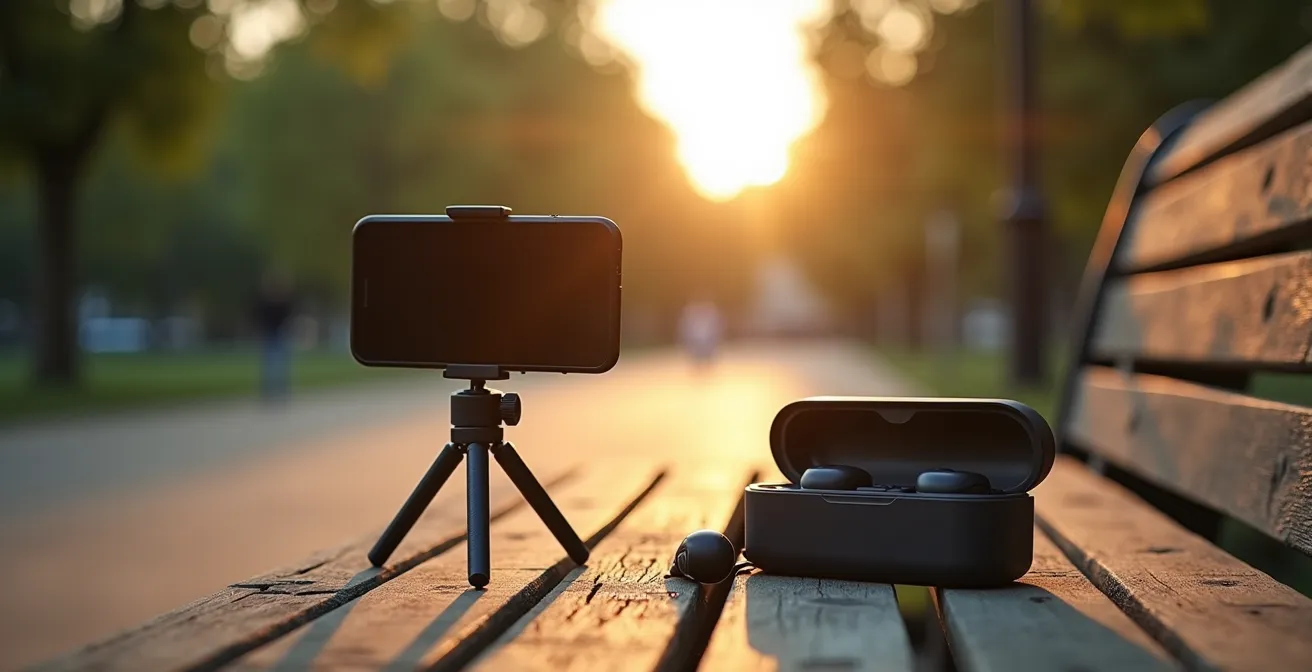
As the minimalist setup above suggests, success in mobile vlogging is about efficiency, not excess. To manage battery drain, turn off 5G when you’re not actively uploading, lower your screen brightness, and carry a compact power bank. But more importantly, change your mindset. See your battery percentage not as a limitation, but as a countdown timer that forces you to be more creative and authentic. The unpolished, spontaneous clip you got just before your phone died is often more compelling than an hour of perfectly framed but soulless footage.
Your audience doesn’t connect with your battery life; they connect with the genuine moments you capture because of it. Embrace the limitations, and you’ll find your content becomes more real and relatable.
How to Tell a Personal Story Without Rambling?
“Telling your story” is a cornerstone of authentic vlogging, but it’s also a trap. Without structure, a personal story quickly becomes a self-indulgent ramble that makes viewers tune out. The magic of vlogging lies in its conversational feel, which scholars Burgess and Green noted makes the medium feel “‘real’ and ‘sincere,’ a significant part of the ‘DIY culture’ on YouTube.” The challenge is to maintain that conversational tone while guiding the viewer through a coherent narrative. The difference between a captivating story and a boring monologue is one thing: structure.
A powerful framework used by professional storytellers at places like Pixar is the “Story Spine.” It’s a simple, seven-step structure that ensures your story has a clear beginning, a compelling middle, and a satisfying end. By plugging your personal experience into this framework, you force yourself to identify the core narrative arc and cut out everything that doesn’t serve the story. This ruthless editing process is what transforms a personal anecdote into a universal lesson that resonates with a broad audience.
Here is the Story Spine framework, adapted for vloggers:
- Once upon a time… (Establish your normal, everyday situation.)
- And every day… (Describe the routine or pattern of that situation.)
- Until one day… (Introduce the catalyst—the single event that changed everything.)
- And because of that… (Show the immediate consequences and your reactions.)
- And because of that… (Continue to show the escalating chain of events.)
- Until finally… (Reveal the climax or resolution.)
- And ever since then… (Share the lesson learned or the new normal.)
By using a simple structure like the Story Spine, you can share your most personal experiences with confidence, knowing you are taking your audience on a purposeful journey, not just an aimless walk through your thoughts.
Key Takeaways
- Authenticity is a measurable strategy, not just a feeling, and its impact is seen directly in viewer retention metrics.
- Technical limitations, such as using a smartphone instead of a pro camera, can be a strategic advantage that enhances intimacy and trust.
- A clear story structure, like the Story Spine, is the essential tool that separates a compelling personal story from a boring, rambling monologue.
Why Your Posture Is Sabotaging Your Negotiation Power?
When we think of “negotiation power,” we often picture a corporate boardroom. But for a vlogger, the most important negotiation happens with every viewer: you are negotiating for their trust and attention. In this context, your “posture” isn’t just about sitting up straight; it’s about your entire physical presence and how it signals authenticity—or a lack thereof. A forced, overly professional posture can create a subconscious barrier, making you seem distant and performative. Conversely, a relaxed, natural presence acts as a powerful trust signal.
A fascinating study of Norwegian lifestyle YouTubers revealed that creators who adopted an “amateur style”—sitting casually on their bedroom floor, leaning against a wall, or using relaxed body language—fostered significantly higher levels of viewer trust and stronger parasocial relationships. This “anti-posture” approach signals that you are not putting on a performance. It communicates that the viewer is getting the “real you,” creating a sense of intimacy that polished, corporate-style presentations can never achieve. It’s the visual equivalent of speaking in a conversational tone.
This doesn’t mean you should slouch or appear unprofessional. It means you should film in environments where you feel comfortable, in positions that are natural to you. If you’re a high-energy person, stand and move around. If you’re more reflective, sitting in a comfortable chair is perfect. Your body language should match your personality and the tone of your content.
Videos that evoke emotions – whether that’s joy, excitement, or curiosity – make a lasting impact. Be authentic in your delivery.
– RouteNote Editorial Team
Your next step isn’t to buy new gear or chase a fleeting trend. It’s to take these principles and apply them to your next video idea. Choose a simple story, structure it with the Story Spine, and film it in a way that feels natural to you. Focus on delivering genuine value, measure your results, and build from there. That is the true path to sustainable growth.