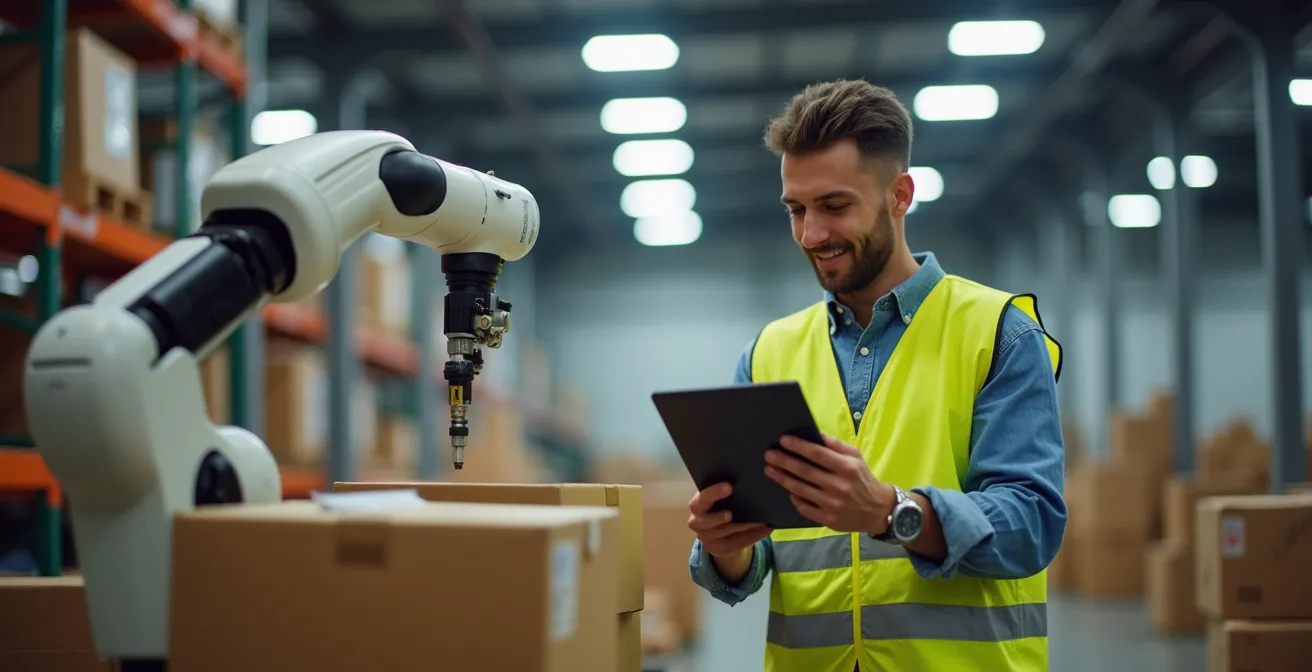
Solving the warehouse labor crisis isn’t about replacing people; it’s about redesigning your operation to mitigate systemic risks that high turnover creates.
- Automation justifies itself not just by volume, but by its ability to reduce costly errors, improve safety, and prevent catastrophic downtime.
- Modern collaborative robots (cobots) and Autonomous Mobile Robots (AMRs) offer flexible, scalable solutions that can be deployed in weeks and deliver ROI in under 18 months.
Recommendation: Shift your evaluation framework from a simple headcount replacement cost to a comprehensive risk assessment of your current manual operations.
For logistics managers and supply chain directors, the phrase “labor shortage” is more than a headline; it’s a daily operational reality. The constant cycle of hiring, training, and losing staff creates instability that ripples through the entire supply chain. The common response is to see automation simply as a way to plug these gaps, a one-to-one replacement for missing headcount. This view, however, is dangerously shortsighted and misses the true strategic value of robotics.
The persistent challenge isn’t just finding people, but retaining them in demanding, repetitive roles. This leads to a state of perpetual crisis management, where resources are spent on recruitment rather than optimization. The real problem isn’t the empty slot on the warehouse floor; it’s the systemic risk that this instability introduces: inconsistent quality, safety hazards, and an inability to scale for peak demand. The conversation must evolve beyond simply replacing labor.
But what if the true power of robotics lies not in its ability to mimic human hands, but in its capacity to build a foundation of operational resilience? This article reframes the role of warehouse automation. We will move beyond the platitude of “robots increase efficiency” to explore how they fundamentally solve the core issues exacerbated by the labor crisis: safety risks, hidden skill gaps, financial unpredictability, and crippling equipment downtime. We will analyze how to justify the investment, what technology to choose, and how to integrate it for maximum strategic impact.
To navigate this strategic shift, this article breaks down the key decision points and operational benefits of integrating robotics. The following sections provide a clear roadmap for logistics leaders to build a robust business case for automation, moving from immediate problem-solving to long-term resilience.
Summary: How Warehouse Robotics Is Solving the Labor Shortage Crisis
- Why Cobots Are Safer Than Traditional Industrial Arms?
- How Long Does It Take for a Packing Robot to Pay for Itself?
- The “Hidden” Skill Gap That Stalls Robotic Integration Projects
- AGVs vs Conveyors: Which Moves Materials Cheaper in Small Warehouses?
- When Is Your Production Volume High Enough to Justify Robotics?
- Why Waiting for Equipment Failure Costs 10x More Than Sensors?
- How to Vette a Freight Forwarder to Avoid Hidden Fees?
- How Industrial IoT Is Preventing Million-Dollar Production Stoppages?
Why Cobots Are Safer Than Traditional Industrial Arms?
The image of industrial robots is often one of powerful, fast-moving arms operating within heavy-duty safety cages. For a warehouse environment where humans and machines must coexist, this model is a non-starter. This is where collaborative robots, or “cobots,” fundamentally change the safety equation. Unlike their traditional counterparts, cobots are designed from the ground up for direct human interaction, transforming them from a potential hazard into a reliable partner on the warehouse floor.
Their inherent safety doesn’t come from external barriers, but from integrated technology. These systems operate based on a clear hierarchy of controls designed to eliminate risks at the source. Key safety mechanisms include:
- Power and Force Limiting: The defining feature of a cobot is its ability to sense and react. Integrated sensors in the robot’s joints detect any abnormal resistance or an unexpected impact, such as contact with a person. This triggers an immediate stop or a reduction in force, preventing injury. The precise thresholds for this are guided by extensive research, with international safety standards like ISO/TS 15066 providing reference data for allowable force and pressure across different parts of the human body.
- Speed and Separation Monitoring: Cobots are spatially aware. Using advanced laser scanners, radar, or 3D vision systems, they continuously track movement within their vicinity. If a person enters a predefined safety zone, the system automatically slows down. If they get closer, it halts motion completely, only resuming once the area is clear.
This built-in safety architecture is why a significant number of cobot applications can operate without cages. Universal Robots, a pioneer in the field, notes that its patented safety system allows its cobots to work cage-free in 80% of their thousands of applications worldwide. However, it’s critical to understand that the final determination always hinges on a thorough risk assessment of the entire application, including the tooling (e.g., a sharp gripper) and the specific tasks being performed.
How Long Does It Take for a Packing Robot to Pay for Itself?
For any supply chain director, the primary question for a capital expenditure is about the return on investment (ROI). While the initial cost of robotic systems can seem substantial, the payback period is often much shorter than anticipated, especially when viewed through the lens of solving the labor crisis. The operational calculus extends far beyond simply comparing a robot’s cost to an employee’s salary. It must factor in the immense hidden costs of high turnover, including recruitment, training, and the impact of picking errors on customer satisfaction.
When these variables are included, the business case becomes compelling. The consistency and accuracy of a robotic packing system directly translate into bottom-line benefits. Robots don’t need breaks, don’t have bad days, and maintain near-perfect accuracy, which reduces costly returns and protects brand reputation. This operational stability allows for more predictable forecasting and resource planning, moving the warehouse from a reactive to a proactive model.
This paragraph introduces the concept of robotic packing precision. The image below provides a close-up view of a robotic gripper handling a package, illustrating the mechanical detail involved in achieving high levels of accuracy and consistency in a modern fulfillment center.
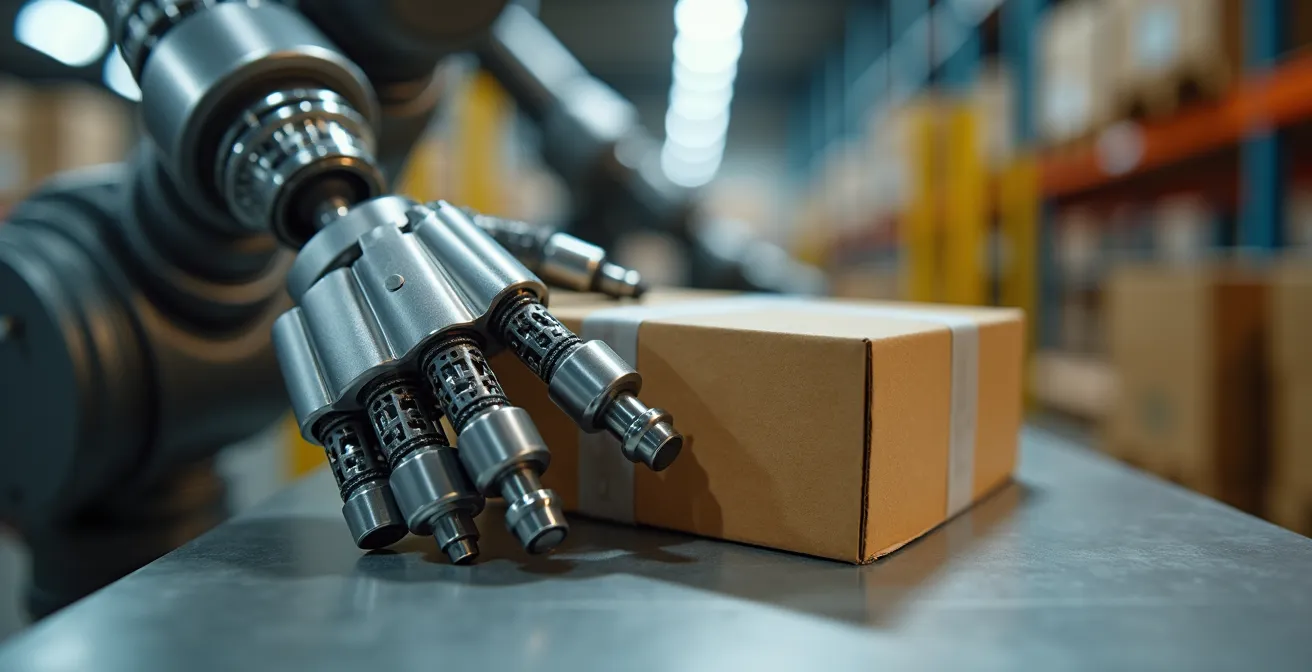
As the image demonstrates, the value lies in this repeatable precision. Because of these combined efficiencies—higher throughput, reduced errors, and lower operational overhead associated with labor churn—the financial returns are realized quickly. While every application is unique, industry data provides a reliable benchmark. Analysis of real-world implementations shows that for most warehouse automation projects, customers typically reach their ROI within six to 18 months. This rapid payback transforms the investment from a long-term goal into an immediate strategic advantage.
The “Hidden” Skill Gap That Stalls Robotic Integration Projects
The common fear surrounding automation is job displacement. However, the reality on the warehouse floor reveals a different, more pressing issue: the labor crisis is not just a shortage of bodies, but a chronic deficit of stable, engaged employees. The manual, physically demanding nature of many warehouse tasks leads to staggering turnover. Some operations report an average turnover of 100 percent of their team every six months. This isn’t a skill gap; it’s a retention catastrophe that makes consistent operation impossible.
Robotics directly addresses this by absorbing the most monotonous and physically taxing tasks—the very jobs with the highest turnover rates. This doesn’t eliminate the workforce; it transforms its role. The “hidden” skill gap that emerges during integration is not a lack of workers, but a need to upskill the existing team to manage, maintain, and collaborate with their new robotic counterparts. This shift from manual labor to technology-centric roles creates a powerful new dynamic.
Instead of packing boxes, employees become robot technicians, process supervisors, and exception handlers. These roles are more engaging, less physically strenuous, and offer a clear path for career advancement. The result is a dramatic improvement in employee morale and retention, solving the root cause of the labor instability.
Case Study: Upskilling for Retention
One company facing extreme turnover introduced robotics and focused on reskilling its workforce. Former pickers and packers were trained for new, higher-value positions. Some became robot mechanics, responsible for keeping the automated systems running at peak performance. Others took on lead roles in exception handling, managing the process for packages that required special attention. The company found that with these new skill sets, retention drastically improved. Employees took pride in the systems they operated, fostering a sense of ownership and partnership with the technology.
This demonstrates that the true solution to the labor crisis is not just automation, but a strategy of human-machine teaming. By investing in both technology and training, companies can create a more stable, skilled, and motivated workforce, turning a chronic operational weakness into a sustainable competitive advantage.
AGVs vs Conveyors: Which Moves Materials Cheaper in Small Warehouses?
Once the decision to automate material movement is made, the next question is “how?” For decades, conveyors have been the go-to solution, but their rigid infrastructure presents significant challenges, especially for small to medium-sized warehouses. They require a high upfront investment, and their fixed layout makes it difficult and expensive to adapt to changing product lines or workflows. In an environment where agility is key, being locked into a static system is a major liability.
This is where modern mobile robotics, particularly Autonomous Mobile Robots (AMRs), offer a superior alternative. Unlike traditional Automated Guided Vehicles (AGVs) that follow fixed magnetic strips or wires, AMRs use advanced sensors and AI to navigate dynamically. They can understand their environment, avoid obstacles, and calculate the most efficient route on the fly. This intelligence makes them incredibly flexible.
The image below shows an AMR navigating an open warehouse floor. Its compact form and independent movement illustrate the flexibility that differentiates it from the fixed infrastructure of a conveyor system, allowing it to adapt to the dynamic needs of a modern logistics operation.
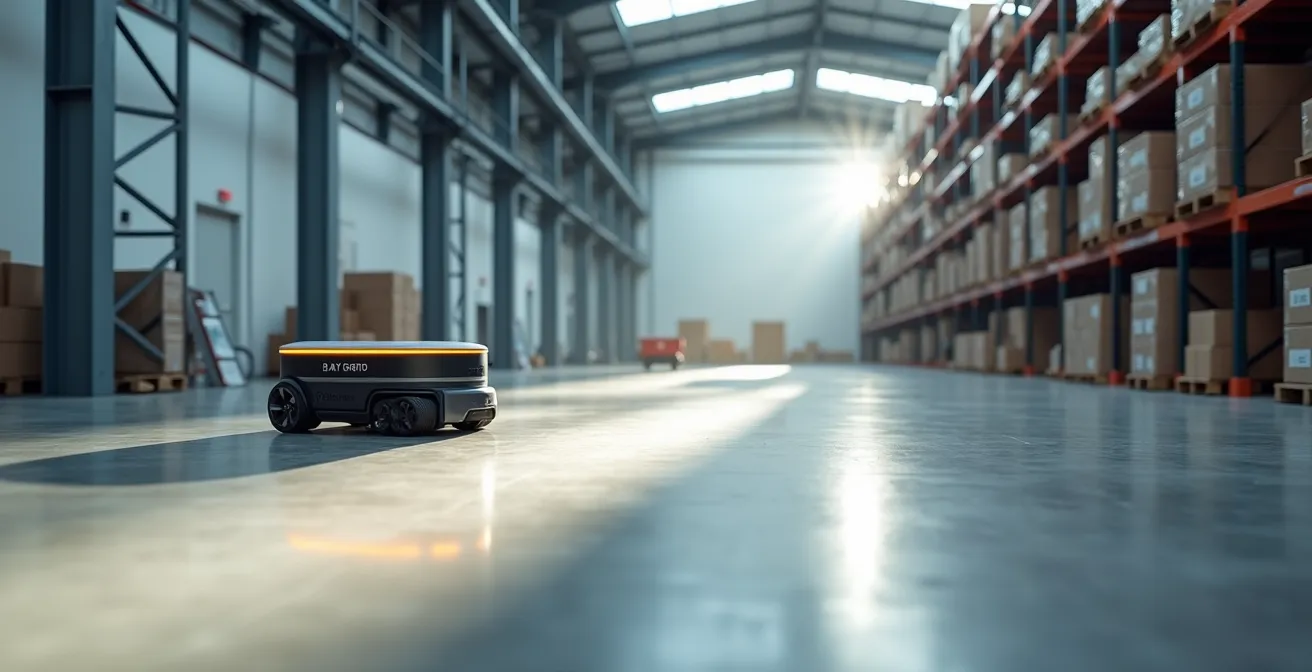
This flexibility translates directly into cost-effectiveness for smaller operations. AMRs work collaboratively with human employees, handling the repetitive and physically demanding task of transporting goods, freeing up staff for higher-value activities like picking and packing. Furthermore, the deployment timeline is a fraction of what’s required for conveyors. Market analysis confirms that modern AMRs can be deployed in weeks, not quarters, minimizing disruption and accelerating the time-to-value.
The following table summarizes the key differences, highlighting why AMRs often present a more strategic choice for agile warehouse environments.
| Technology | Flexibility | Initial Cost | Scalability |
|---|---|---|---|
| Conveyors | Fixed layout | High upfront | Limited |
| AGVs | Fixed paths | Moderate | Gradual expansion possible |
| AMRs | Dynamic navigation, works with humans | Lower with RaaS | Easily scalable with Robots-as-a-Service (RaaS) models |
When Is Your Production Volume High Enough to Justify Robotics?
A common misconception is that robotic automation is only viable for massive operations with huge, predictable production volumes. This leads many smaller or more variable businesses to dismiss the possibility, assuming they don’t have the scale to generate a positive ROI. However, this thinking is anchored in an outdated view of automation. The modern driver for robotics is less about pure volume and more about mitigating the strategic risks posed by an unstable labor market.
In fact, when warehouse operators are asked about their primary motivation for automating, the answer isn’t always throughput. Recent market intelligence reveals that more than half of operators cite unfilled headcount as the top catalyst. This shows that the decision is increasingly driven by the need for operational stability, not just scale. The inability to staff a second shift, the rising costs of recruitment, or the high error rates from an inexperienced workforce are all powerful financial triggers for automation.
The justification for robotics should therefore be based on a broader set of operational pain points, not just order volume. These non-volume-based triggers often present a more compelling business case:
- High Employee Turnover: When annual turnover exceeds 40%, the constant costs of hiring and training can outweigh the investment in automation.
- Costly Picking Errors: If error rates are leading to customer churn or expensive reverse logistics, the near-perfect accuracy of robots provides a direct and measurable return.
- Inability to Scale: If your operation struggles to handle peak season demands without hiring a large, temporary, and often inefficient workforce, robotics offers on-demand scalability.
- Workplace Safety Incidents: Rising incident rates tied to manual, repetitive tasks can be a powerful justification, with automation mitigating both human and financial risk.
- Strategic Goals: The need to meet customer expectations for next-day or same-day delivery can be impossible to achieve consistently with a manual workforce, making automation a strategic necessity.
Action Plan: Your 5-Point Automation Readiness Audit
- Map Your Bottlenecks: Identify all manual tasks where labor instability (turnover, training time) directly impacts throughput or quality. Quantify the cost of these bottlenecks per quarter.
- Collect Error-Rate Data: Inventory all costs associated with manual errors—returns, customer service hours, and lost customers. Compare this to the 99%+ accuracy rate of robotic systems.
- Analyze Peak Season Strain: Document the premium paid for temporary labor, overtime, and the efficiency drop during peak seasons. Model how a scalable robotic fleet would handle the same volume.
- Review Safety and Ergonomics: List all tasks with high rates of repetitive strain or safety incidents. Assign a cost to each incident (lost time, insurance premium hikes).
- Assess Strategic Gaps: Identify strategic goals (e.g., 24-hour fulfillment, product customization) that are currently unachievable due to labor constraints. Place a value on the market opportunity being missed.
Why Waiting for Equipment Failure Costs 10x More Than Sensors?
In a manual warehouse, operational flow is dictated by the availability of labor. In an automated warehouse, it’s dictated by the uptime of your equipment. A single critical failure—a malfunctioning sorter, a seized conveyor motor, a downed robotic arm—can bring the entire operation to a standstill. The traditional “run-to-failure” maintenance model, where repairs are only made after a breakdown, is a catastrophic liability in this environment. The cost of unplanned downtime is not just the price of the repair; it’s the lost revenue from every order that isn’t fulfilled.
The financial impact is staggering. While figures vary by industry, studies have shown that the average large manufacturing plant loses $253 million per year due to unplanned downtime. This illustrates the immense scale of the risk. Shifting to a predictive maintenance model, powered by sensors and the Industrial Internet of Things (IIoT), is not an optional upgrade; it’s a core component of operational resilience. By placing sensors on critical equipment, you can monitor variables like temperature, vibration, and power consumption in real-time.
This data feeds into an analytics platform that uses machine learning to detect subtle anomalies that precede a failure. Instead of an emergency shutdown, you get an alert: “Motor B is showing a vibration pattern that indicates a 90% probability of bearing failure within the next 72 hours.” This allows you to schedule maintenance during a planned slow period, avoiding a costly stoppage during peak hours. The ROI on this approach is well-documented. According to research by McKinsey, predictive maintenance can reduce machine downtime by 30-50% and extend the lifespan of equipment by 20-40%.
This proactive approach fundamentally changes the risk profile of the warehouse. It transforms maintenance from a reactive cost center into a strategic tool for guaranteeing throughput and protecting revenue. In an automated facility, the cost of a sensor is negligible compared to the cost of a single hour of lost production.
How to Vette a Freight Forwarder to Avoid Hidden Fees?
Automating the inside of your warehouse creates a powerful, high-speed fulfillment engine. However, if this engine is connected to an inefficient, manual logistics network, you simply move the bottleneck from your picking aisles to your loading dock. The massive gains in speed and accuracy achieved through robotics can be completely erased by a freight partner who can’t keep up. Hidden fees often arise from data discrepancies—for example, when a carrier’s manual measurement of a pallet’s dimensions and weight differs from your own.
When you automate, you gain the ability to capture precise, real-time data for every single parcel and shipment. Vetting a freight forwarder is no longer just about rates; it’s about their technological capability to integrate with your automated systems. A modern, tech-enabled forwarder can consume this data via an API, eliminating the manual checks and data entry that lead to disputes and surprise charges. Their system and yours should speak the same language, ensuring seamless data flow from the moment an order is picked to the moment it’s loaded onto a truck.
To ensure a potential partner can match your new operational velocity and data accuracy, your vetting process must include a new set of technology-focused questions. The conversation must shift from “What’s your rate?” to “How does your system integrate?”
- API Integration: Can your platform integrate directly with our Warehouse Management System (WMS) and robotics software via API?
- Real-Time Data Exchange: Do you support real-time exchange of precise weight and dimensional (DIM) data to eliminate manual measurement and billing disputes?
- Automation Protocols: What standard automation protocols do you support (e.g., MQTT, OPC UA) for machine-to-machine communication?
- Automated Documentation: How does your system handle the automated generation of booking requests, bills of lading, and customs documentation based on the data we provide?
- Speed and Capacity Matching: Can you provide evidence that your network can handle the increased outbound velocity and volume from our robotic operations without creating a backlog?
Choosing a partner who can answer these questions affirmatively ensures that your investment in internal automation translates into end-to-end supply chain efficiency, rather than just a faster-moving bottleneck.
Key Takeaways
- The true cost of labor shortages lies in systemic risks like high turnover and operational instability, not just unfilled positions.
- Robotics ROI is achieved quickly (often 6-18 months) by reducing errors, increasing throughput, and stabilizing operations.
- Justification for automation should be based on a wide range of triggers, including safety, scalability, and error rates—not just production volume.
How Industrial IoT Is Preventing Million-Dollar Production Stoppages?
The concepts of predictive maintenance and systems integration are individual pillars of a much larger strategic evolution: the creation of a fully connected, intelligent warehouse powered by the Industrial Internet of Things (IIoT). In this model, every asset—from a robotic arm and an AMR to a conveyor belt and an HVAC unit—is equipped with sensors that feed data into a central platform. This creates a complete, real-time digital replica of the entire operation, often called a digital twin.
This is where the paradigm truly shifts from reactive problem-solving to proactive optimization. A digital twin allows managers to not only see what’s happening in the moment but also to simulate future scenarios. What happens to our throughput if we add five more AMRs? How will a 20% increase in order volume affect conveyor load? Where will bottlenecks form during our peak season? These questions can be answered in the virtual model before a single piece of physical equipment is moved or a single dollar is spent.
The most powerful application of this technology is the prevention of catastrophic stoppages. By feeding sensor data from every machine into a cloud-based AI model, the system can predict and prevent failures on a massive scale. This moves beyond single-machine predictive maintenance to holistic operational orchestration. For instance, the system might detect that a critical sorting machine is likely to fail in 48 hours and automatically begin rerouting product flow to other lines, all while scheduling maintenance—completely avoiding a million-dollar production stoppage.
This is not science fiction; it is being implemented today. GE’s “Digital Wind Farm” project, for example, uses a digital twin for each turbine, feeding sensor data into a cloud model that suggests performance tweaks. The result is a significant boost in energy output, translating to massive revenue gains. In a warehouse context, one packaging manufacturer saw its Overall Equipment Effectiveness (OEE) rise by 9% and avoided $25 million in capital costs by using IIoT for predictive maintenance. This is the ultimate form of operational resilience: a system that not only anticipates failure but intelligently adapts to prevent it.
By reframing the labor shortage as a catalyst for strategic investment in operational resilience, logistics leaders can transform a chronic crisis into a competitive advantage. The next step is to begin evaluating your own operation through this new lens of systemic risk and technological opportunity.