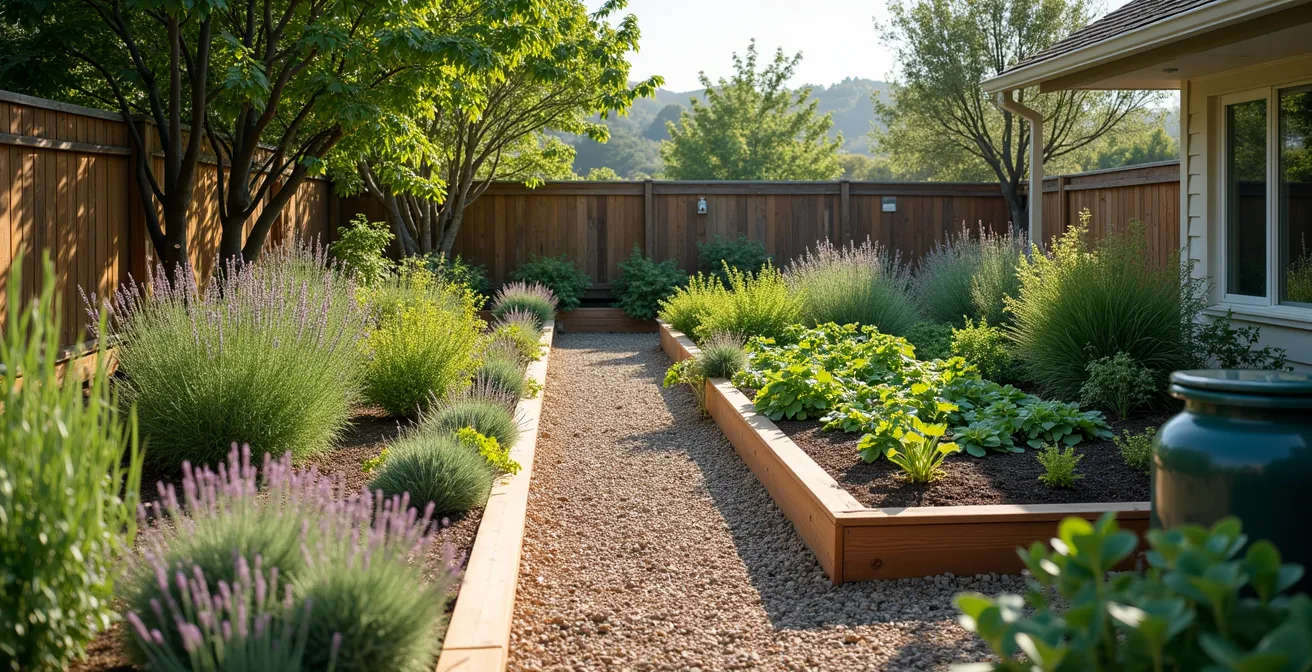
The secret to a lush, low-water garden isn’t just choosing the right plants; it’s designing the right spaces.
- By treating your yard as a mosaic of microclimates, you can group plants by their exact needs for water, sun, and shelter.
- Strategic use of structures like walls, hedges, and raised beds actively shapes these microclimates to conserve resources.
Recommendation: Start by mapping the sun and shade patterns in one small section of your yard for a full day. This simple observation is the first step toward thinking like a landscape designer.
For homeowners in drought-prone regions, the garden can be a source of constant frustration. You follow the advice, you water diligently, yet you watch your plants struggle through heatwaves while your water bill climbs. It’s a cycle of waste and disappointment that leaves many wondering if a beautiful, thriving garden is even possible without excessive water use. The common solutions—mulching, watering at dawn, picking drought-tolerant species—are all valuable pieces of the puzzle, but they often miss the bigger picture.
These tactics treat the garden as a uniform space, applying a single strategy across an entire yard. But what if the problem isn’t your watering schedule or plant choice, but the very layout of your garden? The most profound shift in creating an efficient, resilient landscape comes from a change in perspective. Instead of seeing your yard as one entity, you must learn to see it as a dynamic system of interconnected microclimates. This is the core of permaculture design: working with nature’s patterns, not against them.
This approach, which we can call microclimate architecture, moves beyond simple hydrozoning. It’s about consciously designing small, specific environments by observing and manipulating the natural flows of sun, water, and wind. By understanding these forces, you can create pockets of humidity, sheltered corners, and heat sinks that allow a wider variety of plants to thrive with significantly less intervention. This article will guide you through the principles of designing these zones, transforming your garden from a water-intensive liability into a self-sustaining ecosystem.
To help you master this design-led approach, this guide breaks down the essential strategies for creating an efficient, zoned garden. From grouping plants to harnessing thermal energy, each section provides a key piece of the microclimate puzzle.
Contents: Designing Your Water-Wise Garden Ecosystem
- Grouping Thirsty Plants: The Layout Trick That Saves Hours of Watering
- How to Map Your Garden’s Light Before Planting a Single Seed?
- Hedges vs Fences: Which Protects Delicate Plants Better from Wind?
- Why You Should Never Plant Tomatoes Next to Potatoes?
- Thermal Mass: How to Grow Figs Against a Brick Wall in Cool Climates?
- Wood vs Metal Raised Beds: Which Lasts Longer in Wet Climates?
- Can White Walls Really Double Your Tomato Yield in Shade?
- Why Native Plants Survive Heatwaves When Exotics Die?
Grouping Thirsty Plants: The Layout Trick That Saves Hours of Watering
The foundational principle of a water-wise garden is hydrozoning—the practice of grouping plants with similar water needs together. This is the first step in microclimate architecture. Instead of broadcasting water uniformly across a diverse landscape, you create logical, water-based zones. A thirsty lawn area receives different irrigation from a bed of native, drought-tolerant perennials. This simple act of organization prevents the chronic overwatering of some plants and underwatering of others, which is a massive source of plant stress and water waste. The efficiency gains are significant; studies show that hydrozoning can result in water savings of between 30% to 80%, depending on the garden’s original inefficiency.
Implementing this requires seeing your garden not as a collection of individual plants, but as a series of communities. The practical application of this concept can be seen in a real-world garden transformation.
Case Study: From Uniform Watering to Smart Zoning
A homeowner’s garden was initially watered by a single controller, leading to a soggy lawn and wilting vegetables. By redesigning the space into four distinct hydrozones—a lawn zone, a daily-drip vegetable zone, a twice-weekly shrub zone, and a minimal-water native plant zone—the results were transformative. The implementation of zone-specific irrigation led to a nearly 30% reduction in water consumption. More importantly, every plant community thrived, as each received the precise amount of moisture it needed. The lawn was lush without being waterlogged, and vegetables grew healthier with a consistent, targeted water supply.
Action Plan: Your 5 Steps to Create Effective Hydrozones
- Map Your Space: Create an accurate map of your garden. Draw circles around existing plants that have similar water needs (e.g., ferns and hostas vs. lavender and rosemary).
- Identify Natural Zones: Look for existing, well-zoned areas. A low-lying spot that collects moisture is a natural zone for water-loving plants.
- Group by Plant Type: Create macro-zones for distinct plant types. Treat your lawn as one high-water zone, perennial beds as a medium-water zone, and shrub borders as another.
- Define Irrigation Levels: Categorize your zones into four levels: routine irrigation (vegetables, annuals), reduced irrigation (established perennials), limited irrigation (drought-tolerant shrubs), and no routine irrigation (native plants).
- Install Zone-Specific Irrigation: If possible, set up your irrigation system with separate valves for each zone. This allows you to deliver customized watering schedules automatically, maximizing efficiency.
How to Map Your Garden’s Light Before Planting a Single Seed?
After water, the most critical energy flow to understand in your garden is sunlight. The amount and intensity of light an area receives dictates which plants can grow there and how much water they will need. A south-facing wall that bakes in the afternoon sun creates a completely different microclimate than the cool, dappled shade under a mature tree. Mapping these patterns of light and shadow is a non-negotiable step for any serious garden designer. It allows you to place sun-loving herbs where they will thrive and protect delicate, shade-preferring plants from scorching. Ignoring this step is a recipe for failure, leading to leggy, weak plants in the shade and burnt, stressed plants in the sun.
Observing the sun’s path across your yard throughout the day and across the seasons reveals the true nature of your space. The shadows cast by your house, trees, and fences are not problems to be solved but defining features of your garden’s microclimate architecture. Visualizing this is key.
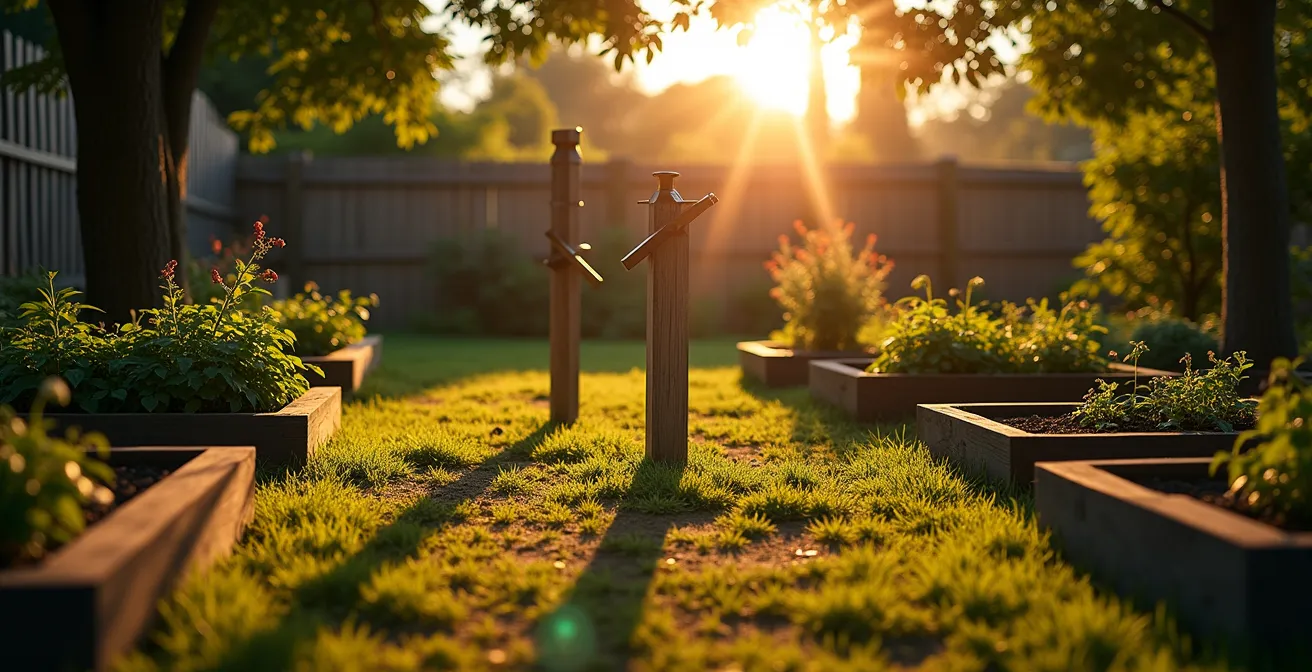
As the image illustrates, a garden is a dynamic tapestry of light and shade that changes by the hour. Understanding these patterns allows you to choose the right plant for the right place, a core tenet of ecological design. Fortunately, mapping your garden’s light can be as simple or as technical as you wish, with several methods available to suit any budget or skill level.
The following table outlines some of the most common methods for tracking solar exposure, helping you choose the best approach for your specific needs.
| Method | Cost | Accuracy | Time Required | Best For |
|---|---|---|---|---|
| Sundial Stake Method | $0-10 | Moderate | Full day observation | Small gardens |
| Manual Shadow Tracking | $0 | Basic | Multiple days | Budget gardeners |
| Smartphone AR Apps | $5-20 | High | Minutes | Tech-savvy gardeners |
| Professional Light Meters | $50-200 | Very High | Hours | Large landscapes |
Hedges vs Fences: Which Protects Delicate Plants Better from Wind?
Wind is the invisible force that shapes your garden’s microclimates. It accelerates evaporation from soil and leaves (a process called transpiration), can physically damage plants, and lowers ambient temperature. Managing this energy flow is crucial for water conservation and plant health. The most common tools for this are fences and hedges, but they behave in fundamentally different ways. A solid barrier, like a wooden fence, seems like the obvious choice for blocking wind, but it often creates more problems than it solves. When wind hits a solid wall, it doesn’t just stop; it goes up and over, creating intense turbulence and eddies on the leeward side. This can result in a smaller, more chaotic zone of protection that can be surprisingly harsh for delicate plants.
A living hedge, by contrast, acts as a permeable filter. Instead of blocking the wind, it slows it down. The intricate network of branches and leaves allows some air to pass through, reducing the wind’s velocity gently and over a much larger area. This creates a calm, sheltered zone that can extend for a distance of up to ten times the hedge’s height. This protected pocket has lower evaporation rates, more stable temperatures, and provides a perfect sanctuary for plants that would otherwise be battered by the elements.
Choosing a hedge over a fence is an example of “system stacking,” a permaculture principle where one element performs multiple functions. A fence is only a barrier. A hedge is a windbreak, a visual screen, a source of habitat and food for wildlife, and a beautiful living element in your garden. It is an active participant in your garden’s microclimate architecture, not just a static boundary.
Why You Should Never Plant Tomatoes Next to Potatoes?
Beyond the large-scale forces of sun and wind, the relationships between plants themselves create tiny, yet powerful, microclimates. This is the world of companion planting, but we can elevate this concept by thinking in terms of “ecological guilds”—communities of plants that work together, or against each other. Planting the right things together can deter pests, attract beneficial insects, and improve soil health. Conversely, planting the wrong things together can lead to competition, stunted growth, and the rapid spread of disease. Understanding these relationships is key to designing a resilient and productive garden.
The classic negative example is planting tomatoes and potatoes side-by-side. Both are members of the nightshade family (Solanaceae) and have similar needs, making them direct competitors for the same soil nutrients. More critically, they are susceptible to the same devastating diseases, most notably early and late blight. Planting them in proximity creates a “disease bridge,” allowing fungal spores to easily spread from one crop to the other, potentially wiping out both. This is a perfect example of a negative guild, where the close relationship is detrimental.
In contrast, a positive guild creates a supportive micro-ecosystem. For instance, planting basil near tomatoes is a well-known strategy. The strong aroma of basil is thought to repel the tomato hornworm moth, protecting the tomato fruit. Similarly, planting garlic between rows of potatoes can help deter aphids and other pests. These are not just old wives’ tales; they are small-scale examples of creating a balanced ecosystem where plants serve multiple functions—a core principle of permaculture and effective garden zoning.
Thermal Mass: How to Grow Figs Against a Brick Wall in Cool Climates?
One of the most powerful tools in a designer’s arsenal is the ability to manipulate temperature. By using materials with high thermal mass, you can create “thermal banks” that store the sun’s heat and slowly release it, creating warmer microclimates that can extend your growing season or even allow you to grow plants outside their normal hardiness zone. Thermal mass refers to the ability of a material to absorb, store, and radiate heat energy. Dense materials like stone, brick, concrete, and even large bodies of water are excellent at this.
The classic example of this is a south-facing brick wall. Throughout the day, the dark, dense brick absorbs immense amounts of solar energy. As evening falls and the air temperature drops, the wall begins to radiate this stored heat back into its immediate surroundings. This creates a bubble of warmth that can keep the ambient temperature several degrees higher than the rest of the garden overnight, protecting tender plants like figs or citrus from a light frost. This “thermal banking” effectively creates a microclimate that mimics a warmer growing zone.
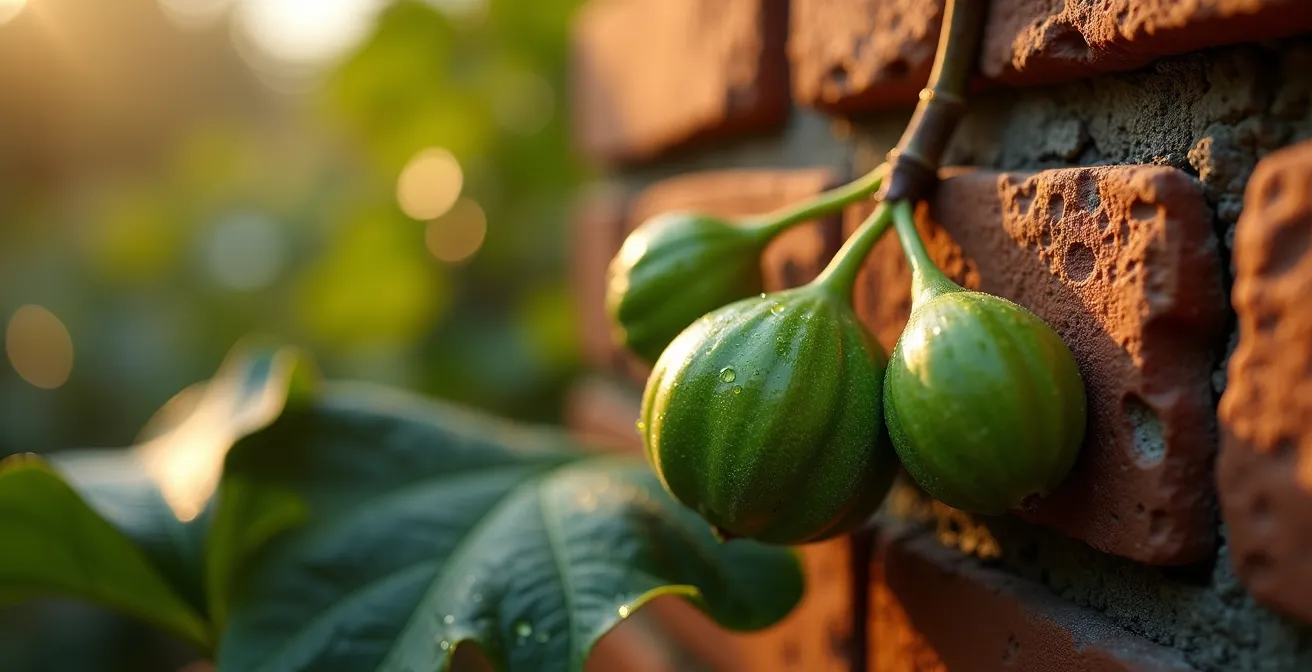
As shown in the close-up, the heat radiating from a sun-warmed wall creates a unique environment right at its surface. This is microclimate architecture at its most tactical. By espaliering a fig tree against this wall, you are giving it the extra warmth it needs to ripen its fruit in a climate it would otherwise struggle in. This same principle can be applied with stone pathways, rock retaining walls, or even large, dark-colored containers, all of which can be strategically placed to create pockets of warmth throughout your garden landscape.
Wood vs Metal Raised Beds: Which Lasts Longer in Wet Climates?
Raised beds are a popular solution for gardeners dealing with poor soil or drainage issues. However, the material you choose for your raised beds has a significant impact on the microclimate within them, particularly concerning soil temperature and water retention. While durability is a major consideration, especially in wet climates where rot is a concern, a permaculture designer also evaluates the choice based on its thermal properties. The two most common materials, wood and metal, have nearly opposite effects on the internal environment of the bed.
Wood is a natural insulator. It heats up slowly and cools down slowly, which means it helps maintain a more stable soil temperature. This buffering effect protects plant roots from extreme temperature swings, both from midday heat and overnight cold. Critically for water conservation, this insulation also means less moisture is lost to evaporation. Metal, particularly dark-colored galvanized steel, is a conductor. It heats up very quickly in direct sun, which can cook the soil near the edges of the bed and dramatically increase the rate of water evaporation. While metal beds may last longer, they often require more frequent watering to compensate for this heating effect.
As a comparative analysis from North Carolina State Extension highlights, the material choice has direct consequences for water management and plant health.
The following table, based on data from an NC State Extension analysis on smart watering, breaks down the key differences.
| Feature | Wood Beds | Metal Beds |
|---|---|---|
| Thermal Properties | Insulating – maintains stable soil temp | Heat-conducting – soil temp fluctuates |
| Water Evaporation Rate | Lower – insulation reduces evaporation | Higher – heat increases evaporation |
| Durability in Wet Climates | 5-10 years (cedar/redwood) | 20+ years (galvanized steel) |
| Water Conservation Potential | Can reduce water use by up to 50% with drip irrigation | Requires additional insulation for water efficiency |
Can White Walls Really Double Your Tomato Yield in Shade?
While a south-facing wall can act as a heat source, a wall of any orientation can be transformed into a light source. This is achieved by leveraging a simple principle of physics: albedo, or the reflectivity of a surface. Dark surfaces absorb light energy and convert it to heat. Light-colored surfaces, especially white, reflect it. By painting a wall or fence white, you can effectively create a giant reflector that bounces sunlight into adjacent shady areas, fundamentally altering the microclimate. This can be a game-changing strategy for gardens with limited sun exposure or for gardeners trying to maximize production in tight urban spaces.
For sun-loving plants like tomatoes, which typically require 6-8 hours of direct sunlight to produce well, a shady spot is usually a non-starter. However, by planting them near a white wall, you can significantly increase the total amount of light they receive throughout the day. The reflected, or diffuse, light may not be as intense as direct sunlight, but it can be enough to boost photosynthesis and trigger fruiting. In some cases, this simple trick can make the difference between a meager harvest and a bountiful one, effectively “doubling” the usable light in that specific zone.
This strategy is the epitome of smart, efficient design. Instead of trying to fight against a shady spot, you are augmenting the available energy flow. This kind of efficiency is critical when you consider that, according to experts, as much as 50 percent of the water used for irrigation is wasted due to inefficiency. By making the most of natural light, you enable plants to be more productive, reducing the need to compensate for poor conditions with extra resources like water and fertilizer.
Key Takeaways
- Garden zoning is not just about plant choice; it’s a design strategy that manages the flow of sun, water, and wind.
- Microclimates are created by physical elements: hedges filter wind differently than fences, and walls can be used to store heat or reflect light.
- The relationships between plants (guilds) and the materials you choose (raised beds) are active components of your garden’s ecosystem and water efficiency.
Why Native Plants Survive Heatwaves When Exotics Die?
The final and perhaps most important layer of microclimate architecture is choosing plants that are already perfectly adapted to your macroclimate. Native plants are the species that have evolved over thousands of years to thrive in your region’s specific soil, rainfall patterns, and temperature extremes. While an exotic plant from a different continent might need constant life support in the form of extra water and fertilizer, a native plant is already home. It possesses the genetic toolkit to survive your local conditions, including heatwaves and droughts.
These adaptations are remarkable. Many native plants have incredibly deep root systems that can access moisture far below the surface, long after the topsoil has dried out. Others have leaves coated in fine hairs or a waxy cuticle to reduce water loss through transpiration. Some can even enter a state of dormancy during the hottest, driest parts of the year, conserving their energy until conditions improve. This is why, during a brutal heatwave, you will often see lawns and exotic ornamentals turn brown and die, while the native plants in a nearby meadow or woodland remain resilient.
Incorporating native plants is the ultimate water-saving strategy. Once established, they generally require little to no supplemental watering, fertilizer, or pesticides. By dedicating zones of your garden to native species, you are creating self-sustaining ecosystems that also provide critical food and habitat for local pollinators and wildlife. The impact on water consumption can be dramatic; studies have shown that replacing lawns with diverse garden plantings reduces water consumption by up to 60%. This is because you are working in harmony with your environment, not in a constant battle against it.
By starting to see your garden as a system of systems—a dynamic mosaic of light, water, and life—you move from being a mere caretaker to a true designer. Begin today by choosing one small area and observing its unique character. This is the first step to creating a beautiful, abundant, and water-wise landscape.