
Contrary to popular belief, mastering your energy isn’t about memorizing your “animal” chronotype, but about actively managing the biological levers that control your internal clock.
- Light exposure is the most powerful signal that sets your body’s clock for the entire day, influencing everything from alertness to nightly sleep quality.
- The timing of caffeine and meals are not just about energy and calories; they directly interact with your hormonal cascade, impacting your metabolic health and ability to enter deep sleep.
Recommendation: Stop trying to fit a generic schedule and start aligning your key daily activities—light, food, and activity—with your personal biology.
That familiar wall of fatigue hits you in the afternoon, or the Monday morning fog feels impenetrable despite a weekend of “rest.” You’ve slept eight hours, you’ve tried the generic productivity hacks, and maybe you’ve even taken a quiz that labeled you a “Lion,” “Bear,” “Wolf,” or “Dolphin.” While identifying your chronotype is a helpful first step, it often stops there, leaving you with a label but no real strategy. The common advice to “work during your energy peaks” is true, but it misses the fundamental point.
The real power doesn’t come from passively knowing your chronotype; it comes from actively understanding and manipulating the biological mechanisms that govern it. Your body’s internal clock, or circadian rhythm, isn’t a fixed program. It’s a dynamic system that responds to powerful environmental cues. The secret to sustained energy and restorative sleep isn’t just about scheduling tasks; it’s about timing these cues—light, temperature, food, and activity—to anchor your rhythm correctly.
But what if the true key to unlocking your potential wasn’t just working *with* your biology, but learning to *speak its language*? What if you could strategically use these levers to sharpen your focus, deepen your sleep, and eliminate that feeling of being perpetually out of sync? This isn’t about a rigid set of rules for four animal types; it’s about mastering the universal principles of chronobiology.
This guide will deconstruct the science behind your daily rhythm. We will move beyond the labels to explore the core biological levers you can pull, from the timing of your morning coffee to the temperature of your bedroom, to finally structure a day that is truly aligned with your unique internal clock.
This article provides a detailed roadmap for understanding and optimizing your daily schedule based on your biological rhythms. Below, the summary outlines the key pillars we will explore, from a biological perspective on the afternoon slump to the critical role of temperature in sleep quality.
Summary: Mastering Your Day by Understanding Your Biology
- The 2 PM Crash: Is It Sugar or Biology?
- Intermittent Fasting vs Breakfast: Which Suits Early Risers?
- Morning Sun: Why Viewing Light in the First hour Changes Your Night?
- Coffee Half-Life: Why Your Noon Espresso Affects Your Deep Sleep?
- Social Jetlag: Why Sleeping In on Saturday Makes Monday Harder?
- Why Your Morning Routine Should Start the Night Before?
- 65 Degrees: Why Your Room Is Too Hot for Deep Sleep?
- Why You Wake Up Tired Even After 8 Hours of Sleep?
The 2 PM Crash: Is It Sugar or Biology?
That sudden wave of drowsiness that hits mid-afternoon is often blamed on a heavy lunch or a blood sugar spike. While diet can be a factor, the primary culprit is biological, not behavioral. This post-lunch dip is a programmed feature of your circadian rhythm, a natural trough in alertness that occurs roughly eight hours after you wake up. For most people, this is a universal experience; according to circadian rhythm research, most people experience drowsiness between 1 PM and 3 PM. This dip is caused by a temporary decrease in your core body temperature and a lull in the circadian drive for wakefulness.
However, the intensity and exact timing of this crash are heavily influenced by your chronotype. For a Lion (early type), this dip may feel more pronounced because jejich peak cortisol and alertness happened very early in the morning. For a Wolf (late type), the dip might arrive later and feel less severe because their primary alertness phase is just beginning. Understanding this allows you to strategically manage it instead of fighting it. Instead of forcing a high-focus task during this biological low point, you can schedule less demanding activities like answering emails, going for a walk, or engaging in creative brainstorming.
This isn’t about a lack of willpower; it’s a predictable dip in your body’s 24-hour cycle. The key is to anticipate it and work around it. For instance, some chronotypes benefit from a short “power nap” (10-20 minutes) to reset, while others find that light physical activity is more effective. The goal is to bridge the energy gap without disrupting your sleep schedule later in the evening.

As the steam from a coffee cup forms unique patterns, so too does our energy fluctuate throughout the day. Recognizing your specific pattern of alertness and fatigue is the first step toward optimizing it. By planning for this natural dip, you can maintain productivity and avoid the frustration of working against your own biology. Your chronotype dictates the shape of your energy wave; your strategy is to learn how to ride it.
Intermittent Fasting vs Breakfast: Which Suits Early Risers?
The debate between intermittent fasting and a traditional breakfast often revolves around calories and weight management, but its most profound impact may be on your circadian rhythm. The concept of Metabolic Timing suggests that *when* you eat is as important as *what* you eat, and the optimal timing is deeply personal. For early risers, or “M-types,” this is especially critical. Their entire hormonal cascade, including the morning cortisol spike that promotes alertness and the evening melatonin onset that signals sleep, runs on an earlier schedule.
Research into chronobiology provides a clear mechanism for this. As noted in a study on biological rhythm and chronotype, M-types and E-types (evening chronotypes) show significant differences in their hormonal profiles. Specifically, morning types show earlier cortisol peaks, suggesting their bodies are metabolically “ready” for energy intake sooner. Forcing an M-type to skip breakfast and fast until noon means they are consuming their first meal long after their metabolic machinery has peaked, which can lead to feelings of lethargy and potential metabolic dysregulation.
Conversely, a well-timed breakfast can act as a powerful “circadian anchor,” reinforcing the body’s natural wake-up signal. The science behind this is linked to the rapid hormonal shifts in the morning. As chronotype researchers Gibertini et al. discovered:
Morning types evidence a more rapid decline in melatonin levels after the peak than do evening types
– Gibertini et al., Chronotype Research – Wikipedia
This rapid drop in the sleep hormone melatonin, combined with a sharp rise in the stress/alertness hormone cortisol, primes a Lion’s or Bear’s body for digestion and energy utilization. For them, breakfast isn’t just “the most important meal of the day”; it’s a chronobiological tool. For a Wolf, whose melatonin levels decline later, delaying the first meal might feel more natural and align better with their internal clock. The choice isn’t IF vs. breakfast, but rather aligning your eating window with your unique hormonal schedule.
Morning Sun: Why Viewing Light in the First hour Changes Your Night?
Of all the environmental cues that regulate your internal clock, none is more powerful than light. Specifically, viewing sunlight within the first 30-60 minutes of waking up acts as the master switch for your entire 24-hour cycle. This single action initiates a precise hormonal cascade that dictates your energy levels throughout the day and, crucially, determines the quality of your sleep that night. When photons from sunlight hit your retinas, they send a signal directly to the suprachiasmatic nucleus (SCN)—your body’s master clock—to suppress the production of melatonin, the sleep hormone.
This morning light exposure does more than just wake you up; it sets a timer for melatonin’s return. By signaling a definitive “start” to your day, your SCN is programmed to release melatonin approximately 14-16 hours later, paving the way for a smooth transition into sleep. Skipping this morning light, or getting it too late, leaves your clock “drifting,” causing a delay in the evening melatonin surge. This is why you might feel tired but “wired” at bedtime, unable to fall asleep despite a full day’s activity. This is known as phase-shifting; morning light shifts your clock earlier, while evening light shifts it later.
The timing and duration of light exposure should be tailored to your chronotype. A Wolf, who naturally has a later-running clock, can use 10-20 minutes of morning sunlight to help phase-shift their rhythm earlier, making it easier to wake up and feel alert in the mornings. A Lion, already an early riser, needs that light to simply reinforce and stabilize their early rhythm. The effectiveness of this is tied to a key biological marker, as research by Zavada et al. demonstrates that mid-sleep on free days correlates strongly with dim-light melatonin onset (DLMO). By managing your morning light, you are directly influencing your DLMO, and therefore, your natural sleep time.
This doesn’t require a special lamp or complex protocol. A simple walk outside, drinking your coffee by a window, or even sitting on a balcony for 10-15 minutes is enough. The goal is to get natural, unfiltered light into your eyes to send that unambiguous “day has begun” signal to your brain. It’s the most effective, free, and fundamental tool for aligning your body with a predictable daily rhythm.
Coffee Half-Life: Why Your Noon Espresso Affects Your Deep Sleep?
Many people reach for a coffee to power through the afternoon slump, assuming its effects will wear off by bedtime. However, this common habit often sabotages sleep quality, even if you don’t have trouble falling asleep. The issue lies in the two-process model of sleep regulation: the battle between your circadian drive for wakefulness and your homeostatic sleep pressure. Sleep pressure is driven by a molecule called adenosine, which builds up in your brain throughout the day, creating a stronger and stronger desire to sleep.
Caffeine works by blocking adenosine receptors. It doesn’t eliminate adenosine; it just masks its effects, making you feel alert. The problem is caffeine’s half-life, which is the time it takes for your body to eliminate 50% of the substance. For most adults, this is about 5-6 hours. This means if you drink an espresso at 12 PM, 25% of that caffeine could still be active in your system at 10 PM. While this might not be enough to prevent you from falling asleep, it’s often enough to disrupt your sleep architecture, specifically by reducing the amount of deep sleep you get in the first half of the night.
This effect is highly personalized and linked to your chronotype. Your genetic makeup plays a significant role in how quickly you metabolize caffeine. For example, the PER3 gene, which is known to influence chronotype, also seems to affect sleep-wake patterns and how we respond to substances. Individuals with certain variations of this gene, often those who are evening chronotypes (Wolves), may metabolize caffeine differently, making them more or less sensitive to its sleep-disrupting effects. A Dolphin chronotype, already prone to light, fragmented sleep, is often exquisitely sensitive to even small amounts of afternoon caffeine.
As a general rule, it’s wise to establish a “caffeine curfew” 8-10 hours before your intended bedtime. For a Bear who goes to bed at 11 PM, this means no coffee after 1-3 PM. For a Lion who sleeps at 9 PM, the cutoff should be closer to noon. This ensures that by the time your circadian drive for sleep begins, your sleep pressure is not being artificially suppressed by lingering caffeine, allowing you to access the deep, restorative stages of sleep you need to wake up feeling refreshed.
Social Jetlag: Why Sleeping In on Saturday Makes Monday Harder?
The feeling of grogginess and low energy on a Monday morning is often blamed on the return to work, but its roots are biological. The culprit is often social jetlag, a term for the misalignment between your body’s internal clock and your “social clock”—the schedule demanded by work, school, and social obligations. This is most pronounced on weekends, when you abandon your weekday alarm and sleep in according to your natural biological preference. An hour or two of extra sleep might feel restorative, but it’s actively shifting your internal clock later.
Imagine your circadian rhythm as a finely tuned orchestra. During the week, it’s forced to play on a strict schedule. On the weekend, you let the conductor (your internal clock) follow its natural tempo. For a Wolf, this might mean waking up at 10 AM instead of 7 AM. This three-hour shift is equivalent to flying from New York to Los Angeles for the weekend. When Monday morning arrives and your 7 AM alarm goes off, your body’s clock is still on “West Coast time,” and it’s essentially 4 AM. This causes profound sleep inertia, that feeling of being stuck in a mental fog.
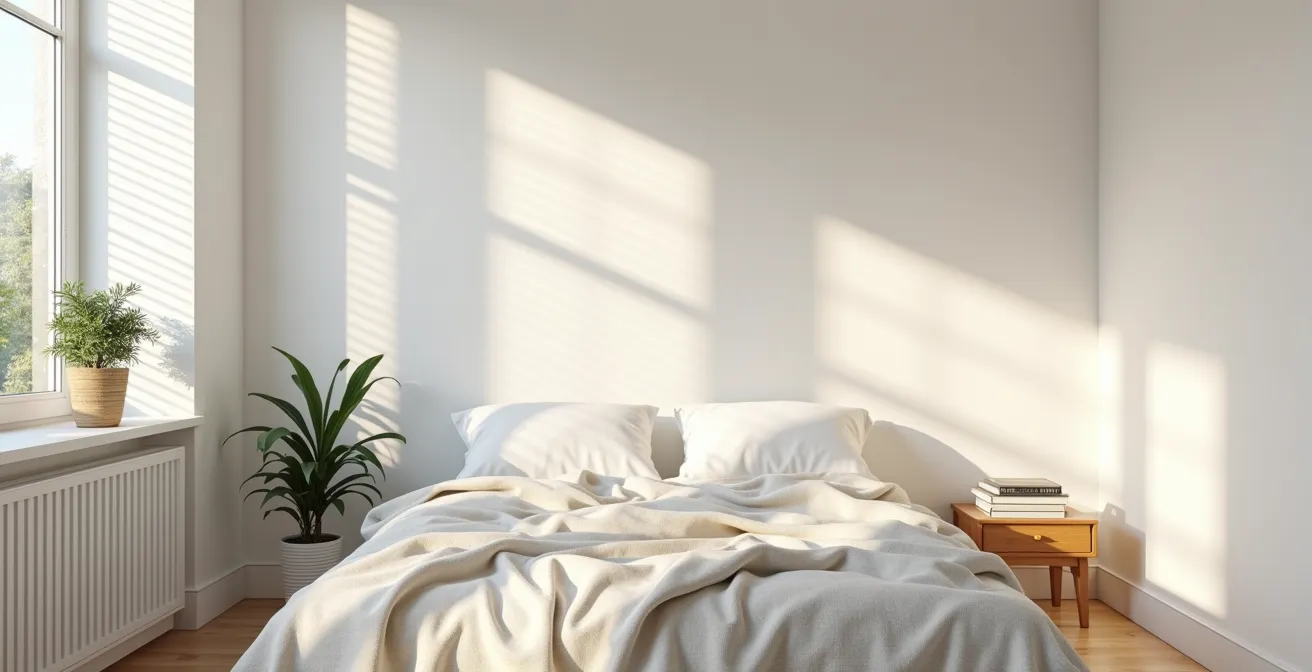
This misalignment is more than just an inconvenience; it has been linked to a host of negative health outcomes. The key to mitigating it isn’t to force a rigid 7-day-a-week alarm, but to maintain consistency in your core circadian anchors. This means your wake-up time on weekends should ideally stay within 60-90 minutes of your weekday schedule. If you’re a Wolf who needs more sleep, it’s better to go to bed earlier on Friday and Saturday (if possible) rather than sleeping in excessively late.
Furthermore, you can use other cues to anchor your clock. Regardless of when you wake up, get morning sunlight at a consistent time. This will help minimize the phase-shifting effect of sleeping in. Research has shown that our innate chronotype is a powerful predictor of sleep quality, often more so than external schedules. By minimizing the discrepancy between your biological clock and your social schedule, you can enter Monday feeling aligned and rested, rather than jetlagged.
Why Your Morning Routine Should Start the Night Before?
A successful morning doesn’t begin when your alarm goes off; it’s the result of strategic preparation the night before. This goes beyond laying out your clothes or packing your lunch. The most critical evening preparations are those that align with your biology to ensure high-quality sleep, making a smooth and energetic morning possible. Two of the most powerful levers you can pull are managing evening light and temperature, which are directly tied to your chronotype’s unique rhythm.
Your body is programmed to respond to darkness by producing melatonin. However, in the modern world, our evenings are flooded with artificial light, especially the blue-spectrum light from screens, which tricks your brain into thinking it’s still daytime. This suppresses and delays your melatonin release, pushing your natural bedtime later and leading to sleep inertia in the morning. This is especially problematic for Wolves, who are already biologically predisposed to a later schedule. An evening routine should therefore focus on creating a “dim light” environment 1-2 hours before bed. This can involve dimming smart lights, using warm-toned lamps, and, most importantly, wearing blue-light-blocking glasses if you must use screens.
Simultaneously, your body temperature must drop to initiate and maintain sleep. This process is also chronotype-dependent. Research has shown that morning types (Lions) experience their core body temperature minimum around 4 AM, while evening types (Wolves) reach theirs two hours later, around 6 AM. You can facilitate this natural temperature drop by having a warm bath or shower 90 minutes before bed. The subsequent rapid cooling of your body mimics the natural dip, signaling to your brain that it’s time for sleep. These evening rituals are not just about “relaxing”; they are about providing the correct biological signals to your internal clock.
Your Action Plan: Evening Prep by Chronotype
- Lions: Begin your wind-down routine as early as 8 PM. Focus on calming, non-stimulating activities like reading a physical book or gentle stretching to align with your early melatonin onset.
- Bears: Start dimming all lights at 9 PM. Use this time to prepare for the next day (pack your bag, choose your clothes) to reduce morning decision fatigue.
- Wolves: Use blue-light-blocking glasses after 8 PM. This allows you to remain productive or enjoy entertainment without disrupting your later melatonin surge.
- Dolphins: Implement calming rituals starting two hours before your intended bedtime. This could include meditation, journaling, or listening to calming music to quiet an overactive mind.
65 Degrees: Why Your Room Is Too Hot for Deep Sleep?
While we often focus on comfort and quiet, the temperature of your sleep environment is one of the most overlooked yet critical factors for achieving deep, restorative sleep. Your body’s core temperature naturally follows a circadian rhythm, peaking in the late afternoon and reaching its lowest point in the early morning hours. To initiate sleep, your body needs to actively cool itself down. In fact, sleep research indicates that a 1-2 degree Fahrenheit drop in core temperature triggers deep sleep. A bedroom that is too warm actively works against this essential biological process.
If your room’s ambient temperature is too high, your body struggles to offload heat, which can delay sleep onset and, more importantly, fragment your sleep architecture. It may prevent you from entering or staying in the deeper, more restorative stages of non-REM sleep. This is why you can sleep for a full eight hours in a warm room and still wake up feeling unrefreshed; you achieved sleep *quantity* but missed out on sleep *quality*.
The ideal room temperature for sleep is surprisingly cool, generally recommended to be between 60-67°F (15-19°C). However, the perfect temperature is also personal and can be influenced by your chronotype, as different types have varying degrees of temperature sensitivity and regulation. For example, a Wolf, who tends to run warmer, might benefit from a cooler room temperature than a Bear.
As this comparative analysis of sleep chronotypes shows, optimizing your thermal environment is a highly personalized endeavor.
| Chronotype | Ideal Room Temp | Temperature Sensitivity | Best Cooling Strategy |
|---|---|---|---|
| Lion | 65-67°F | Moderate | Light blankets, cotton sheets |
| Bear | 65-68°F | Average | Standard bedding, adjust seasonally |
| Wolf | 63-65°F | High | Cooling mattress pad, minimal covers |
| Dolphin | 65-67°F | Very High | Breathable fabrics, temperature-regulating materials |
Finding your optimal sleep temperature is a key component of sleep hygiene. It’s a powerful lever for improving sleep quality that requires no medication or complex routines—just a simple adjustment of your thermostat. By creating a cool sleep environment, you are directly supporting one of your body’s most fundamental sleep-initiation mechanisms.
Key Takeaways
- Light is the Master Switch: Morning sunlight is the most powerful signal to set your body’s 24-hour clock, directly impacting nightly melatonin production.
- Temperature is a Trigger: A cool sleep environment is non-negotiable, as a 1-2 degree drop in core body temperature is a primary trigger for initiating deep sleep.
- Timing is Everything: When you eat and consume caffeine is as important as what you consume, as it must align with your body’s natural hormonal and metabolic rhythms.
Why You Wake Up Tired Even After 8 Hours of Sleep?
The ultimate frustration is dedicating eight hours to sleep, only to wake up feeling exhausted. The reason for this paradox is simple but profound: you’re chasing sleep quantity at the expense of sleep quality. True restoration doesn’t come from a number on a clock; it comes from aligning your sleep period with your unique, genetically determined chronotype. When your sleep is misaligned with your internal clock, you might get enough “unconscious time,” but you miss out on the optimal architecture of deep and REM sleep needed for physical and mental repair.
Waking up tired is a symptom of a larger conflict between your lifestyle and your biology. This could be caused by social jetlag, where your weekend sleep schedule de-syncs your clock for Monday. It could be from a poorly timed afternoon coffee that blocks deep sleep, or from a bedroom that’s too warm, preventing your core temperature from dropping. Each of these factors disrupts the delicate hormonal cascade of melatonin and cortisol that governs your sleep-wake cycle. You are essentially trying to force your body to sleep when it’s biologically programmed to be alert, or vice versa.
The solution is to stop fighting your biology and start working with it. This involves a shift in mindset from “how long did I sleep?” to “how well-aligned was my sleep?” The first step is to identify your natural sleep-wake preference, either by tracking your sleep for two weeks without an alarm or by using a validated assessment. Once you know your chronotype, you can begin to systematically adjust the key circadian anchors:
- Light Exposure: Get sunlight as soon as possible upon waking and dim lights/block blue light 2-3 hours before your natural bedtime.
- Activity & Meal Timing: Schedule demanding tasks and main meals during your natural energy peaks, avoiding heavy food close to bedtime.
- Caffeine Curfew: Stop consuming caffeine at least 8-10 hours before your chronotype-aligned bedtime.
- Temperature Control: Ensure your bedroom is cool (60-67°F) to facilitate the natural drop in body temperature needed for sleep.
- Consistency: Keep your wake-up time as consistent as possible, even on weekends, to avoid social jetlag.
Start today by identifying the one lever that is most out of sync in your life—whether it’s morning light, afternoon caffeine, or weekend consistency—and make a small, targeted adjustment. By taking this biology-first approach, you can finally achieve the kind of sleep that leaves you feeling genuinely rested and ready for the day.