In summary:
- Customs delays are rarely random; they result from specific failures in contracts (FOB/CIF), paperwork (HS Codes), and partner vetting.
- Your choice of Incoterm (FOB) is the first step to gaining control over the process and avoiding hidden fees from carrier-appointed forwarders.
- Financial survival depends on proactive risk management, including correct cargo insurance, currency hedging, and payment terms that protect your cash flow.
- The integrity of your “paper trail” is paramount. A mistake in an HS Code or a supplier’s invoice can double your duties and halt your shipment for weeks.
For a small import business, a shipment stuck in customs is more than an inconvenience; it is a direct threat to cash flow, customer relationships, and viability. The conventional advice—to simply “fill out paperwork correctly”—is insufficient because it ignores the systemic nature of these failures. Delays are not acts of bureaucratic malice; they are the predictable and expensive result of specific, identifiable breakdowns in contractual terms, supplier vetting, and financial planning. The core issue is a loss of control, often ceded unknowingly at the very start of the shipping process.
The assumption that a freight forwarder or supplier will manage the complexities is a critical error. The responsibility, and ultimately the financial burden, falls upon the importer. This guide abandons platitudes and instead provides a procedural framework. It reframes the challenge from avoiding delays to actively managing the risk of them. The true solution lies not in hoping for the best, but in asserting control over the paper trail that dictates the physical journey of your goods. Mastering this bureaucratic process is the only way to insulate your business from the shocks of global trade.
This article will dissect the critical control points in the import process. We will examine how to establish contractual liability from the outset, implement rigorous vetting procedures for partners, ensure paper trail integrity, and build financial buffers to absorb the impact of the inevitable hiccup. By following this framework, you can transform customs from a source of crippling uncertainty into a manageable business process.
Summary: Navigating the Procedural Hurdles of International Importing
- FOB vs CIF: Who Pays if the Cargo Sinks in the Ocean?
- How to Vette a Freight Forwarder to Avoid Hidden Fees?
- The HS Code Mistake That Could Double Your Import Duty
- Alibaba vs Direct Factory: How to Verify a Supplier Without Flying There?
- When to Buy Extra Cargo Insurance Despite Carrier Liability?
- How to Accept International Payments Without Losing Money on Fees?
- Why Imported Electronics Cost Double When the Currency Drops 10%?
- How Long Does It Take for a Packing Robot to Pay for Itself?
FOB vs CIF: Who Pays if the Cargo Sinks in the Ocean?
The most critical decision an importer makes happens before the goods are even manufactured: the choice of Incoterms. These standardized trade terms define the responsibilities of the seller and buyer. The two most common for sea freight, Free on Board (FOB) and Cost, Insurance, and Freight (CIF), present a fundamental trade-off between convenience and control. Under CIF, the seller arranges and pays for shipping and insurance to the destination port. This appears simpler, but it means you have no control over the carrier, the freight forwarder, or the documentation they file on your behalf. This is a primary source of customs issues.
Under FOB terms, the importer assumes control and liability once the goods are loaded onto the vessel. This means you choose your own freight forwarder. While it requires more administrative effort, it grants you direct oversight of the entire logistics process. You control the flow of documents, the choice of customs broker, and communication, which is essential for pre-empting problems. Given that a 2024 WeFreight report indicates that 60% of customs delays stem from incomplete or incorrect paperwork, ceding control over documentation is an unacceptable risk for a serious importer.
The question of “who pays if the cargo sinks” is a matter of insurance, but the more frequent and costly risk is who is responsible for delays. With CIF, you are at the mercy of a forwarder chosen by your supplier, whose main incentive is low cost, not your delivery schedule. Establishing contractual liability and control through FOB is the first and most important step in professionalizing your import operations and safeguarding your supply chain.
How to Vette a Freight Forwarder to Avoid Hidden Fees?
Once you have secured control via FOB terms, your next task is selecting a competent freight forwarder. This is not a commodity service; a poor choice leads directly to hidden fees and delays. A proper vetting process focuses on their procedural expertise, particularly in customs clearance for your specific country and product type. You are not just hiring a shipping agent; you are hiring a compliance partner whose performance directly impacts your bottom line. Ask for references from businesses that import similar goods and inquire specifically about their experience with customs holds and fee transparency.
The most dangerous hidden fees are demurrage and detention charges. Demurrage is a fee levied by the port terminal when a container is not moved out within the allotted free time. Detention is a fee from the carrier for not returning the empty container on time. These costs are not trivial and can escalate exponentially.
Case Study: Demurrage Charge Escalation
A small business’s container was held at the port. The initial free time was 4 days. While the first 4 days might cost ~$180/day, the terminal’s rates jumped to over $400 per day thereafter. A one-week delay, caused by a documentation error the forwarder failed to catch, resulted in thousands of dollars in demurrage fees, effectively doubling the total cost of shipping for that container.
To avoid this, demand a complete, all-in quote that explicitly lists all potential ancillary charges. Verify the forwarder’s customs brokerage license and their direct lines of communication with customs authorities. A competent forwarder acts as your early warning system, flagging potential document issues before the ship even docks. This procedural vetting is an investment that pays for itself by preventing catastrophic budget overruns.

The vetting process must involve a thorough review of their standard operating procedures for documentation submission and problem resolution. This ensures they are not just a booking agent, but a strategic partner in navigating the bureaucratic maze of international trade.
The HS Code Mistake That Could Double Your Import Duty
At the heart of every customs declaration is the Harmonized System (HS) code. This internationally standardized system of numbers classifies traded products. The HS code you declare determines the import duty rate, and a mistake here is the single most common and costly error in the entire import process. Misclassifying a product, even unintentionally, can lead to customs authorities reassessing the duty at a much higher rate, imposing fines, and seizing the shipment for extensive inspection. This is the cornerstone of paper trail integrity.
The difference between two similar codes can be substantial. An error can easily turn a profitable shipment into a loss. For example, classifying a “plastic phone case” versus a “protective case with integrated battery” involves completely different codes and duty rates. Getting it wrong not only increases costs but also flags your business for future scrutiny. A proactive importer does not delegate this task blindly. You must work with your supplier and customs broker to verify the correct HS code for every product before shipment.
The following table illustrates the escalating consequences of HS code errors. A minor mistake can cause a delay of a few days and a slight increase in duties. A major misclassification, however, can be devastating.
As this comparative analysis from customs experts demonstrates, the accuracy of your classification is directly tied to your costs and timelines.
| HS Code Accuracy | Duty Rate Impact | Clearance Time | Risk Level |
|---|---|---|---|
| Correct Classification | Standard Rate | 1-2 days | Low |
| Minor Error | +5-15% potential increase | 3-5 days | Medium |
| Major Misclassification | Can double duties | 7-14 days | High |
Furthermore, advanced importers engage in what is known as “tariff engineering.” This is a legal strategy of making slight modifications to a product’s design or composition to qualify it for an HS code with a lower duty rate. As I.C.E. Transport’s experts note, this requires deep expertise:
Through tariff engineering importers can change the HS code classification they use through small changes in the product or packaging. This achieves a lower duty rate that, over time, could save you substantial amounts of money. Most importers are not well-versed enough in HS classifications to recognize these and similar opportunities.
– I.C.E. Transport Customs Experts, U.S. Customs Clearance Cost Analysis
Alibaba vs Direct Factory: How to Verify a Supplier Without Flying There?
The integrity of your paper trail begins at the source: your supplier. Whether you are sourcing from a large platform like Alibaba or a direct factory, their ability to provide accurate and timely export documentation is as important as the quality of their product. A supplier who is inexperienced or sloppy with paperwork will inevitably cause customs delays, regardless of how good your freight forwarder is. Verifying a supplier’s documentation competence is a critical, non-negotiable step that must be done before any money changes hands.
You do not need to fly across the world to perform this due diligence. A robust procedural vetting process can be conducted remotely. Start by treating your initial conversations as an audit. Do not just ask about product specifications; ask about their export process. Request samples of key documents they have used for recent shipments to your country, such as a Commercial Invoice, Packing List, and Bill of Lading (with sensitive information redacted). Assess the professionalism and completeness of these documents. Are they clear, detailed, and error-free?
A supplier’s reluctance to provide these samples is a major red flag. A competent, experienced exporter will have a dedicated documentation team and will understand the importance of this information. They will be able to answer specific questions about their experience with your country’s customs regulations and the freight forwarders they typically use. This is not about trust; it is about verifying capability through evidence. An unreliable paper trail from your supplier will break your supply chain.
Your 5-Point Supplier Customs Compliance Audit
- Points of contact: Identify and list all communication channels with the supplier’s dedicated export team, not just the sales representative.
- Collecte: Request and inventory their existing export documents, such as sample commercial invoices and packing lists from recent shipments to your country.
- Cohérence: Confront their stated capabilities with the evidence. Do they have a dedicated export team? What is their reported percentage of delayed shipments?
- Mémorabilité/émotion: Evaluate their transparency. A trustworthy partner provides clear, verifiable answers and documents without hesitation. Evasiveness is a significant warning sign.
- Plan d’intégration: Based on the audit, define strict terms of engagement. For a new or unverified supplier, this may include using an escrow service or structuring payments contingent on the approval of shipping documents.
When to Buy Extra Cargo Insurance Despite Carrier Liability?
A common misconception among new importers is that the carrier’s liability provides sufficient protection for their cargo. This is a dangerous assumption. Basic carrier liability is minimal, often calculated based on the weight of the shipment, not its value. It covers catastrophic events like total loss or physical damage, but it offers virtually no protection against the most common financial threats: theft, partial damage, or losses incurred due to delays. For this reason, purchasing separate, all-risk cargo insurance is not an optional extra; it is a fundamental component of risk transfer.
Standard cargo insurance covers your goods from the moment they leave the supplier’s warehouse until they reach your own. However, even this may not be enough. The fine print of many policies reveals a critical gap: coverage can be suspended or voided during extended customs holds. The insurance covers the goods in transit, but a container sitting in a port for weeks on end may fall outside the definition of “normal transit.” This creates a scenario where your goods are stuck, uninsured, and racking up demurrage fees.
Case Study: The Extended Customs Hold Insurance Gap
An importer’s shipment to an Amazon FBA warehouse was held by customs for over 60 days due to a regulatory inquiry. The standard cargo insurance did not cover losses related to the delay itself. To make matters worse, Amazon’s system automatically closes any inbound shipment not received within 90 days of creation. The digital paperwork expired while the physical goods were stuck at the port, creating a logistical and financial nightmare that standard insurance did not address.
To properly protect your business, you must analyze your specific risks and choose the right type of coverage. For high-value goods or products prone to regulatory scrutiny, specialized policies like “warehouse-to-warehouse” coverage or even Business Interruption insurance may be necessary. These policies are designed to cover the full journey, including delays at customs, and can even compensate for financial losses like lost sales resulting from the delay.
| Coverage Type | What’s Covered | Customs Delay Protection | Cost Range |
|---|---|---|---|
| Basic Carrier Liability | Physical loss/damage only | None | Included |
| Standard Cargo Insurance | Loss, damage, theft | Limited (stops at customs) | 0.3-0.5% of value |
| Warehouse-to-Warehouse | Full journey coverage | Yes, including customs holds | 0.5-1% of value |
| Business Interruption | Financial losses from delays | Yes, covers lost sales | 1-2% of potential loss |
How to Accept International Payments Without Losing Money on Fees?
Managing international payments is not merely about minimizing transaction fees; it is a powerful tool for mitigating the financial risks associated with the entire import process, including customs delays. While using modern fintech platforms can reduce currency conversion costs, the structure of your payment terms with the supplier is far more critical for maintaining cash flow and leverage. The standard approach of paying 50% upfront and 50% on shipment is high-risk for the importer. It leaves you with little recourse if the supplier’s documentation is flawed and causes a costly customs hold.
A more robust payment strategy involves tying payments to specific performance milestones. For example, a structure of 30% deposit, 40% upon presentation of a clean Bill of Lading (proving goods have shipped correctly), and the final 30% after the goods have successfully cleared customs in your country. This incentivizes the supplier to provide accurate paperwork and shares the risk of a customs delay. If the supplier resists such terms, it may be a sign of their lack of confidence in their own export processes.
Beyond payment terms, prudent financial buffering is essential. You must maintain a cash reserve specifically for unforeseen import costs. This buffer, typically 15-20% of the total shipment value, should be earmarked to cover potential demurrage charges, unexpected duties, or fees for secondary inspections. Relying on your main operating cash flow to cover these emergencies is a recipe for financial distress. This is not a cost of failure; it is a planned cost of doing business in the unpredictable world of international logistics. For high-risk transactions, especially with new suppliers, using a third-party escrow service provides the ultimate protection for both parties.
- Structure payments as 30% deposit, 40% on shipment, 30% after customs clearance
- Include clauses in your purchase order that make the supplier liable for costs arising from their documentation errors
- Maintain a 15-20% cash buffer dedicated solely to unexpected customs and shipping charges
- Negotiate with suppliers for credit terms on the payment of duties and taxes where possible
- Utilize escrow services for all high-risk or first-time supplier transactions
Why Imported Electronics Cost Double When the Currency Drops 10%?
For importers of high-value goods like electronics, currency volatility is a major and often underestimated risk. A 10% drop in your local currency against the supplier’s currency doesn’t just increase the cost of goods by 10%; it can have a compounding effect that significantly inflates your total landed cost. This is because import duties and taxes are not calculated on the price you paid in the foreign currency. They are calculated on the “customs value,” which is the value of the goods converted into your local currency at the time of import.
Imagine you agree to buy $10,000 worth of electronics. At the time of the agreement, the exchange rate makes this equal to 10,000 in your local currency. If the duty is 10%, you budget for 1,000 in duties. However, by the time the goods arrive at customs a month later, your currency has weakened by 10%. The customs value is now 11,000. The 10% duty is now 1,100. Your product cost also increased to 11,000, so the total cost increase is far more than the initial 10% drop. This is before factoring in other ad valorem taxes or fees, such as the fact that the annual permit user fee increased to $180.57 as of October 1, 2024, showing how fees are constantly in flux.
This currency risk cannot be eliminated, but it must be managed through proactive financial buffering and hedging strategies. Importers can use financial instruments like forward contracts to lock in an exchange rate for a future transaction, providing cost certainty. At a minimum, businesses must build a currency fluctuation buffer of 10-15% into their pricing models and calculate potential duties based on a worst-case exchange rate scenario. Ignoring foreign exchange risk is akin to leaving a massive, unpredictable hole in your budget.
Currency Risk Hedging Strategies for Importers
- Lock in exchange rates with forward contracts for 30-90 days to guarantee your cost of goods.
- When building your budget, calculate estimated customs duties using a “worst-case” exchange rate (e.g., 10% weaker than current).
- Maintain multi-currency accounts with financial providers to pay suppliers directly in their currency, avoiding costly retail conversion fees and timing issues.
- Negotiate fixed-currency invoicing with suppliers where possible, shifting the exchange risk to them.
- Build a permanent 10-15% currency risk buffer into your product’s landed cost model to absorb fluctuations without destroying your margin.
Key takeaways
- Take Control Early: Your choice of Incoterms (FOB over CIF) is the single most important decision for controlling your supply chain, documentation, and costs.
- Vet Your Partners Rigorously: A cheap freight forwarder or an unverified supplier is a direct path to expensive delays. Audit their documentation processes before committing.
- Master the Paper Trail: The HS Code is the heart of your customs declaration. An error here is the fastest way to double your duties and get your shipment seized.
How Long Does It Take for a Packing Robot to Pay for Itself?
While most of this guide focuses on proactive process control to prevent delays, the reality is that some holds are unavoidable. A random inspection, a new regulation, or a port-wide slowdown can halt even the most perfectly documented shipment. Customs clearance can take anywhere from 24 hours to as long as two months. In these situations, the focus shifts from prevention to mitigation. How can a business absorb the shock of a delay and prevent it from cascading through the rest of its operation? The answer increasingly lies in operational efficiency, specifically, warehouse automation.
When a delayed container is finally released, it often arrives alongside other scheduled shipments, creating a massive backlog at the receiving warehouse. This surge requires significant overtime labor to unload, sort, and process, incurring further costs and delaying customer orders. A manual operation struggles to handle this “bullwhip effect.” This is where automation, such as robotic packing and sorting systems, provides a critical buffer. These systems can operate 24/7 and handle volume surges at a speed and consistency that is impossible for a manual workforce.
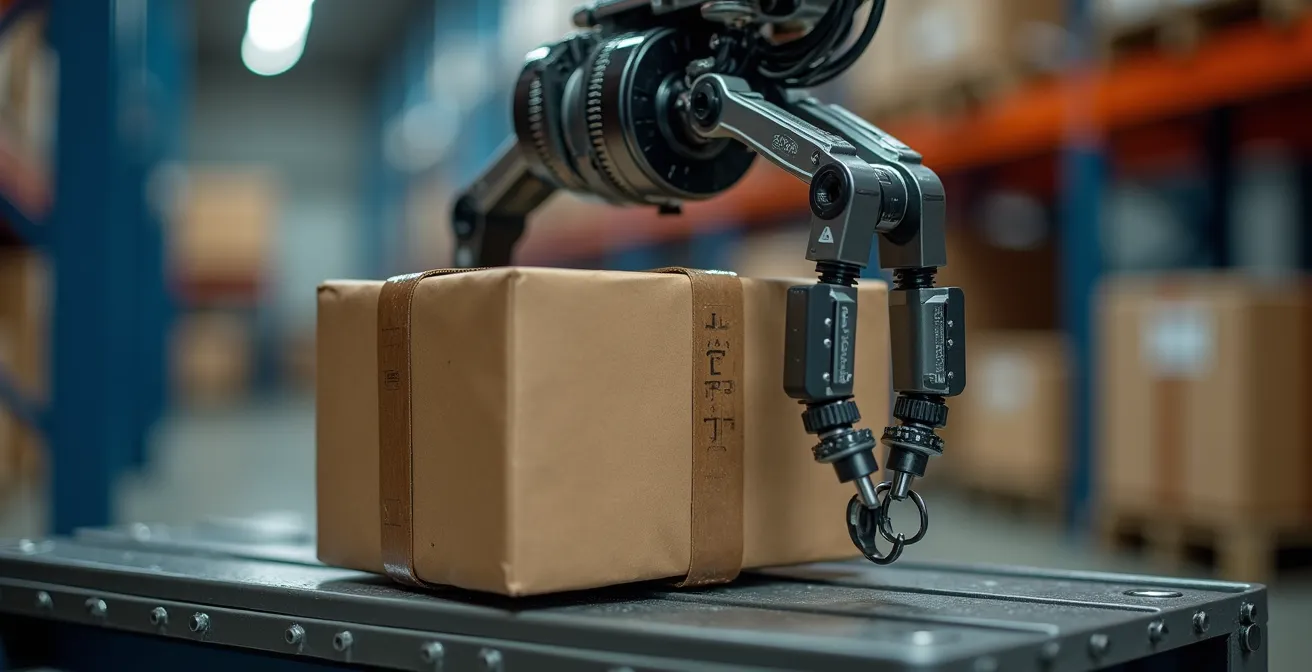
The return on investment (ROI) for a packing robot is not just calculated by labor savings under normal conditions. Its true value is realized in its ability to mitigate the high costs of disruption. By rapidly clearing backlogs, automation directly prevents the accumulation of detention fees for late container returns and slashes the need for expensive overtime labor.
Case Study: Automation as a Buffer Capacity Strategy
A mid-sized e-commerce company faced crippling detention and demurrage fees whenever a customs hold created a container backlog at their warehouse. After implementing an automated packing and sorting system, they found they could process delayed containers three times faster than with their previous manual operation. This allowed them to clear backlogs within a single day, virtually eliminating detention fees and reducing overtime labor costs during peak receiving periods by over 60%.
To implement these strategies and gain control over your import process, the next logical step is to conduct a full audit of your current supply chain, from supplier contracts to final delivery, and identify your key points of failure.