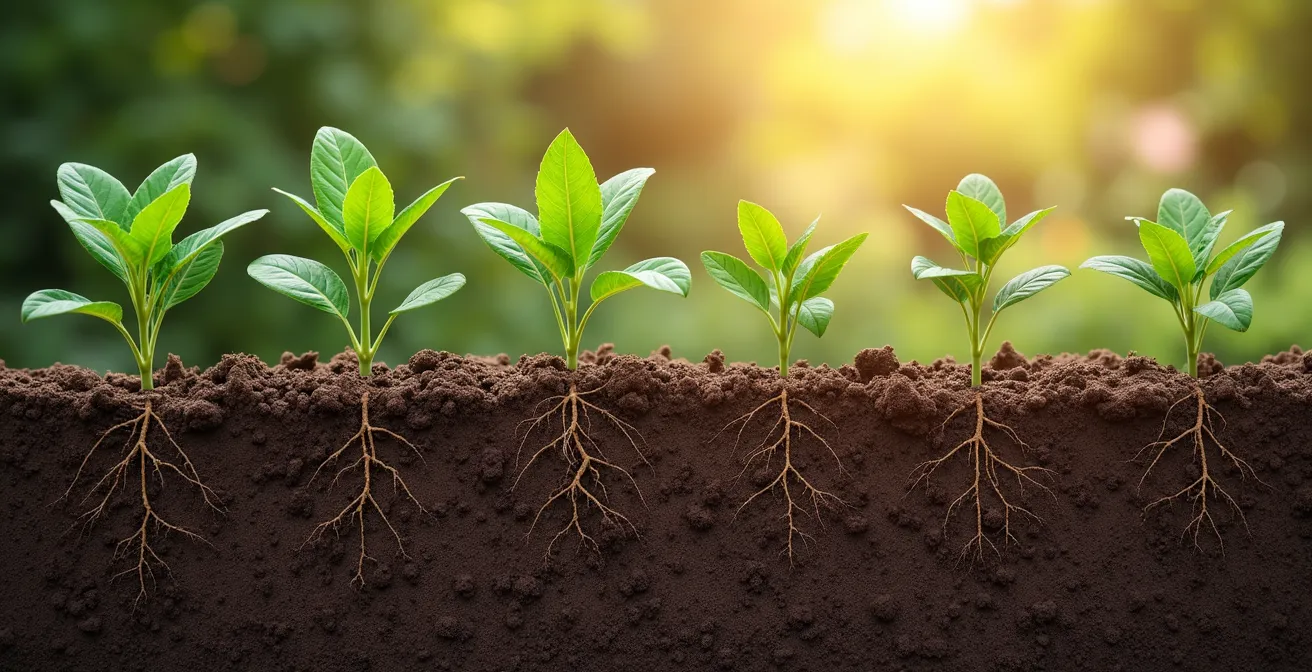
The secret to fixing heavy clay soil isn’t brute force, but understanding and applying soil physics.
- Chemical amendments like gypsum trigger flocculation, forcing tiny clay particles to clump together and create pore space for air and water.
- Biological “tools” like cover crop roots and fungal networks act as living machinery, building stable soil aggregates from within and doing the heavy lifting for you.
Recommendation: Stop tilling, which destroys soil life. Instead, implement these targeted, labor-saving strategies to build a permanently well-drained and fertile soil structure.
The feeling is all too familiar for gardeners battling heavy clay: a spade that rings when it hits the ground in summer, and a waterlogged quagmire that drowns plant roots after a single downpour. This dense, sticky soil, composed of microscopic, plate-like particles, holds onto water and nutrients with a vengeance but offers little room for the oxygen that plant roots desperately need. The conventional wisdom has always been to fight it with brute force—endless tilling, double-digging, and hauling in mountains of compost. These methods offer temporary relief but often lead to back-breaking work and a soil structure that collapses back into a dense plate within a season.
Many gardeners, in their frustration, turn to other solutions. They might build raised beds to simply bypass the problem, or fall for the myth of adding sand, which can accidentally create a concrete-like substance. While these approaches have their place, they don’t address the fundamental issue: the physics of the clay itself. But what if the solution wasn’t about fighting the soil, but about giving it the right signals to restructure itself? What if we could use scientific principles to catalyse natural processes, turning that dense clay into a crumbly, fertile loam with a fraction of the physical effort?
This guide moves beyond the generic advice. We will explore the science of soil flocculation, the power of biological machinery, and the strategies that leverage plant biology to do the heavy work for you. By understanding the ‘why’ behind these techniques, you can stop the cycle of endless digging and start building a resilient, well-drained soil that works in harmony with your plants, not against them.
In the following sections, we will break down the specific, labor-saving strategies you can implement. From chemical amendments that change soil behaviour at a particle level to sophisticated crop rotation plans that build structure over time, you will find a complete toolkit for transforming your clay soil permanently.
Summary: A Scientific Approach to Improving Clay Soil
- Gypsum: The Miracle Mineral That Loosens Clay Without Changing pH?
- Wood vs Metal Raised Beds: Which Lasts Longer in Wet Climates?
- Winter Rye: How to “Feed” Your Soil While It Sleeps?
- Why You Should Buy Grafted Tomato Plants for Disease Resistance?
- The 4-Year Rotation Plan That Prevents Potato Blight
- Carbon vs Nitrogen: What is the Golden Ratio for Fast Compost?
- Why Tilling Your Soil Kills the Micro-Organisms That Feed Your Plants?
- How Clover Feeds Your Apple Tree for Free?
Gypsum: The Miracle Mineral That Loosens Clay Without Changing pH?
The core problem with clay soil is its physical structure. The microscopic, flat particles carry a negative electrical charge, causing them to repel each other and lie flat, like a stacked deck of wet cards. This leaves no room for air or water to move. The solution lies in a process called flocculation, where these particles are encouraged to clump together into larger aggregates. Gypsum, or calcium sulfate, is a powerful tool for this. The calcium ions in gypsum have a positive charge that neutralizes the clay particles, allowing them to bind together. This creates a more crumbly, “cottage cheese” texture with improved pore space, dramatically enhancing drainage and aeration.
Unlike lime (calcium carbonate), which also provides calcium, gypsum has a minimal effect on soil pH. This makes it the ideal choice for gardeners who need to improve clay structure without making their soil overly alkaline. The effectiveness of gypsum depends on its form; for example, research from University of Arizona Extension shows that flue gas gypsum, a synthetic byproduct, dissolves much faster than mined gypsum, providing quicker results. The key is to see it not as a one-time fix, but as a chemical catalyst that kick-starts a physical transformation, making the soil more hospitable to the biological life that will create long-term stability.
Before applying gypsum across your entire garden, it’s wise to test its effect on your specific soil. A simple jar test can show you the power of flocculation in action. By observing how quickly gypsum-treated soil settles and clears in water compared to an untreated sample, you can confirm its potential and avoid wasting time and resources on an amendment that may not be necessary for your particular soil chemistry.
Wood vs Metal Raised Beds: Which Lasts Longer in Wet Climates?
For gardeners needing an immediate solution to waterlogged clay, raised beds are an effective bypass. By elevating the growing area, you create a zone of perfect drainage regardless of the native soil beneath. However, in wet climates where soil moisture is constantly high, the choice of material becomes a critical decision for longevity and soil health. Wood, particularly untreated cedar, is a popular choice for its natural aesthetic. It decomposes slowly over 10-15 years, gradually adding organic matter to the soil below. However, treated pine, while lasting longer, can introduce copper compounds that may negatively affect sensitive soil organisms.
On the other hand, modern metal beds, typically made of galvanized or powder-coated steel, offer superior longevity, often lasting 20 years or more even in constantly damp conditions. They are inert and do not leach chemicals into the soil, though it’s important to consider potential zinc leaching from galvanized steel in highly acidic soils. From a drainage perspective, metal beds are excellent, provided they have adequate drainage holes. They also warm up faster in the spring, which can be a significant advantage for extending the growing season. The ultimate choice often comes down to balancing aesthetics, budget, and long-term durability.
The following table provides a clear comparison of common materials, focusing on their performance in the challenging conditions created by proximity to wet clay soil, based on data from university extension programs.
This comparative analysis of materials provides a clear framework for making a decision based on long-term performance.
| Material | Lifespan (Wet Climate) | Soil Impact | Drainage Effect |
|---|---|---|---|
| Untreated Cedar | 10-15 years | Neutral, natural decomposition adds organic matter | Good if elevated properly |
| Galvanized Steel | 20+ years | Potential zinc leaching in acidic conditions | Excellent with proper drainage holes |
| Composite Lumber | 25+ years | Minimal impact, inert material | Good with proper design |
| Treated Pine (ACQ) | 15-20 years | Copper compounds may affect soil biology | Good but requires liner |
Winter Rye: How to “Feed” Your Soil While It Sleeps?
One of the most powerful, labor-saving ways to improve clay soil is to let plants do the work for you. Cover crops, and particularly cereal rye planted in the fall, are masters of this. As winter rye grows, its extensive, fibrous root system acts as a “bio-drill,” pushing through compacted clay to create thousands of tiny channels. When the plant is terminated in the spring, these roots decompose in place, leaving behind a network of pathways for air and water to penetrate deep into the soil profile. This process achieves a level of soil aeration that would require hours of mechanical tilling, but it does so gently and without destroying the soil structure.
Beyond its physical benefits, winter rye is a master of nutrient management. It scavenges for any leftover nitrogen in the soil that would otherwise be leached away by winter rains, storing it in its tissues. When you terminate the crop in the spring (a process known as “chop and drop”), this biomass acts as a green manure, releasing that stored nitrogen and a wealth of organic matter right where your next crop needs it. This effectively “feeds” your soil food web during the dormant season, ensuring a burst of fertility in the spring. However, it’s important to manage rye’s allelopathic properties—it releases natural compounds that can inhibit the germination of small seeds. Waiting two to three weeks after termination before planting sensitive crops is a crucial step for success.
Why You Should Buy Grafted Tomato Plants for Disease Resistance?
Improving clay soil is a long-term project. While you work on building better structure, your plants remain vulnerable to the primary threat of waterlogged soil: root diseases. Pathogens like Fusarium and Verticillium wilt thrive in the anaerobic (low-oxygen) conditions of compacted clay. A powerful strategy to ensure a successful harvest while your soil improves is to use grafted tomato plants. Grafting is a horticultural technique where the top part of a desirable tomato variety (the scion) is fused onto the super-vigorous and disease-resistant root system of another (the rootstock).
Think of the rootstock as an insurance policy. It’s specifically bred to withstand the exact soil-borne diseases that plague clay soils. While a normal tomato plant might succumb to root rot in wet conditions, a grafted plant’s root system will power through, continuing to draw water and nutrients. The results are dramatic; university extension trials demonstrate that grafted tomatoes show an up to 85% reduction in soil-borne disease incidence in challenging soils. This allows you to enjoy a full, healthy harvest of your favorite heirloom varieties, even in the first few years of soil remediation.
This approach perfectly encapsulates the idea of working smarter, not harder. As the renowned horticultural scientist Dr. James Wong notes in the RHS Gardening Science Journal:
Grafted plants act as an insurance policy, guaranteeing harvest while long-term soil improvement methods take effect.
– Dr. James Wong, RHS Gardening Science Journal
By investing in grafted plants, you uncouple your harvest success from the immediate condition of your soil, buying you the time needed for deeper, more permanent solutions to take hold.
The 4-Year Rotation Plan That Prevents Potato Blight
A single technique is rarely a silver bullet for clay soil. The most profound and permanent transformations come from a strategic, multi-year approach that uses different plants to perform specific functions. A four-year crop rotation is not just about preventing disease buildup like potato blight; it’s a sophisticated plan to systematically de-compact, enrich, and build a resilient soil ecosystem. Each plant family in the rotation is chosen for its unique ability to interact with and improve the soil structure at different levels.
The rotation can be designed as a sequence of soil-building functions. For example, Year 1 might be dedicated to “bio-drillers” like potatoes and daikon radishes, whose large tubers and deep taproots physically break up compacted layers. Year 2 would feature “nitrogen builders” like beans and clover, which fix atmospheric nitrogen and add significant biomass. Year 3 could be for “mycorrhizal networkers” like squash and corn, which form extensive partnerships with beneficial fungi, weaving the soil together into stable aggregates. Finally, Year 4 could be for “cleansers and resters” like garlic (known for its antifungal properties), followed by a winter rye cover crop to rest and protect the soil.
This systematic approach ensures that you are not just growing food, but actively engineering a better soil structure year after year. It’s the ultimate labor-saving technique, as the plants themselves become your primary cultivation tools.
This plan methodically addresses soil health from multiple angles, ensuring progressive improvement over time, as detailed in guidelines from organizations like the NRCS.
| Year | Function | Crops | Soil Amendment | Primary Benefit |
|---|---|---|---|---|
| Year 1 | Bio-drillers | Potatoes, Daikon Radish | Gypsum or Biochar | Break compaction, create channels |
| Year 2 | Nitrogen Builders | Fava Beans, Clover | Compost | Fix nitrogen, add biomass |
| Year 3 | Mycorrhizal Networkers | Squash, Corn | Mycorrhizal inoculant | Build fungal networks |
| Year 4 | Cleansers & Resters | Garlic, then Winter Rye | Mulch only | Break disease cycles, rest soil |
Carbon vs Nitrogen: What is the Golden Ratio for Fast Compost?
Simply adding “organic matter” is the most common advice for clay soil, but it’s incomplete. The *type* of organic matter is critical. Clay soils benefit most from a stable, long-lasting compost dominated by fungi rather than bacteria. Fungal networks, with their sticky, web-like hyphae, are the master architects of soil structure, binding tiny clay particles into large, stable aggregates that create the pores needed for drainage and aeration. Bacterial-dominant compost, on the other hand, breaks down quickly and provides a shorter-term benefit.
The key to creating this fungal-dominant compost lies in the carbon-to-nitrogen (C:N) ratio of your ingredients. While a “hot” bacterial compost pile aims for a ratio around 25:1 or 30:1, fungi thrive in a much more carbon-rich environment. In fact, soil biology research indicates that a 40:1 or higher C:N ratio actively promotes fungal dominance. This means prioritizing “brown” materials high in lignin and cellulose, which are tougher for bacteria to break down but are a feast for fungi. Think wood chips, shredded cardboard, and tough, fibrous stalks rather than just green grass clippings and kitchen scraps.
Building a fungal-dominant pile requires a different mindset: less turning (to preserve the delicate fungal hyphae) and more patience. The resulting compost may look less “finished” than a hot-composted product, but it is a powerful inoculant, bringing the very organisms needed to restructure your clay soil from within.
Your Action Plan: Fungal-Dominant Compost Recipe for Clay Soils
- Mix 5 parts aged wood chips (high lignin content).
- Add 3 parts shredded cardboard (carbon-rich, fungal food).
- Include 1 part dry leaves (moderate carbon).
- Add 1 part food scraps (nitrogen source).
- Inoculate with a handful of forest soil for diverse fungal spores and keep moisture at 50-60% (damp but not wet).
Key Takeaways
- Focus on flocculation (chemically altering clay structure with amendments like gypsum) rather than just adding bulk organic matter.
- Utilize “biological machinery” like cover crop roots and mycorrhizal fungi to do the heavy lifting of soil aeration and aggregation from within.
- A multi-year, no-till rotation plan where different plants perform specific soil-building functions is the most effective strategy for creating deep, resilient structure.
Why Tilling Your Soil Kills the Micro-Organisms That Feed Your Plants?
For generations, tilling has been the go-to method for breaking up compacted soil. The immediate result is satisfying: a bed of loose, fluffy earth. However, from the perspective of soil physics and biology, this is one of the most destructive actions a gardener can take. Tilling is a violent earthquake for the soil ecosystem. It pulverizes soil aggregates, the clumps of particles held together by biological glues that are essential for good drainage. This leaves the individual clay particles exposed and ready to re-compact into a dense, impermeable layer at the first heavy rain.
Even more damaging is the effect on soil life. The intricate, microscopic web of mycorrhizal fungi that acts as a root system extension for your plants is shredded and destroyed. These fungal networks are critical for transporting water and nutrients, and their sticky hyphae are the primary builders of stable soil structure. Tilling also exposes beneficial bacteria, earthworms, and other organisms to the harsh sun and predators, decimating their populations. In essence, by tilling, you are killing the very workforce that you need to build and maintain healthy soil structure for you.
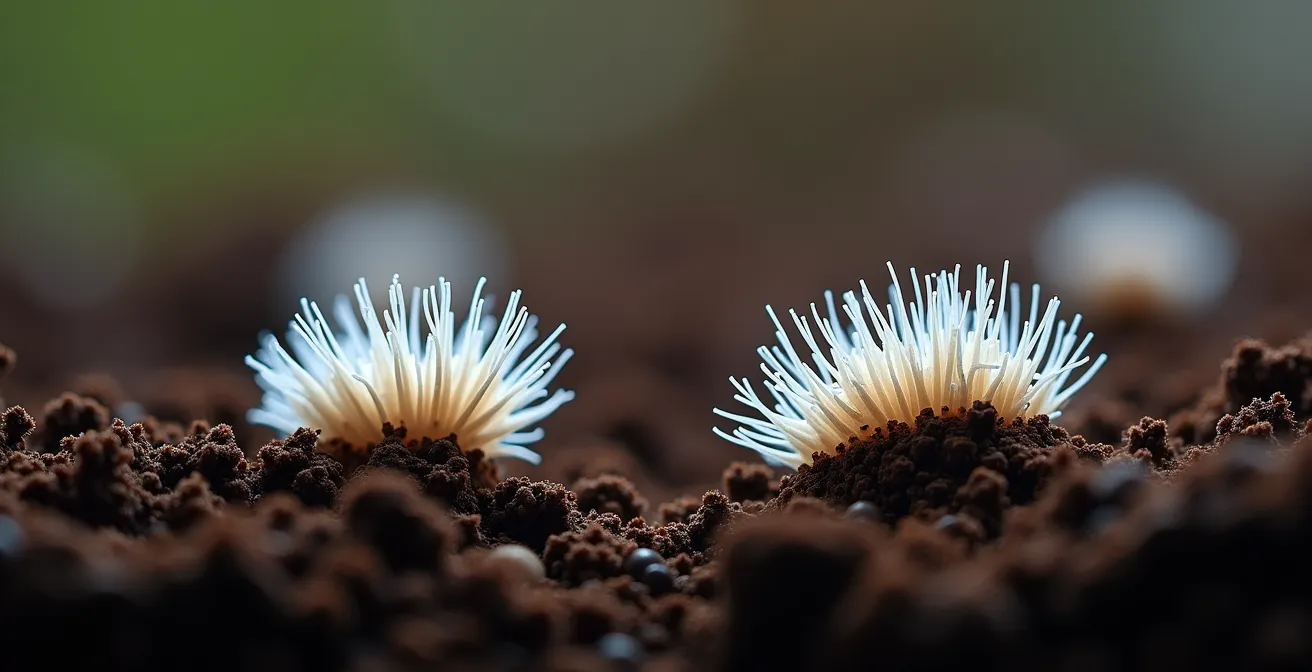
Adopting a no-till or minimal-tillage approach is the cornerstone of a labor-saving clay soil strategy. Instead of mechanically pulverizing the soil, you protect this underground ecosystem. You add compost and mulch to the surface, allowing earthworms and microbes to do the work of incorporating it. You use cover crops to create aeration channels. This shift in mindset—from soil as an inert medium to be manipulated to soil as a living ecosystem to be nurtured—is essential for building a truly resilient and low-maintenance garden.
How Clover Feeds Your Apple Tree for Free?
The ultimate expression of a labor-saving, scientific approach to gardening is the creation of a self-sustaining system. Instead of treating each plant as an individual, we can assemble “guilds”—communities of plants that support each other and improve the soil together. A classic example for clay soil is building a guild around a fruit tree, like an apple tree. By underplanting the tree with a carefully selected group of companion plants, you create a living system that fertilizes, protects, and improves the soil automatically.
The star of this guild is often white clover. As a legume, it performs nitrogen fixation, pulling nitrogen from the air and making it available in the soil, providing a constant, free source of fertilizer for the hungry apple tree. It also acts as a living mulch, suppressing weeds, retaining soil moisture, and keeping the soil cool. This is complemented by “dynamic accumulators” like comfrey, which have deep taproots that “mine” minerals like potassium from the clay subsoil. When you “chop and drop” the comfrey leaves, these minerals are released on the surface for the tree to use. Finally, interplanting aromatic herbs like chives or garlic can help confuse pests and provide antifungal benefits.
Case Study: The Permaculture Guild Transformation
A three-year permaculture study demonstrated the power of this approach. Establishing a guild around fruit trees with white clover, comfrey, and garlic chives dramatically improved the underlying clay. Researchers measured an increase in topsoil depth by 2 inches and an improvement in water infiltration by a remarkable 40% compared to bare soil. Furthermore, this living system reduced irrigation needs by 30%, in part due to a phenomenon called “hydraulic lift,” where the deeper-rooted comfrey shared water with the shallower-rooted clover and apple tree during dry periods.
Creating a guild transforms a simple planting into a functioning ecosystem. It’s a strategy that builds fertility, improves soil structure, and reduces your workload year after year, embodying the principle of working with nature’s own systems.
By shifting your perspective from fighting clay to feeding its biology, you can begin implementing these strategies today to build a garden that is not only more productive but also requires significantly less work in the long run.