Contrary to popular belief, simply putting up a bee hotel and some flowers can do more harm than good.
- Many commercial bee hotels are “ecological traps” that breed disease and attract parasites.
- Providing the wrong water source can be a death sentence, and inconsistent food sources lead to starvation.
Recommendation: To truly help solitary bees, focus on providing safe, manageable nesting materials, a consistent, year-round food supply within a 300-foot radius, and a drowning-proof water source.
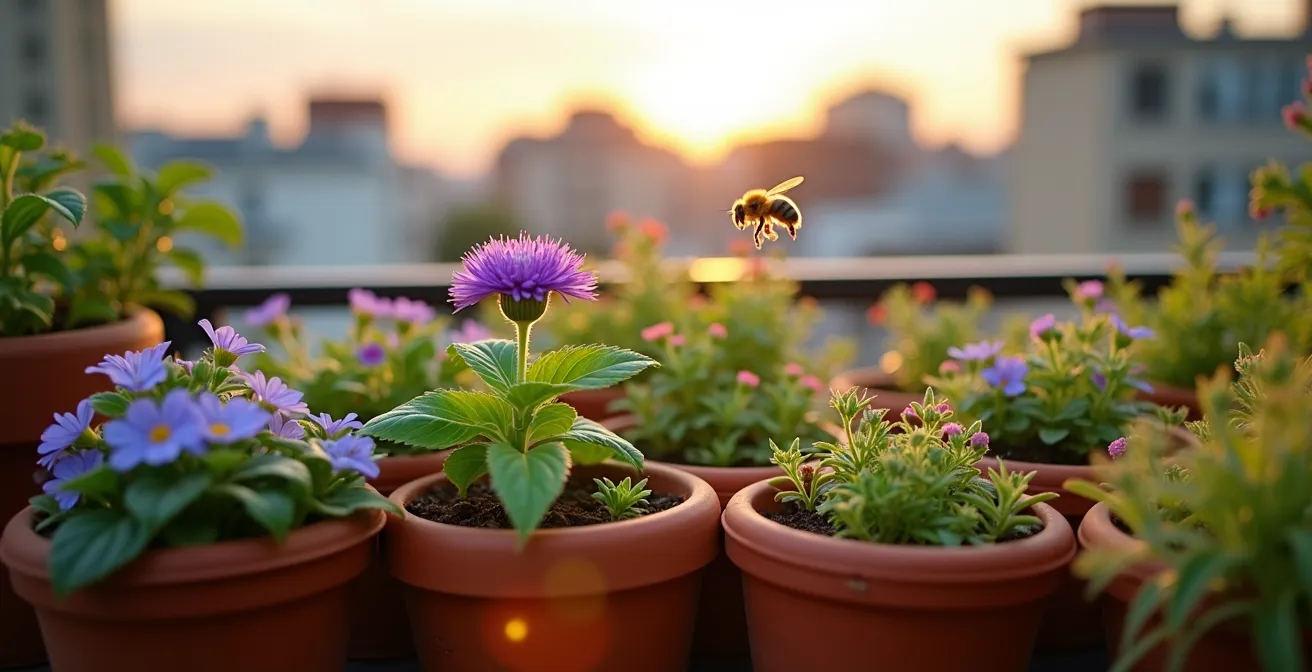
You look out at your small balcony, a space you’ve carefully curated with a few pots and a chair. You love nature and feel a pang of responsibility, a desire to help the struggling bee populations you hear so much about. The common advice seems simple enough: buy a “bee hotel,” plant some lavender, and provide a dish of water. You follow the steps, feeling a sense of accomplishment. But what if these well-intentioned actions are inadvertently creating a dangerous environment for the very creatures you want to save?
The internet is filled with tips that are often incomplete or, worse, misguided. A bamboo bee hotel can become a death trap, a breeding ground for deadly mold and parasites. A simple dish of water can become a graveyard for exhausted bees. This isn’t about shaming good intentions; it’s about elevating them with knowledge. The world of solitary bees—the gentle, efficient pollinators that make up the vast majority of bee species—is fascinatingly complex. Helping them effectively on a small urban balcony requires moving beyond the basics and understanding their world from their perspective.
The real key to creating a bee sanctuary isn’t just about providing resources, but about providing the *right* resources, managed in the *right* way. It’s a shift from passive decoration to active stewardship. This guide will dismantle the common myths and give you the expert-backed, nuanced strategies to turn your balcony into a genuinely safe, effective, and thriving haven for solitary bees. We will explore how to choose safe nesting, provide food all year, create a safe water source, and even use the science of bee vision to your advantage.
This article breaks down the essential, often-overlooked details for creating a true bee sanctuary on your balcony. Follow along as we explore how to select safe housing, provide consistent food and water, and cultivate a complete ecosystem that supports these vital pollinators.
Summary: Your Guide to a Truly Bee-Friendly Balcony
- Bamboo Tubes: Why Your DIY Bee Hotel Might Be a Death Trap?
- Neonicotinoids: The Label Terms to Avoid at the Garden Center
- February to November: How to Ensure Bees Have Food All Year?
- Pebbles and Water: How to Make a Bee Bath They Won’t Drown In?
- Purple vs Red: Which Colors Actually Bring More Bees?
- Which Native Flowers Save the Specific Butterfly Species in Your Area?
- Ladybug Larvae: Why You Are Mistakenly Killing Your Garden’s Best Friend?
- How to Garden Without Disrupting Local Wildlife Corridors?
Bamboo Tubes: Why Your DIY Bee Hotel Might Be a Death Trap?
The most iconic symbol of helping solitary bees—the bee hotel—is often the most dangerous thing you can offer. Many commercially available or DIY hotels, especially those made from bamboo sticks or drilled wood blocks, become what ecologists call an “ecological trap.” They look like a perfect home, but they concentrate bees in one spot and become breeding grounds for lethal parasites and diseases like chalkbrood, pollen mites, and Houdini flies. Because these materials cannot be opened and cleaned, the pathogens build up year after year, turning your well-intentioned hotel into a slum and then a tomb.
Furthermore, the physical structure itself is often flawed. Parasitic wasps have long ovipositors (egg-laying organs) that can pierce thin-walled materials. Research from the Sustainable Agriculture Research & Education program shows that nesting walls must have a minimum thickness of 1 millimeter to prevent these wasps from laying their eggs directly into the bee larvae. Most bamboo is far too thin to offer this protection. The solution is not to abandon bee housing, but to embrace active management with materials that can be opened, inspected, and cleaned.
The best practice is to use systems with removable nesting materials, such as stacking trays, cardboard tubes, or natural phragmites reeds. These allow you to harvest the precious bee cocoons in the fall, clean them, and store them safely over winter, away from predators and parasites. This single act of management breaks the life cycle of diseases and ensures the next generation of bees emerges healthy and strong. It transforms you from a landlord of a dangerous tenement to the steward of a healthy, thriving bee nursery.
Your 5-Point Bee Hotel Safety Audit
- Nesting Materials: List all nesting materials you use. Are the tubes the right diameter (6-10mm for mason bees) and are they protected from direct rain by a sufficient roof?
- Current Inventory: Take stock of your nesting blocks. Are they made of un-openable bamboo or drilled wood, or are they replaceable paper liners and reeds that allow for cocoon harvesting?
- Safety Principles: Compare your hotel to best practices. Does it have a solid, non-removable back? Is it mounted securely against a wall to prevent swinging in the wind?
- Management Plan: Review your annual process. Do you have a clear, simple plan for harvesting, cleaning, and storing cocoons in the fall, or does the task seem too complex to remember and perform?
- Integration Strategy: Create a plan to fix the gaps. Prioritize replacing all sealed bamboo or wood blocks with openable stacking trays or paper tubes at the end of the current season.
Neonicotinoids: The Label Terms to Avoid at the Garden Center
Even with the perfect home and food source, your balcony can become toxic if the plants themselves are the problem. The most pervasive threat comes from a class of systemic pesticides called neonicotinoids (or “neonics”). These pesticides are absorbed by the plant and distributed throughout its tissues, including the pollen and nectar. When a bee forages on a treated plant, it ingests a neurotoxin that can cause paralysis, impair navigation, and suppress its immune system, eventually leading to death. The effect is not isolated; a comprehensive Nature Sustainability study analyzing over 178,000 bee observations showed widespread negative effects on bee populations directly linked to neonicotinoid use.
The challenge for the conscious consumer is that these chemicals are rarely labeled in plain English. You won’t see “Contains Bee-Killing Poison” on the tag. Instead, you need to learn to spot the chemical names of the most common neonicotinoids used in horticulture. When you’re at the garden center, carefully inspect the plant tags, especially on non-organic flowering perennials that look suspiciously perfect.
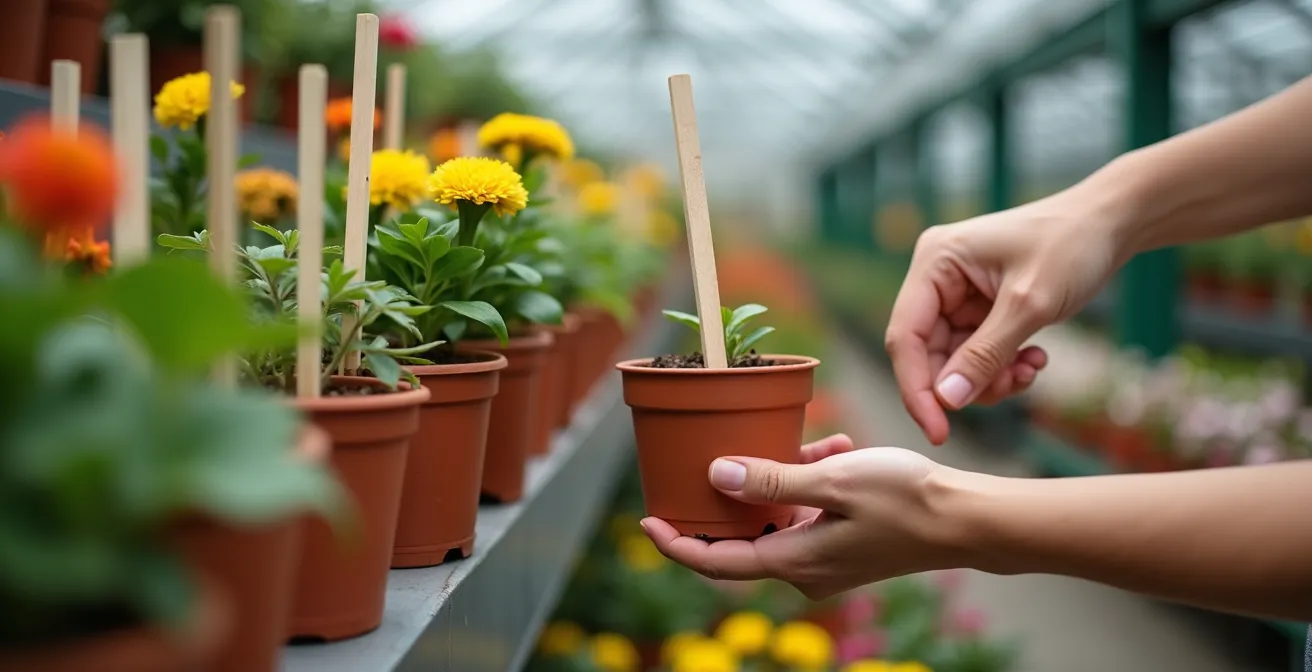
As you check the labels, be vigilant for these common active ingredients: Imidacloprid, Thiamethoxam, Clothianidin, Acetamiprid, and Dinotefuran. If you see any of these listed, do not buy the plant. The safest route is to purchase plants that are certified organic or explicitly labeled as “neonicotinoid-free.” Many local, non-chain nurseries are more aware of this issue and are a great resource for bee-safe plants. By voting with your wallet, you not only protect the bees on your balcony but also send a powerful message to the horticulture industry that consumers demand plants that are safe for pollinators.
February to November: How to Ensure Bees Have Food All Year?
Attracting bees is one thing; sustaining them is another. A common mistake is planting a beautiful burst of summer flowers, which creates a short-lived feast followed by a long famine. Solitary bees have different life cycles and are active at different times, from early spring to late fall. A truly bee-friendly balcony provides a continuous, overlapping sequence of blooms. This is especially critical in an urban environment. Unlike honey bees that can travel for miles, most solitary bees are homebodies. An essential fact to remember about mason and leafcutter bees is that they typically forage for pollen and nectar within just 300 feet (about 90 meters) of their nests. Your balcony isn’t a brief stop; for many of these bees, it’s their entire world.
To create a season-long buffet, you need to think in terms of “phenology”—the timing of natural events. Your goal is to have something in bloom from the moment the first mason bees emerge in February or March until the last ones are active in November. This requires strategic planting in containers.
Here is a simple framework for your balcony garden:
- Early Spring (Feb-Apr): This is the most critical and often overlooked period. Early-emerging mason bees are desperate for food. Plant bulbs in the fall like Crocus, Siberian Squill, and Grape Hyacinth. Early-blooming perennials like Hellebores (Lenten Rose) and native Oregon Grape are also excellent choices for pots.
- Late Spring & Summer (May-Aug): This is the easiest period. A wide variety of flowers will be in bloom. Focus on native perennials like Coneflowers (Echinacea), Black-Eyed Susans (Rudbeckia), and herbs like Borage, Lavender, and Thyme.
- Late Summer & Fall (Sep-Nov): As summer blooms fade, you need late-season powerhouses to sustain the final generations. Asters, Goldenrod (choose clump-forming varieties for containers), and Sedum ‘Autumn Joy’ provide vital late-season nectar and pollen.
By planning your container garden this way, you ensure there is always a food source available within the limited foraging radius of your resident bees, preventing starvation and helping them successfully raise their young.
Pebbles and Water: How to Make a Bee Bath They Won’t Drown In?
Like all living things, bees need water. They use it for drinking, cooling their nests, and even for construction (mason bees use mud). But providing water on a balcony can be a deadly affair. A bee’s hairy body is its downfall when it comes to open water. If a bee lands directly on the water’s surface, the surface tension immediately traps it, making it impossible to take off again. The bee will struggle and quickly drown. That shallow dish of water with a few smooth pebbles at the bottom, so often recommended, is a well-intentioned death trap. While the pebbles provide a place to land, a gust of wind or a misstep can easily knock a bee into the open water between them.
The key to a safe bee bath is to eliminate open water surfaces entirely. You need to create a “wicking” station where bees can walk on a damp, textured surface and drink without risk. Forget smooth, decorative stones. Instead, fill a shallow plant saucer or dish with materials that provide countless tiny footholds and escape routes. Natural, textured materials are far superior.
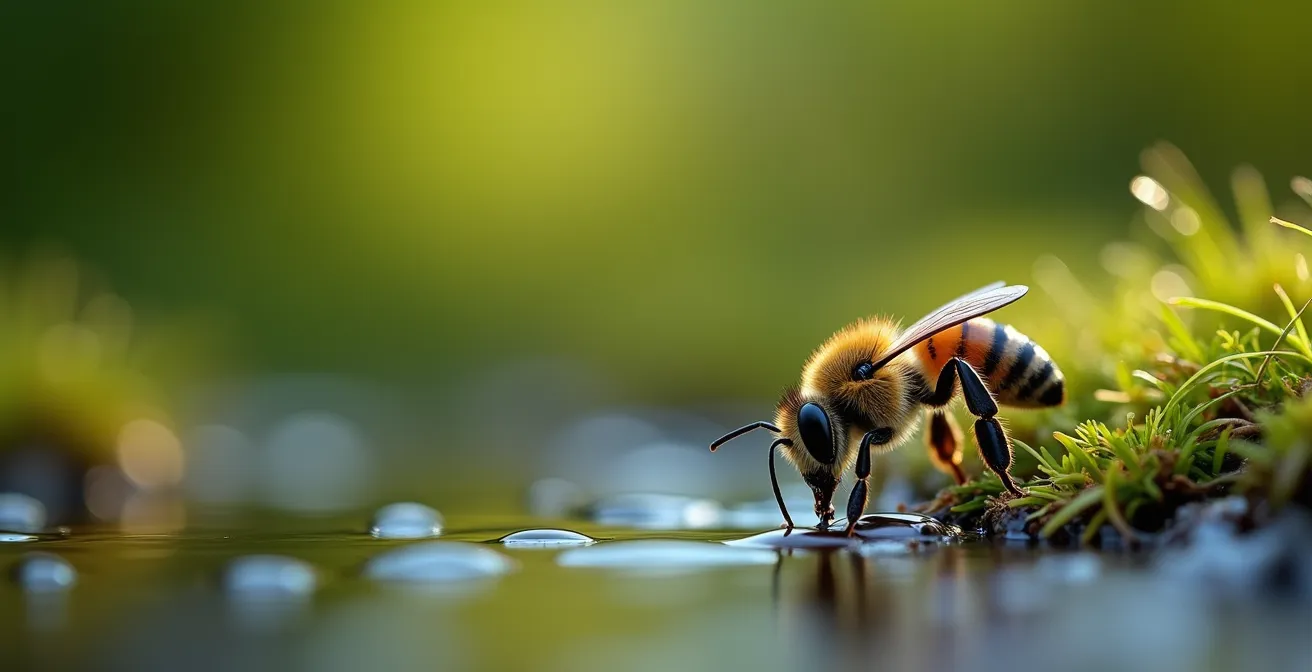
The best options for a safe bee watering station are materials like natural moss, jute rope, cork pieces, or even a rough piece of untreated wood. Pack these materials tightly into your saucer and fill it with water until the surfaces are damp but not submerged. Bees can land safely, crawl around, and drink from the moist fibers. Another critical aspect of water stations is management. Stagnant water is a breeding ground for mosquitoes. To prevent this, you must change the water every 48 hours. Alternatively, you can use a Bti mosquito dunk (or bits from one), a naturally occurring bacterium that is harmless to bees and other wildlife but lethal to mosquito larvae.
Purple vs Red: Which Colors Actually Bring More Bees?
To create a truly irresistible balcony buffet, it helps to see the world as a bee does. Human and bee vision are dramatically different. While we have three color receptors tuned to red, green, and blue, bees also have three, but they are tuned to green, blue, and ultraviolet (UV). This has two major consequences for your plant choices. First, research on bee vision capabilities demonstrates that bees cannot see the color red. To them, a bright red flower appears as a dark, unattractive void, similar to black. While some red flowers are pollinated by hummingbirds, they are largely invisible to bees.
The second, more fascinating consequence is their ability to see ultraviolet light. This unlocks a secret world of floral communication. Many flowers that appear plain to us have intricate patterns on their petals that are only visible in the UV spectrum. These patterns, called “nectar guides,” act like runway landing lights, guiding the bee directly to the flower’s pollen and nectar rewards. The pollen and anthers themselves often absorb UV light, appearing as a dark bullseye at the center of the flower, making the target unmistakable for an approaching bee.
Even though humans can see more colors, bees have a much broader range of color vision. Their ability to see ultraviolet light gives them an advantage when seeking nectar. Many patterns on flowers are invisible to humans.
– Bee Culture Magazine, How Bees See And Why It Matters
So, what does this mean for your balcony? To maximize its appeal, you should focus on colors that bees see best. The most attractive colors to bees are shades of blue, purple, violet, white, and yellow. When you’re choosing between flower varieties, opt for the purple petunia over the red one, or the blue salvia over the scarlet. By planting a garden that aligns with the sensory ecology of bees, you make your balcony not just a source of food, but a vibrant, can’t-miss destination that speaks their language.
Which Native Flowers Save the Specific Butterfly Species in Your Area?
While this article focuses on bees, the principles of supporting them extend to a whole community of pollinators, including butterflies. The most impactful strategy for supporting any local pollinator, be it a bee or a butterfly, is to plant native species. While many garden-variety flowers provide some nectar, native plants have a deep, co-evolutionary relationship with local wildlife. They are the specific food source that certain species, known as “specialists,” have evolved to rely on exclusively. A generalist bee might be happy with a non-native lavender, but a specialist like the Squash Bee can only feed its young with pollen from squash and gourd flowers.
Your balcony, no matter how small, can become a vital resource for these specialist species. The first step is to become a local naturalist. You don’t need a biology degree; you just need a smartphone. Citizen science apps like iNaturalist or Seek can help you identify the bees and butterflies that are already visiting your area. By simply taking photos, you can start to build a picture of your local pollinator community. Pay close attention to which plants they visit.
Once you start identifying your local specialists, you can tailor your balcony garden to support them. Research which plant families are known to support specialist bees in your region. Two of the most important families are:
- Asteraceae (The Sunflower Family): This huge family includes asters, coneflowers, and sunflowers, and it supports a vast number of specialist bees.
- Fabaceae (The Legume or Pea Family): Plants like lupines and clover are crucial for many specialist species.
By choosing container-suitable native species from these families, you move beyond simply feeding any bee and start actively conserving the unique, local biodiversity of your specific area. This is the next level of urban pollinator stewardship.
Ladybug Larvae: Why You Are Mistakenly Killing Your Garden’s Best Friend?
Creating a bee haven is not just about addition; it’s also about subtraction—specifically, subtracting the need for pesticides. The best way to do this is by fostering a balanced ecosystem where natural predators keep pests in check. One of the most effective and misunderstood predators in a garden is the ladybug larva. While everyone recognizes the cute adult ladybug, their larval stage is often mistaken for a pest and destroyed. These larvae look like tiny, spiny, black-and-orange alligators, and they are voracious eating machines.
The numbers are staggering. According to research from the University of Kentucky Extension Service, a single ladybug larva will consume its weight in aphids every day, totaling up to 5,000 aphids in its lifetime. By killing a single larva, you are eliminating one of nature’s most efficient forms of pest control. Learning to identify these beneficial predators is a crucial skill for any balcony gardener. The same goes for other “good bug” larvae, such as the alligator-like lacewing larva and the translucent, slug-like hoverfly larva. Before you squish any unfamiliar bug, take a moment to identify it.
Case Study: The First Triumph of Biological Control
The power of beneficial insects is not a new discovery. In 1887, California’s citrus industry was on the brink of collapse due to an invasive pest, the cottony cushion scale. Instead of more pesticides, entomologists introduced a natural predator from Australia: the vedalia beetle, a species of ladybug. The project was a stunning success. The beetle larvae quickly brought the pest under control, saving the industry. This became a textbook example of classical biological control, demonstrating that fostering natural predators is often more effective and sustainable than chemical warfare.
You can actively attract these beneficial predators to your balcony by planting “banker plants.” These are plants like dill, fennel, yarrow, and calendula that provide a consistent source of nectar and pollen for the adult predators, encouraging them to stick around and lay their eggs even when pest populations are low. This ensures you have a standing army of pest-control larvae ready to act at the first sign of an aphid outbreak.
Key Takeaways
- Ditch bamboo bee hotels; use manageable systems like stacking trays or paper tubes that you can clean annually.
- Always buy organic or “neonic-free” plants; check labels for chemicals like Imidacloprid to avoid poisoning your bees.
- Plant a sequence of blooms for spring, summer, and fall to provide food within the bees’ limited 300-foot foraging range.
- Create a safe water station with moss or jute rope to prevent bees from drowning due to water surface tension.
How to Garden Without Disrupting Local Wildlife Corridors?
It can be easy to feel like your tiny balcony is an insignificant island in a sea of concrete. But in reality, it’s a potential stepping stone in a vast, interconnected network known as a wildlife corridor. Urban pollinators don’t see city blocks; they see a series of potential rest stops and refueling stations. Your balcony, along with your neighbor’s window box and the park down the street, can link together to form a vital pathway that allows bees, butterflies, and other insects to move through the urban landscape, connecting larger green spaces and promoting genetic diversity.
One of the most disruptive things in these corridors is light pollution. Artificial night lighting can disorient nocturnal insects and disrupt the foraging and nesting behavior of crepuscular (dawn/dusk active) bees. Creating a wildlife-friendly lighting environment is a simple but powerful way to make your balcony a better stepping stone. This involves using shielded, downward-facing lights, choosing warm-colored bulbs (below 3000K), and putting them on timers or motion sensors to minimize their “on” time. Even a small change can make a big difference to the insects navigating the night.
Don’t be discouraged by the size of your space. As one urban gardener with a tiny 1m² balcony shared, after starting a pollinator garden, they observed over 10 different species of bees and saw multiple mason bees lay eggs in their small insect hotel. Your actions have a real, measurable impact. Every native flower you plant, every safe water source you provide, and every harmful pesticide you avoid contributes to the health of this larger ecological network.
By moving beyond the generic advice and embracing these informed, compassionate strategies, you transform your balcony from a simple garden into a vital, functioning piece of a larger ecosystem. Start today by choosing one action—auditing your bee hotel or setting up a safe water source—and become an active steward for the solitary bees in your neighborhood.
Frequently Asked Questions About Balcony Beekeeping
Why do bees drown in water sources?
Surface tension traps their hairy bodies, making it impossible for them to escape once they land directly on water.
What materials work better than pebbles for bee safety?
Natural moss, jute rope, cork pieces, or rough wood provide better wicking surfaces and textured escape routes than smooth stones.
How often should bee water be changed to prevent mosquitoes?
Change water every 48 hours to interrupt mosquito breeding cycles, or use a Bti mosquito dunk which is harmless to bees but lethal to mosquito larvae.
What do beneficial ladybug larvae look like?
Ladybug larvae are elongated, segmented, and resemble tiny alligators with spiny, bristled bodies. They’re typically black or dark gray with orange or yellow markings.
Which other beneficial insect larvae might be mistaken for pests?
Lacewing larvae (brown and alligator-like), hoverfly larvae (translucent and slug-like), and ground beetle larvae (dark and fast-moving) are all beneficial predators often killed by mistake.