
For field broadcasters, 5G’s real power isn’t just speed; it’s a complete operational paradigm shift that requires mastering its real-world behavior.
- True “broadcast-ready” 5G is defined by sustained uplink and low latency, not just the icon on your screen.
- Intelligent bonding of 5G, 4G, and satellite is the professional solution for overcoming inconsistent coverage and ensuring stream integrity.
Recommendation: Shift your focus from chasing the highest theoretical speeds to building a resilient, multi-network strategy for ultimate production agility.
For any field technician, journalist, or streamer, the promise of 5G feels like a revolution. We’ve all been sold the dream: flawless 4K streaming from anywhere, zero-latency remote camera control, and the end of bulky, expensive satellite trucks. The marketing tells us it’s all about blinding speed and instantaneous response. But out in the field, under pressure, the reality is far more nuanced. The real challenge isn’t just using 5G; it’s understanding and taming it.
The common advice revolves around its theoretical benefits over 4G, but this often ignores the practical hurdles. What do you do when your 5G connection drains your power packs twice as fast? How do you know if the “5G” signal you’re getting is actually strong enough for a stable high-bitrate uplink, or just a glorified 4G signal? This is where the true transformation lies. It’s not just about an incremental upgrade. It’s about a new operational paradigm.
But what if the key to unlocking 5G’s potential wasn’t just about finding the strongest signal, but about intelligently managing a portfolio of connections? This guide moves beyond the hype to give you a field-oriented perspective. We’ll explore the real-world quirks of 5G broadcasting and provide expert strategies to master them, turning technological challenges into your greatest production advantage. We’ll dissect everything from power management and signal verification to making the right gear choices and leveraging 5G for more authentic storytelling.
To navigate this new landscape, we will cover the critical questions that every field professional is asking. This structured guide will provide clear, actionable answers to help you harness the true power of 5G for your live productions.
Summary: Your Field Guide to 5G Broadcasting
- Why 5G Drains Your Battery 20% Faster and How to Fix It?
- How to Know if You Are Really on 5G or Just “Fake 5G”?
- 4G vs 5G: Is the Upgrade Worth It for Remote Maintenance Video?
- When Will Rural Areas Finally Get Reliable 5G Streaming Speeds?
- How to Force Your Phone to Stay on Stable 4G Instead of Weak 5G?
- Fiber vs 5G Home Internet: Which Is More Stable for Large Uploads?
- Phone vs Mirrorless Camera: When Should You Actually Upgrade?
- Why Authenticity Beats Production Value in Modern Vlogging?
Why Does 5G Drain Your Battery 20% Faster and How Do You Fix It?
The first shock for many field crews adopting 5G is the dramatic impact on battery life. Your V-mounts and power packs that lasted for hours on a 4G shoot are suddenly depleted far more quickly. This isn’t just a device issue; it’s rooted in the very nature of 5G technology. The network itself is more power-intensive. For context, some next-generation professional 5G equipment consumes nearly three times the power of its 4G equivalent just to operate.
This high power demand at the infrastructure level trickles down to your field equipment. 5G modems work harder, processing more complex signals and often searching across multiple frequency bands (low-band, mid-band, and mmWave) to find the best connection. In areas with spotty 5G coverage, your device constantly switches between 5G and 4G, an energy-draining process known as network hunting. This constant searching is a primary culprit of rapid battery depletion.
Fixing this requires a professional power management strategy, not just carrying more batteries. Pros in the field implement several key tactics. First, they use intelligent bonding profiles in their cellular transmission units. These profiles can be configured to automatically prioritize stable 4G over a weak, power-hungry 5G signal when bandwidth requirements are low. Second, when possible, deploying Power over Ethernet (PoE) solutions to run 5G modems directly from cameras or encoders eliminates reliance on separate batteries. Finally, for mobile broadcasting, using professional-grade V-mount or Gold-mount batteries with D-Tap outputs is essential to provide the sustained high-power delivery that 5G units demand for extended operations.
How Do You Know if You Are Really on 5G or Just “Fake 5G”?
Seeing the “5G” icon appear on your device is an exciting moment, but for a professional broadcaster, it means very little on its own. The critical difference lies between “consumer 5G” and what we can call a “broadcast-ready” 5G signal. Consumer 5G, particularly the widely deployed 5G NSA (Non-Standalone), often uses a 4G core network and delivers only marginally better performance. It’s the equivalent of a sports car stuck in city traffic—the potential is there, but the environment limits its performance.
A true broadcast-ready 5G signal is defined by its performance metrics, not its marketing name. According to industry standards, a true broadcast-ready 5G requires a sustained uplink of 20+ Mbps with latency under 50ms. This is the baseline needed for stable, high-quality video contribution. Anything less risks dropped frames, compression artifacts, and a loss of signal integrity. The challenge is that a consumer phone can’t provide this level of diagnostic detail. It might show a full-bar 5G connection that, in reality, has an uplink of only 5 Mbps.
This is why professional broadcast organizations don’t rely on the icon. They conduct rigorous, data-driven testing. For instance, in a comprehensive test program, LiveU ran dozens of indoor and outdoor tests at a dedicated 5G testbed. They evaluated various network slice types, guaranteed bandwidth levels, and different 5G QoS Identifiers (5QI) to understand real-world performance under load. The key takeaway for field technicians is to look beyond the icon and use professional diagnostic tools that measure bonded throughput, packet loss, and jitter. This data-driven approach is the only way to know if your signal is genuinely ready for broadcast.
4G vs. 5G: Is the Upgrade Worth It for Remote Maintenance Video?
For years, bonded 4G has been the workhorse of remote production, delivering reliable streams and significant cost savings over satellite. So, is the leap to 5G—with its higher equipment costs—truly worth it? For applications like remote maintenance video, live sports, and multi-camera events, the answer is an emphatic yes. The upgrade is not just incremental; it represents a production paradigm shift.
The primary benefit lies in the massive increase in uplink capacity. While a robust bonded 4G setup might top out around 30 Mbps, native 5G units can push past 70 Mbps. This leap in bandwidth is what enables true 4K HDR transmission from the field and, crucially, supports multiple synchronized camera feeds through a single unit. The dramatically lower latency (sub-50ms) also unlocks real-time remote control of PTZ (Pan-Tilt-Zoom) cameras, something that was often sluggish and imprecise over 4G.
This technological leap has a direct impact on both production capabilities and operational costs. At IBC2025, Brad Cheney, VP of Field Operations & Engineering at Fox Sports, confirmed that ‘5G is here and real,’ signifying the industry’s move from concept to deployment. By replacing satellite trucks with 5G-powered remote production (REMI), networks are achieving unprecedented cost reductions while enabling dynamic, multi-angle coverage that was previously unfeasible.
The following table breaks down the practical differences for professional broadcasting equipment, illustrating why the higher initial capital expenditure (CAPEX) for 5G gear is often justified by massive operational expenditure (OPEX) savings and expanded capabilities.
| Feature | 4G Bonding | 5G Native | Business Impact |
|---|---|---|---|
| Maximum throughput | 30 Mbps | 70 Mbps | Enables 4K HDR transmission |
| Multi-camera support | 1-2 feeds | Up to 4 synced feeds | Complete REMI production |
| Latency | 100-150ms | Sub-50ms | Real-time PTZ control |
| Equipment cost | $15,000-25,000 | $35,000-50,000 | Higher CAPEX, lower OPEX |
| Production cost savings | 30-40% | Up to 90% | Eliminates OB trucks |
When Will Rural Areas Finally Get Reliable 5G Streaming Speeds?
For broadcasters covering events outside of major urban centers, this is the million-dollar question. While carriers are expanding their 5G footprint, true high-performance coverage—especially the high-capacity mmWave and mid-band frequencies—remains concentrated in dense metropolitan areas. In rural locations, “5G” often means low-band spectrum that offers performance similar to or only slightly better than 4G. Waiting for ubiquitous, high-speed rural 5G isn’t a viable strategy for today’s productions.
The professional solution is to adopt a hybrid connectivity model. Instead of relying solely on a potentially weak 5G signal, field crews use bonding technology to combine multiple connections from different carriers (e.g., one 5G SIM from AT&T, two 4G SIMs from Verizon and T-Mobile) with other available networks like Wi-Fi or even a low-earth orbit (LEO) satellite connection like Starlink. This creates a single, robust data pipe that is far more resilient than any individual link. This approach provides the reliability needed for live transmission, even when no single network is strong enough on its own.
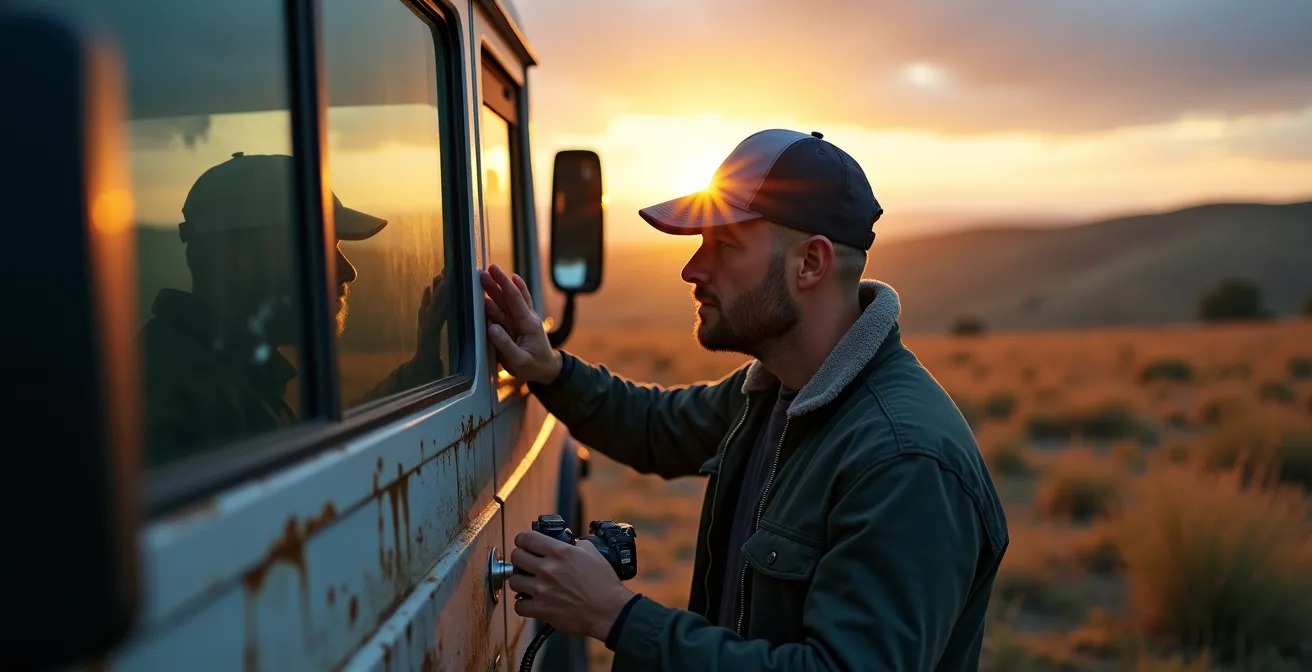
As the image above illustrates, modern field setups are designed for this multi-network reality. Success in these environments depends less on the carrier’s timeline and more on the crew’s preparation. A rigorous digital site survey is no longer optional; it’s a critical part of pre-production. Before even arriving on location, crews must analyze coverage maps, and once on-site, they must test actual uplink capacity to build a reliable connectivity plan.
Your Action Plan: Digital Site Survey for Remote Locations
- Pre-Scout with Data: Use tools like nPerf or OpenSignal coverage maps to identify available carriers and their advertised signal strengths at the production location.
- Deploy and Measure: Send field testing equipment to the site at least 48 hours in advance to measure actual uplink capacity, jitter, and packet loss during peak and off-peak hours.
- Test Hybrid Configurations: Actively test bonded configurations combining the available cellular signals (weak 5G/4G) with a LEO satellite connection like Starlink to find the most stable combination.
- Optimize Placement: Document signal performance at different heights and positions on the site. A few feet of elevation can make a dramatic difference in signal quality.
- Create Venue Profiles: Save the optimal connectivity settings as a venue-specific profile in your transmission unit, allowing other production teams to deploy instantly in the future.
How Do You Force Your Phone to Stay on Stable 4G Instead of Weak 5G?
It’s a common frustration: your device latches onto a weak, single-bar 5G signal, delivering a stuttering connection, when a strong, stable 4G signal is readily available. On a consumer smartphone, you can often dive into the cellular settings and manually select “4G/LTE Only.” But in the world of professional broadcasting, manually forcing a network is a crude solution to a complex problem. The real answer isn’t to force 4G, but to let your equipment intelligently choose the best path for every single data packet.
Professional cellular bonding units like the LiveU LU800 don’t just connect to a network; they constantly analyze the performance of all available connections in real-time. This is the core of intelligent bonding. The system doesn’t commit the entire stream to one network. Instead, it breaks the video stream into thousands of tiny packets and sends them across the optimal path—be it 5G, 4G, or satellite—at that exact moment. If the 5G signal’s latency suddenly spikes, the algorithm instantly redirects traffic to the more stable 4G links without missing a single frame.
This is demonstrated perfectly in advanced applications like network slicing, where LiveU showcased transmitting over 5G slices that were automatically set up based on real-time analysis. The system managed up to four independent camera feeds by dynamically bonding multiple modems and network slices, all without human intervention. This automated “Zero-Touch-Automation” (ZTA) makes manual network selection obsolete. It’s about trusting the algorithm to maintain stream integrity by making thousands of micro-decisions per second.
Instead of forcing a network, professionals create custom bonding profiles for different environments. For example:
- A Downtown Profile might aggressively prioritize mmWave 5G for maximum bandwidth.
- A Rural Profile would de-prioritize 5G Non-Standalone (NSA) and favor known, stable 4G carriers.
- A Stadium Profile could be set to lock onto a private 5G network if one is available, completely ignoring public networks to avoid contention.
This proactive, profile-based approach provides far more control and reliability than simply disabling 5G.
Fiber vs. 5G Home Internet: Which Is More Stable for Large Uploads?
For a fixed broadcast studio or a remote-at-home commentator, fiber has long been the undisputed king of stable, high-capacity uploads. Its symmetrical bandwidth (equal upload and download speeds) and rock-solid reliability make it the gold standard. However, the emergence of private 5G networks is challenging that dominance, especially in venues like stadiums, convention centers, and university campuses where pulling new fiber is impractical or prohibitively expensive.
While consumer-grade “5G Home Internet” often suffers from network congestion and uplink asymmetry (much slower uploads than downloads), a private 5G network is a different beast entirely. It’s a dedicated, localized cellular network built exclusively for the venue. This provides guaranteed, uncontended bandwidth for broadcast operations. As detailed by Haivision, a private 5G network can accommodate multiple mobile video transmitters, each contributing very high-quality 4K or multiple HD video streams at up to 80Mbps. This level of dedicated uplink capacity can exceed what’s available on a shared public fiber connection.
The stability of these private networks, combined with the mobility they offer, creates a powerful alternative to fiber. Crews are no longer tethered to a physical wall port. They can roam an entire stadium or campus while maintaining a broadcast-quality connection. This operational agility is a key driver behind the massive cost savings seen in REMI productions. By leveraging 5G, broadcasters can replace entire production trucks and their associated satellite links, with some reports showing that broadcasters using 5G for remote production can achieve up to a 90% cost reduction. For large, multi-camera uploads in a controlled venue, private 5G is often more stable and flexible than public fiber.
Phone vs. Mirrorless Camera: When Should You Actually Upgrade?
The combination of a modern smartphone and a compact 5G bonding unit has created the ultimate mobile journalist (MoJo) toolkit. It’s lightweight, fast to deploy, and capable of surprisingly high quality. But where is the line? When should a production team upgrade from a simple phone setup to a more traditional mirrorless or ENG camera rig with a professional 5G transmission unit?
The decision comes down to a trade-off between operational agility and production control. A smartphone setup is unbeatable for breaking news, single-person interviews, and situations where speed and discretion are paramount. You can be live in under two minutes. However, you sacrifice control over key video elements. Most phones output a compressed, 8-bit 4:2:0 video file, which offers limited flexibility in post-production color grading. You’re also limited by small sensors and fixed lenses.
Upgrading to a mirrorless camera paired with a professional 5G bonding unit like a LiveU LU300S or Haivision Pro460 is an investment in quality and flexibility. This setup delivers broadcast-standard 10-bit 4:2:2 HDR video, providing rich colors and wide dynamic range. It allows for interchangeable lenses, professional audio inputs (XLR), and extended runtimes thanks to external V-mount batteries. This is the required setup for high-end productions like sports, concerts, and documentaries where cinematic quality is expected. As Paul Shen, CEO of TVU Networks, noted about a 5G phone-based production, “It was such good production quality, most people did not believe that it was done with phones,” highlighting that the gap is closing, but a gap remains for the highest-tier productions.
The following table provides a clear framework for making this critical equipment decision, weighing the total investment against the specific needs of the production.
| Aspect | 5G Smartphone Setup | Mirrorless + 5G Bonding |
|---|---|---|
| Total weight | < 1 kg | 5-8 kg |
| Setup time | < 2 minutes | 15-20 minutes |
| Power runtime | 2-3 hours | 6-8 hours (with V-mount) |
| Video quality | 8-bit 4:2:0 | 10-bit 4:2:2 HDR |
| Total investment | $2,000-3,000 | $40,000-60,000 |
| Ideal for | Breaking news, interviews | Sports, concerts, documentaries |
Key takeaways
- 5G’s value is in the new production workflows (REMI) it enables, not just its speed.
- Mastering hybrid connectivity by bonding 5G, 4G, and satellite is the key to reliability in the field.
- Focus on real-world uplink performance metrics (throughput, latency, packet loss) over the simple 5G icon on a screen.
Why Does Authenticity Beat Production Value in Modern Vlogging?
In an era where modern audiences expect up to 10 times more content than before, a fascinating shift is happening. The relentless demand for content is forcing a change in production philosophy. Highly polished, big-budget productions are making way for a new currency: authenticity. Audiences, particularly younger demographics, often connect more deeply with content that feels real, immediate, and unscripted. And this is where 5G technology becomes a creative enabler, not just a technical tool.
5G’s operational agility—the ability to go live from anywhere in minutes with a compact, high-quality setup—allows broadcasters to capture authentic moments that would be impossible with a traditional, cumbersome production truck. It’s about getting the camera into places it could never go before: in the middle of a celebration on the pitch, in the front row of a concert, or walking alongside a newsmaker. This proximity and immediacy create a powerful sense of presence for the viewer.
A landmark case study from the summer of 2021 perfectly illustrates this. A major U.S. media company covered a major sports event using only 5G mobile phones and a cloud-based production solution from TVU Networks. Instead of using conventional, distant camera angles, they gave viewers a raw, pitch-side view. The result was a broadcast that felt more like a personal experience than a spectator sport. The production was so effective that many viewers didn’t believe it was filmed on phones. This demonstrates the new equation: 5G agility + authentic access = high perceived production value.
The lesson for modern broadcasters and vloggers is clear. While technical quality is still important, the ability to be in the right place at the right time to capture a genuine moment is what truly captivates an audience. 5G is the key that unlocks this capability, allowing smaller crews and even individuals to produce compelling, authentic live content that rivals what was once the exclusive domain of major networks.
Start applying these field-tested strategies today. By moving beyond the hype and mastering the real-world application of 5G, you can transform your remote productions, reduce costs, and deliver more authentic, engaging content to your audience.